 By
By  December 21st, 2022
Credit: The Aerospace Corporation/Center for Space Policy and Strategy
An international open letter is calling upon leading space agencies to reduce risks from uncontrolled reentries of rocket bodies and other space objects.
The Outer Space Institute (OSI) published the December 19th call to action for “multilateral negotiations on a controlled reentry agreement.”
OSI is based at the University of British Columbia in Vancouver.
The Institute is a global network of space experts that addresses grand challenges facing the continued use and exploration of space.

One object that survived reentry of an Iridium satellite discovered on the ground – space junk that survived reentry of Iridium satellite on October 11, 2018.
(Photo courtesy Kings County Sheriff’s Office)
Reentry regime
“The uncontrolled reentry of space objects presents a significant, cumulative, fast-growing risk to human beings around the world. Uncontrolled rocket bodies are of particular concern,” states the letter to space agency leaders.
“We call on your agencies, working with your states’ foreign ministries, to initiate multilateral negotiations on a controlled reentry agreement, starting with rocket bodies. Recognizing that such negotiations take time, we further call on each of your states to unilaterally commit to a national controlled reentry regime,” the letter states.
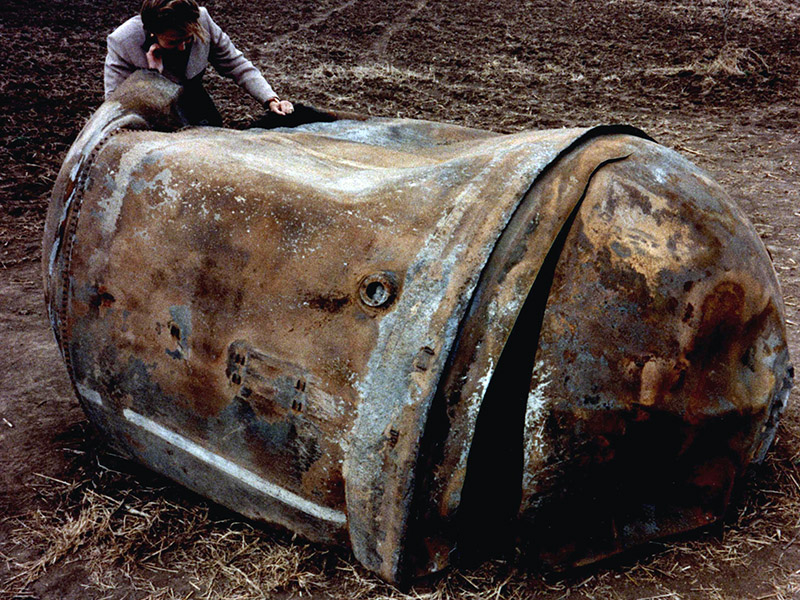
Main propellant tank of the second stage of a Delta 2 launch vehicle which landed near Georgetown, TX, on January 22, 1997. This approximately 250 kg tank is primarily a stainless steel structure and survived reentry relatively intact. Credit: NASA ODPO.
Casualty risks
While the letter focuses on the casualty risks from uncontrolled rocket body reentries, it also flags uncontrolled satellite reentries as a concern, “and may eventually dominate the casualty risk should tens of thousands of medium-sized to large satellites be placed into orbit.”
The OSI open letter suggests a reentry regime that first starts with rocket bodies, then expanded to satellites to reduce all uncontrolled reentry risks.
“Simply hoping that uncontrolled reentries will not cause harm is an unsustainable strategy. With leadership, cooperation and global goodwill, these preventable and therefore unnecessary dangers can be greatly reduced,” the letter concludes.

China’s Long March 5B’s core stage.
Credit: The Aerospace Corporation
Space fallout
Cited in the letter are accounts of uncontrolled space junk reaching land. For example, pieces of a Chinese Long March 5B rocket damaged buildings in the Ivory Coast in 2020.
In July 2022, the breakup of another Long March 5B was visible from the ground in Borneo, and sizable pieces were later found.
On November 4, 2022, another Long March 5B reentered over the Pacific Ocean southwest of Guatemala.
Fuel tanks, pressure vessels
China is not the only actor allowing rocket bodies to reenter in uncontrolled ways, the letter explains.
In 2016, a U.S. SpaceX Falcon 9 second stage was abandoned in orbit, reentering over Indonesia with two refrigerator-sized fuel tanks reaching the ground intact.

Hefty piece of SpaceX space junk found in Australia last July.
Image courtesy: Brad Tucker
In 2018, a number of smaller titanium pressure vessels from a Russian Zenit upper stage reached the ground in Peru.
You can read the full, open letter here – as well as add your name to the list of signatories at:
For more information on the Outer Space Institute, go to:
 Posted in Space News

