 By
By  July 3rd, 2017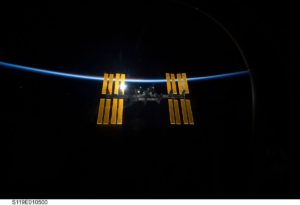
International Space Station.
Credit: NASA
SpaceX’s Dragon cargo spacecraft returned to Earth today, loaded with science samples including the first Chinese experiment to fly onboard the International Space Station.
China’s Xinhua news agency reports that the experiment from the Beijing Institute of Technology was aimed at studying the effects of the space radiation environment on DNA and the changes in mutation rate.
“Everything went according to our plan,” reports Deng Yulin, who led the Chinese experiment. “All the data sent back looks good,” Deng told Xinhua.
The Chinese experiment was brought to the space station under an agreement with Houston-based NanoRacks, which offers services for the commercial utilization of the orbiting complex.

SpaceX booster departs on cargo supply mission June 3, 2017.
Credit: SpaceX
The SpaceX CRS-11 was launched on June 3, later linking up with the ISS, roughly 36 hours after liftoff.
Transfer ceremony
Deng said he will soon fly to Florida, where a ceremony of transfer of the experiment between NanoRacks and his team is scheduled for Friday.
The Chinese research involves no technology transfer between NASA and China.
Xinhua had reported earlier that the 8-pound (3.5 kilogram) experiment is keyed to answer questions, such as: “Does the space radiation and microgravity cause mutations among antibody-encoding genes and how does it happen?”
ISS astronauts conducted studies using the device with data sent back to the Chinese researchers.
For more information, go to:
 Posted in Space News

