 By
By  November 3rd, 2022
Credit: CNSA/CCTV/Inside Outer Space screengrab
The European Union’s Space Surveillance and Tracking (EU SST) Operations Centers are monitoring the uncontrolled reentry into Earth’s atmosphere of China’s large space object CZ-5B (2022-143B). That’s the core stage of the rocket that launched on October 31st Mengtian – the third module of the Chinese large modular space station.
The EU SST network of sensors is observing the object closely, and its radars have narrowed down its re-entry window to November 4th.
Initial measurements from EU SST contributing sensors confirmed that the core stage is tumbling.
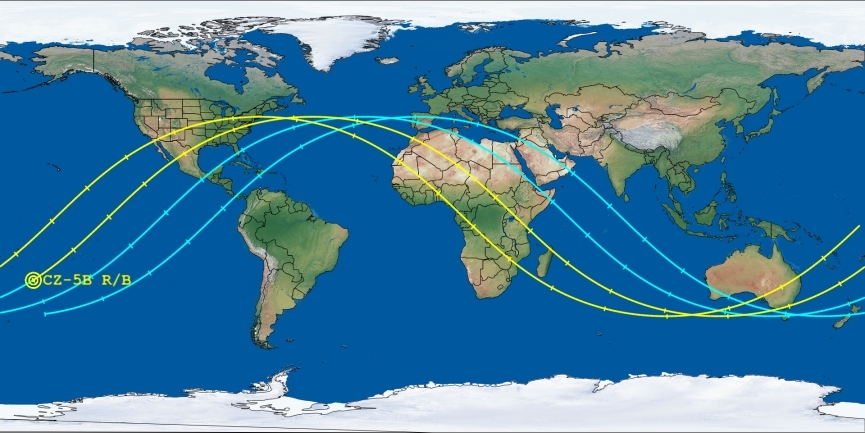
China’s Long March 5 Core Stage – Predicted Reentry Time now November 4, 2022 at 11:20 UTC ± 3 hours – from The Aerospace Corporation.
Yellow Icon – location of object at midpoint of reentry window
Blue Line – ground track uncertainty prior to middle of the reentry window (ticks at 5-minute intervals)
Yellow Line – ground track uncertainty after middle of the reentry window (ticks at 5-minute intervals)
Pink Icon (if applicable) – vicinity of eyewitness sighting or recovered debris
Note: Possible reentry locations lie anywhere along the blue and yellow ground track. Areas not under the line are not exposed to the debris.
Level of risk
“The uncertainty of where the large debris will ultimately land presents a level of risk to human safety and property damage that is well above commonly accepted thresholds,” explains The Aerospace Corporation and its Center for Orbital and Reentry Debris Studies (CORDS).
CORDS — as is the U.S. military and a global network of satellite watchers — are actively tracking the CZ-5B rocket body.
And for good reason.
The core booster weighs an estimated 22.5-metric tons. That’s about the size of a 10-story building.
Notes The Aerospace Corporation, similar uncontrolled reentries of Long March rockets occurred in 2020, 2021 and most recently in July 2022 – of which, two resulted in large debris landing near populated areas.
Precautionary preparation
“Over 88 percent of the world’s population lives under the reentry’s potential debris footprint. Factors such as the rocket core’s uncontrolled manner of descent and its size, which is too large to entirely burn up in the Earth’s atmosphere, collectively present risks high enough that require additional precautionary preparation around the world,” adds The Aerospace Corporation.
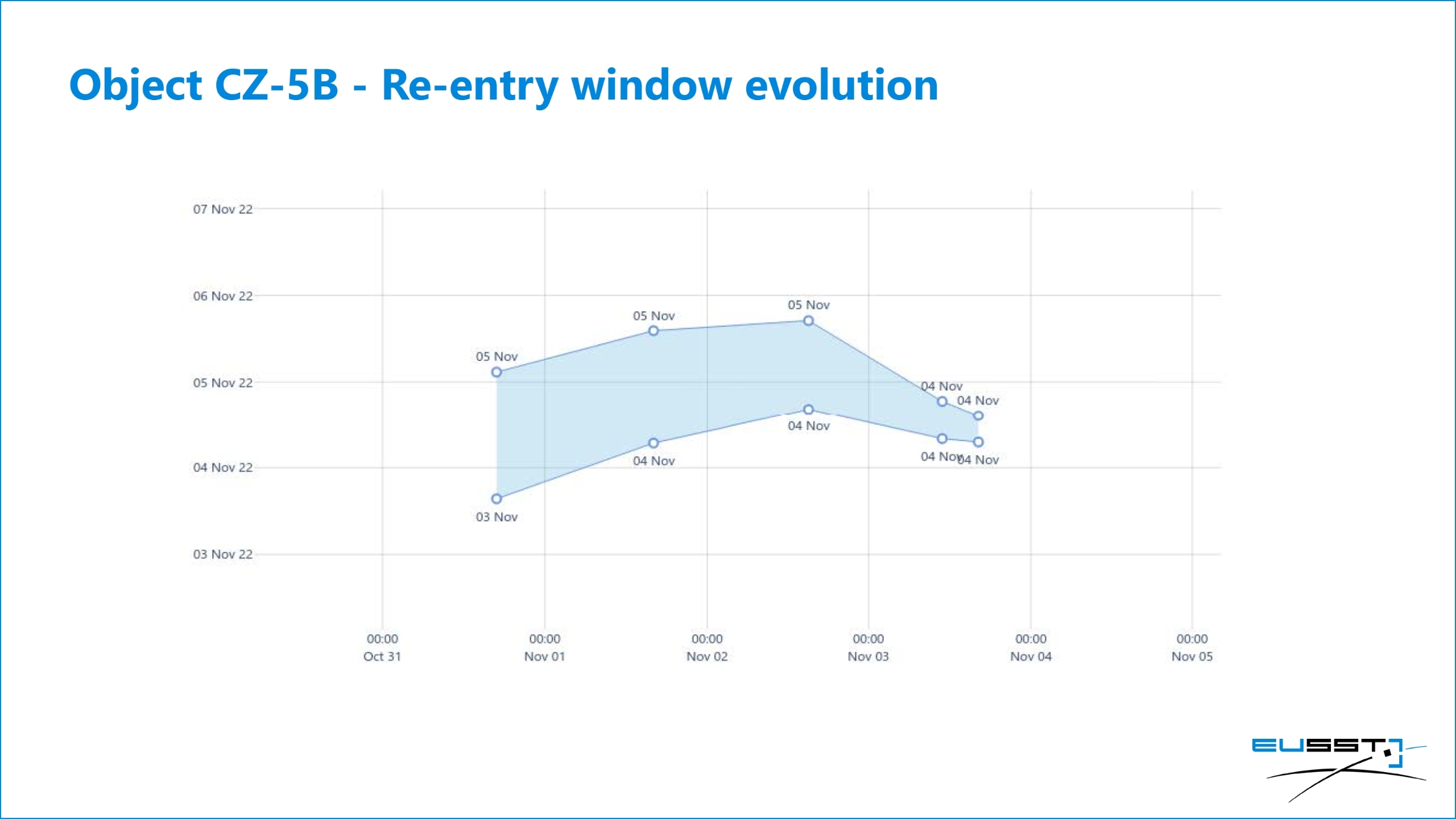
Credit: European Union’s Space Surveillance and Tracking (EU SST)
 Posted in Space News

