 By
By  June 24th, 2026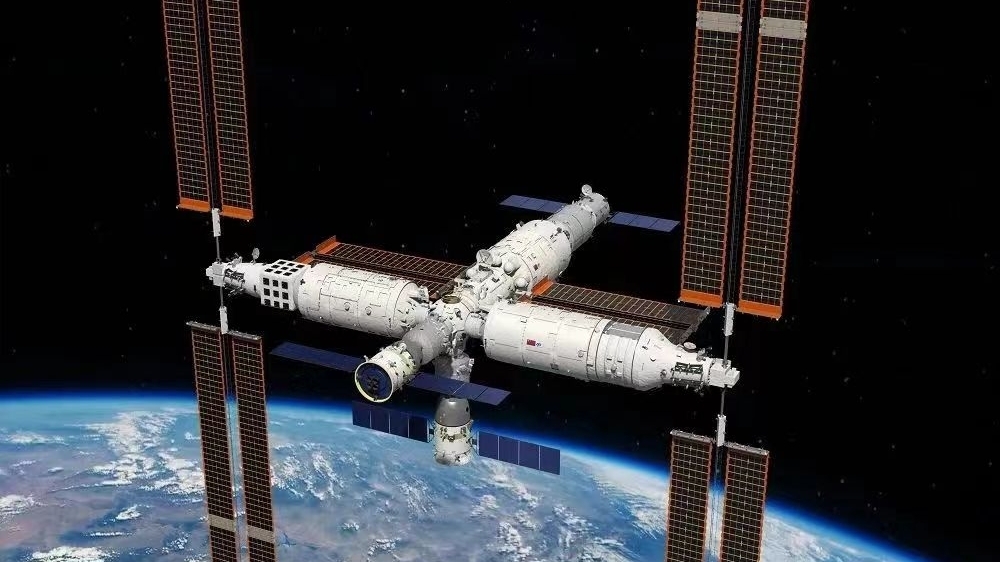
Artwork depicts China’s current Tiangong space station configuration.
Image credit: China Manned Space Agency
Now circling Earth in a T-shaped configuration, China is readying a new module that upgrades the orbiting facility to a cross shape.
The current station consists of the Tianhe core module, the Wentian lab module and the Mengtian lab module. According to a report by China Media Group (CMG), the first phase of expansion will add a new 20-ton-class multifunctional module.
The new module would be docked to the core module to form a cross shape.
More docking ports
This expansion will add more docking ports, CMG notes, allowing multiple spacecraft to dock simultaneously. The module includes an additional extravehicular activity hatch, and expanded storage and experiment capacity.
In a June 24 story from the state-run Xinhua news agency, they report that two additional laboratory modules can be docked with the new expansion module.

Image credit: CGTN/Inside Outer Space screengrab
Longer-term plan
Yang Hong, chief designer of the space station system, said a longer-term plan would upgrade the station to a six-module configuration, increasing its total mass from the current 90 tons to up to 180 tons.
At that stage, Yang said, different modules could be dedicated to specific research fields, and crew capacity would be significantly expanded.
Xinhua notes that China’s long-awaited Xuntian Space Telescope is scheduled for launch in 2027. It will fly in co-orbit with the station and dock when maintenance and upgrades are required.

Image credit: CCTV/Inside Outer Space screengrab
Current crew
Meanwhile, the three astronauts now onboard China’s orbiting outpost are busy carrying out experiments and in-orbit training and health management tasks, reports China Central Television (CCTV).
Zhu Yangzhu, Zhang Zhiyuan and Li Jiaying (Lai Ka-ying in Cantonese) have also carried out their first in-orbit medical rescue training since entering the space station in late May, CCTV adds.
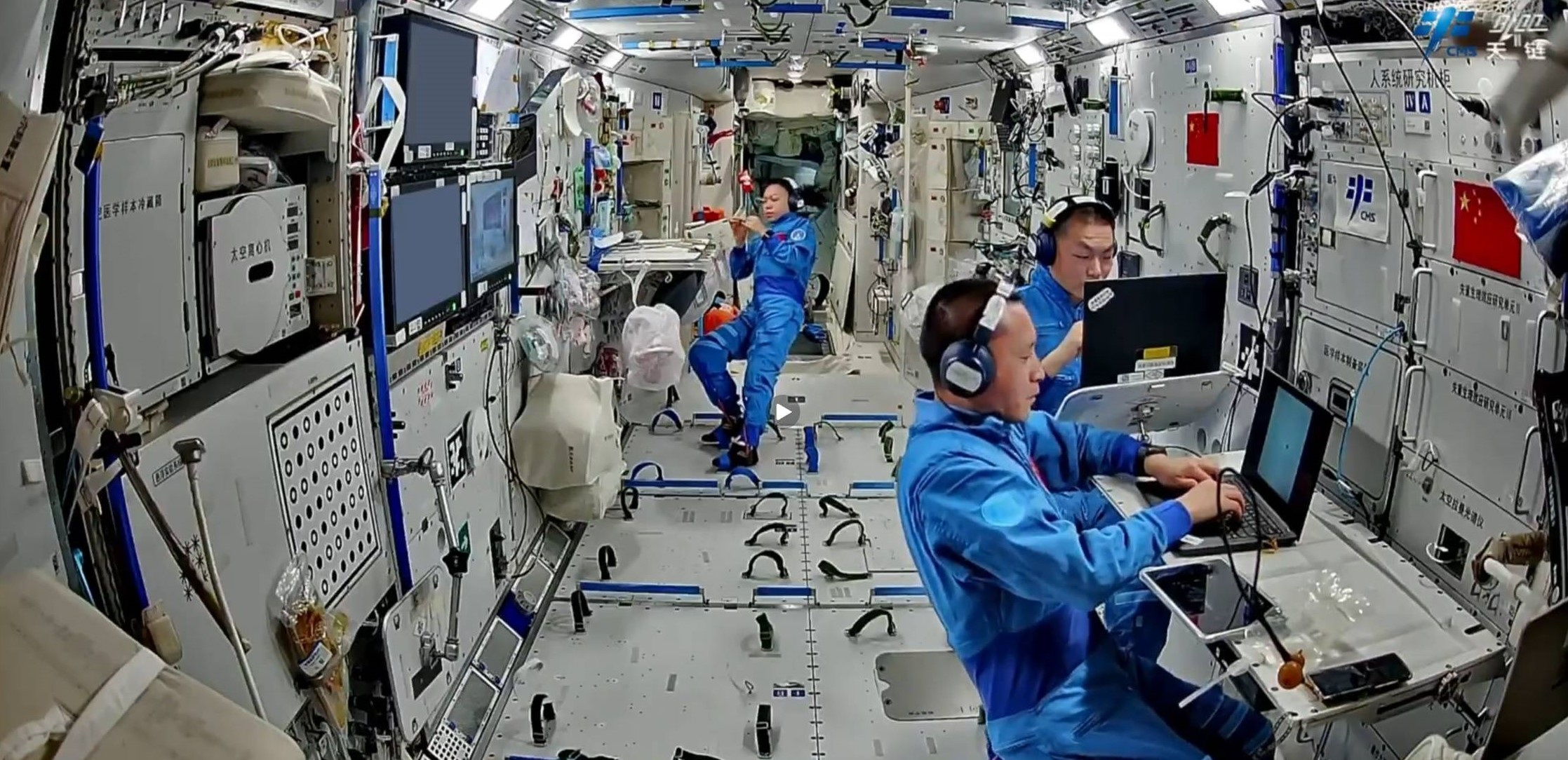
Image credit: Tiangong TV/China Manned Space Engineering Office/Inside Outer Space screengrab
“The astronauts also carried out behavioral experiments on visual motion processing and microgravity intuitive physics, aiming to investigate how gravity affects visual motion information processing, as well as the impact of long-duration spaceflight on intuitive physical representation and its recovery mechanisms,” CCTV reports.
The trio of taikonauts has conducted “in-orbit emotional recognition and evaluation research, along with emergency decision-making ability assessments, to study the patterns of emotional state changes and emergency response capabilities,” CCTV notes.
 Posted in Space News

