 By
By  October 26th, 2023
Image credit: CCTV/CNSA/Inside Outer Space screengrab
China’s Shenzhou-17 crew has successfully linked up with the country’s space station, joining the already resident Shenzhou-16 crewmembers.
The spaceship, atop a Long March-2F carrier rocket, rumbled off the launch pad at 11:14 (Beijing time) October 26 from the Jiuquan Satellite Launch Center in northwest China.
After entering orbit, the spaceship made an automated rendezvous and docking with China’s space station combination. The whole process took about 6.5 hours, the China Manned Space Agency (CMSA) reported.

Image credit: CCTV/CNSA/Inside Outer Space screengrab
Space get-together
The Shenzhou-17 astronauts — Tang Hongbo, Tang Shengjie and Jiang Xinlin – were greeted aboard the Tiangong space station by the Shenzhou-16 crew who arrived at the orbiting outpost back on May 30.
“The space get-together of the two crews kicked off the third in-orbit crew rotation in China’s space station,” noted China Central Television (CCTV).
China’s Shenzhou-16 crew — Jing Haipeng, Zhu Yangzhu and Gui Haichao – are slated to return to the Dongfeng landing site in the Gobi Desert, north China’s Inner Mongolia Autonomous Region on October 31, according to the CMSA.

Image credit: CMS/Inside Outer Space screengrab
Research in orbit
According to the China Global Television Network (CGTN), a total of 70 experiments in space medicine, life ecology, biotechnology, material science, fluid physics, fluid mechanics and space technology, as well as eight research projects on human factors engineering were carried out. Some testing samples will be brought to Earth aboard the Shenzhou-16 spacecraft.
CGTN also noted that the Shenzhou-16 crew will hold HD cameras and take pictures of the Chinese space station before returning to Earth. They are expected to obtain the first full picture of the space station with Earth as the background for the first time in orbit.

Image credit: China Manned Space Agency
Moon plans
“In the near future, we will continue to enhance our space station. Our plans include sending taikonauts to the Moon and further exploration of the universe, including a closer examination of our solar system,” said Qi Faren, an academician of the Chinese Academy of Engineering and first chief designer of the Shenzhou spaceship.
China plans to land its astronauts on the Moon before 2030 to carry out scientific exploration, according to a preliminary plan released CMSA.
The plan is to launch two carrier rockets to send a lunar lander and a piloted spacecraft to a lunar orbit, respectively. The craft and lunar lander will rendezvous and dock with each other, and then astronauts will enter the lander.
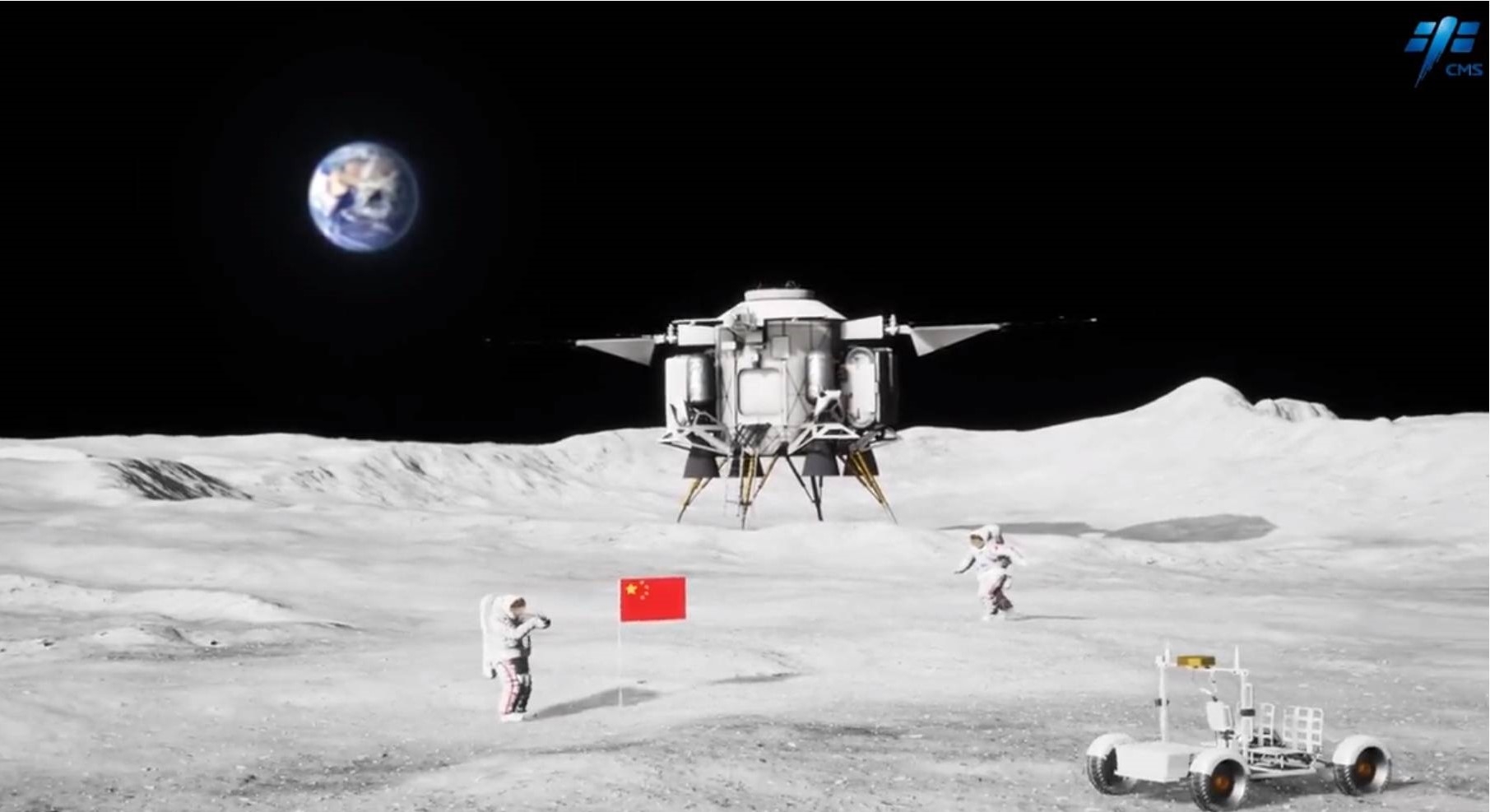
Image credit: China Manned Space Agency
The lunar astronauts are to be selected from individuals with prior space flight experience. China is exploring the construction of a lunar scientific research station for systematic and long-term lunar exploration and related technical tests and verification, according to the CMSA.
For video views of the Shenzhou-17 liftoff to link-up, go to:
https://youtu.be/h_w6wLZy1x4?si=PkDd5m_IAU2edEck
 Posted in Space News

