 By
By  June 6th, 2026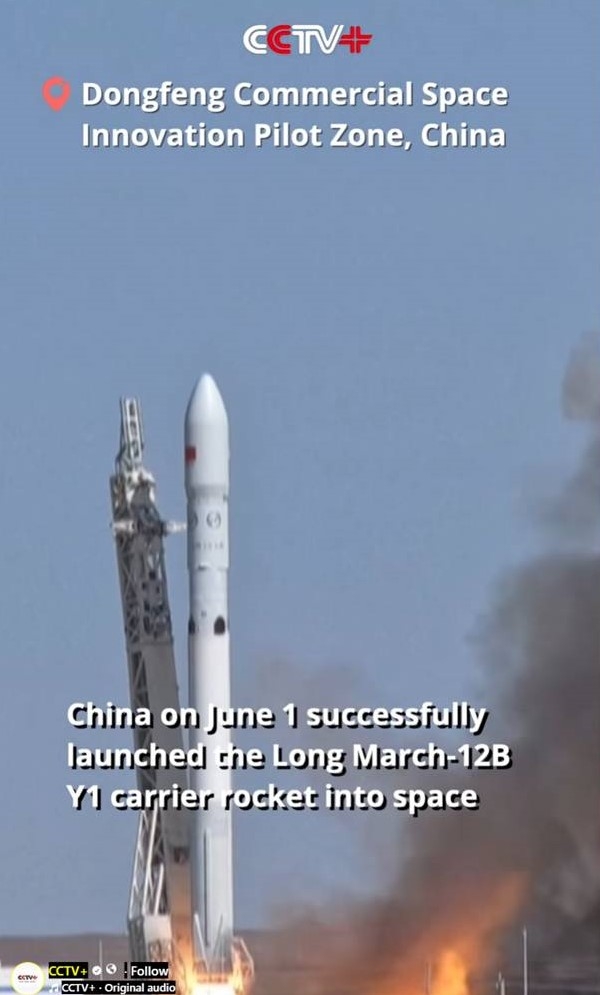
Image credit: CCTV/Inside Outer Space screengrab
China successfully launched on June 1 the Long March-12B Y1 carrier rocket into space from the Dongfeng commercial space innovation pilot zone.
According to China Central Television (CCTV) it took 21 months for the carrier rocket to go from the concept validation stage to the completion of product development. In doing so, it set a new record for the development cycle of the country’s new-generation rockets.
The booster sent a group of networking satellites destined for the Qianfan Constellation, also known as the Spacesail Constellation, into their preset orbits.
Maiden flight
This mission was the maiden flight of the Long March-12B, a new-generation reusable rocket developed by China Aerospace Science and Technology Commercial Launch Vehicle Group (CACL) – a commercial rocket manufacturing company under the China Aerospace Science and Technology Corporation.
Long March-12B features a single-core, two-stage configuration. The rocket has a body diameter of 4.37 meters, a fairing diameter of 5.2 meters, and a total length of approximately 72 meters.
Racing against time
It is the tallest rocket that has successfully made its maiden flight in China so far, CCTV reported, showcasing developing and launching the new rocket more quickly and safely. Transferring the rocket from its technical zone to the launch area took just 50 minutes.
“Fast speed is a defining feature of the Long March 12B team,” said Liang Yanqian, a rocket designer at CAST’s commercial launch vehicle group. “Whether during the development or the technical validation, we had consistently followed the principle of racing against time,” said Liang.
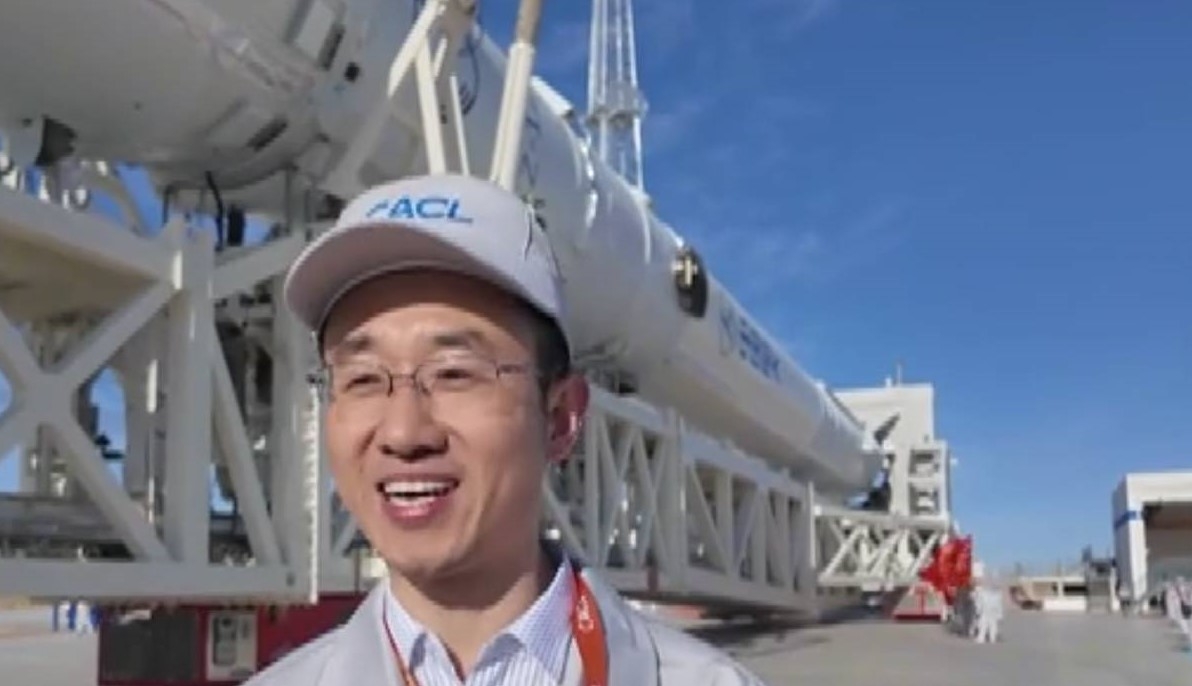
Liang Yanqian, rocket designer, China Aerospace Science and Technology Commercial Launch Vehicle Group (CACL).
Image credit: CCTV/Inside Outer Space screengrab
The team built a simulation platform from scratch, verifying more than 50 key technologies during all stages of the development.
“We had conducted over 200 experiments and verified more than 50 key technologies throughout the entire development process. We all raced against the clock and completed the tasks one by one solidly,” Liang said.
Launch area workload
The rocket adopts a launch mode of horizontal assembly, horizontal testing and horizontal transfer, with all the complex tasks completed in the technical zone in advance to ensure a smooth and faster launch process.
“This giant plate is the interface connecting the rocket to the launch pad. Without it, a lot of work needs to be done to secure the rocket and connect it to the launch pad after it reaches the launch area. Now, everything can be done in the technical zone, so our workload at the launch area is greatly reduced,” said Liang.
Go to this video of the launch at:
 Posted in Space News

