 By
By  September 12th, 2025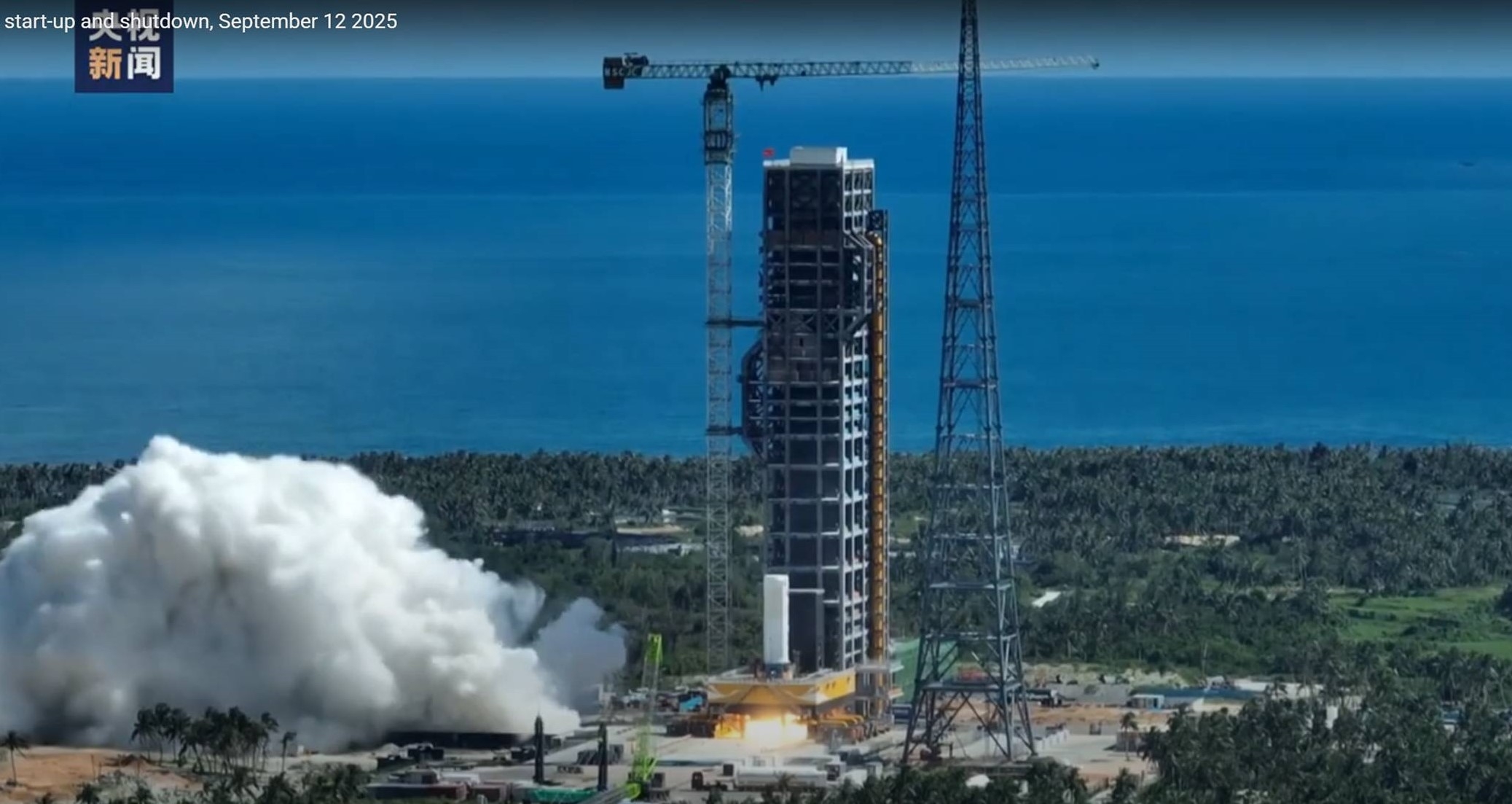
China’s powerful Long March-10 carrier rocket intended to support the country’s humans-to-the-Moon effort has successfully completed its second static fire test.
The September 12 test firing was held at the Wenchang Spacecraft Launch Site in the southern island province of Hainan.
According to China’s Xinhua news agency, all seven YF-100K engines were fired up, followed by a restart of several of the engines. Total test duration: 320 seconds.
The China Manned Space Agency (CMSA) stated that the test focused on evaluating the capabilities of the seven clustered engines of the rocket’s first stage for low-thrust operating condition and secondary restart condition, obtaining complete test data.

Image credit: CCTV/CNSA/Inside Outer Space screengrab
Two versions
An earlier test, the first of the two static fires to date, took place on August 15, with the thrust scale reaching nearly 1,000 tons – the largest such test ever conducted in China.
The Long March-10 carrier rocket is to serve China’s crewed lunar exploration missions. It will loft the piloted spacecraft and the lunar lander. The Long March-10 rocket is a three-stage rocket outfitted with two boosters.
The Long March-10A version is a two-stage reusable rocket, with its first stage designed to be recycled and reused. It will hurl the Mengzhou crewed spacecraft and the uncrewed Tianzhou cargo craft to support China’s space station program.
Go to video below.
 Posted in Space News

