 By
By  November 9th, 2021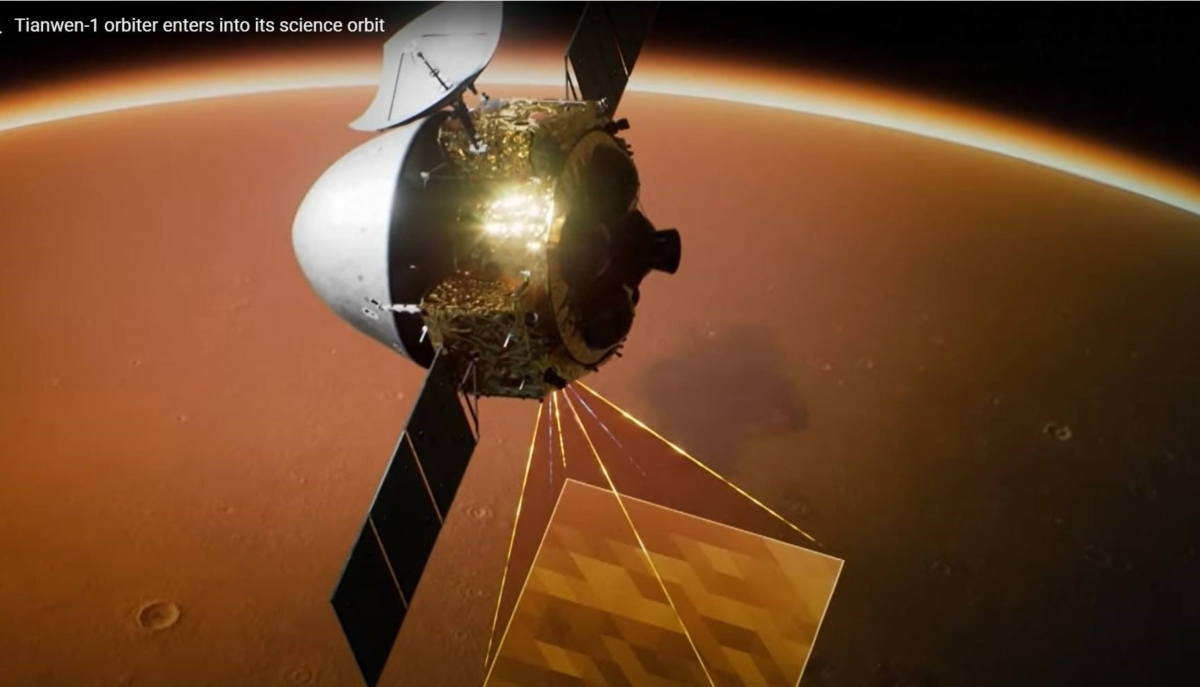
China’s Tianwen-1 Mars orbiter.
Credit: CCTV/Inside Outer Space screengrab
Circling Mars, China’s Tianwen-1 spacecraft has been placed in a new orbit to initiate a global remote sensing sweep of the planet. The orbit change was completed in nearly two hours with four high-power engines pushing the orbiter into a pre-set orbit through a single ignition.
The orbiter is designed to orbit Mars for about two years and has been working since it entered Mars orbit in February 2021.
Tianwen-1 will continue to relay communication between China’s Zhurong Mars rover and Earth in the new orbit.

Credit: Zou Yongliao, et al.
Seven payloads
China National Space Administration (CNSA) has stated that the orbiter’s seven scientific payloads will obtain scientific data relating to morphology and geological structure, surface material composition and soil type distribution, the atmospheric ionosphere and the space environment of Mars.

In a China Central Television (CCTV) interview, Zhu Xinbo, deputy chief designer, Tianwen-1 Mars orbiter, said the orbiter will move between the north and south poles of Mars, and conduct surface sensing at its perigee (lowest point of the orbit) to better observe the Red Planet.
“The camera’s resolution will be greatly improved,” Zhu said.
Zhu said it is estimated that preliminary global data of Mars will be available by June 2022, laying a foundation for subsequent robotic Mars sampling missions.

Zhurong Mars robot. Credit: CNSA
“We can get insightful data about the Mars through the payloads, including magnetic field, topography and subsurface structure,” said Zhu.

Credit: CCTV/Inside Outer Space screengrab
In good condition
To date, CNSA added that the Tianwen-1 spacecraft has worked in orbit for 473 days. Meanwhile the Zhurong rover has operated on the Martian surface for 174 Martian days, accumulating a total distance of 0.7 of a mile (1,253 meters). The two are in good condition and all systems are reportedly working normally.
Before the rover touched down on the Red Planet, the orbiter’s high-resolution camera and medium-resolution camera produced images of the landing area.
“At the end of next year when the orbiter’s designed life comes to an end, we’ll design new missions based on the specific conditions of the orbiter, and will then lower its orbit to extend the segmental arc for closer observation of Mars and obtain more exploratory data,” Zhu said.
Subsurface radar deployment
Onboard the Tianwen-1 orbiter is the Mars Orbiter Subsurface Investigation Radar (MOSIR). MOSIR is intended to search for water ice and liquid water that may be associated with signs of life in the polar layered deposits, Tianwen-1 landing site, and other selected areas.
With its deployment, the subsurface radar will have four antennas, which are about five meters in length. “Electromagnetic waves can be transmitted and received through the four antennas. Then we can explore and get the data about the subsurface structure of Mars, including the distribution of water and ice,” said Zhu.
Go to these newly released videos detailing the orbit change and China’s planning of Red Planet exploration at:
 Posted in Space News

