 By
By  February 14th, 2026
Image credit: CMSE
China rocket makers are high-fiving the recent launch of the Long March-10, seeing its flight as paving the way for future rocket reuses.
The February 11 flight of the Long March-10 is China’s first-ever rocket first-stage booster maritime salvage and recovery mission.
Meanwhile, the test flight also signaled advancement in the country’s crewed lunar exploration program.
Maximum dynamic pressure
According to the China Manned Space Engineering Office (CMSEO), last Wednesday’s test conducted a low-altitude demonstration and verification flight test of its Long March-10 carrier rocket and a maximum dynamic pressure abort flight test of its new-generation crewed spacecraft Mengzhou.

Image credit: CMSE
CMSEO said the success of the tests has provided valuable flight data and engineering experience for crewed lunar exploration.
Both the rocket and spaceship are still in their prototype phases.
Three tasks
On Wednesday, China successfully conducted a low-altitude demonstration and verification flight test of the Long March-10 carrier rocket, along with a maximum dynamic pressure abort flight test of its new-generation crewed spaceship Mengzhou, with both the rocket and spaceship still in their prototype phases.

New generation Mengzhou spacecraft.
Image credit: CMSA
China’s Xinhua news service reported that, during the tests, the rocket prototype undertook three tasks. According to
Yang Shutao, an expert from the China Aerospace Science and Technology Corporation (CASC) that the trio of tasks were:
- verifying the maximum dynamic pressure abort conditions during the Mengzhou spaceship’s ascent
- demonstrating the reliability of its multi-stage parallel operations, and
- testing critical return-phase technologies
Two configurations
The Long March-10 rocket series includes two configurations: the Long March-10 with three stages and “bundled boosters,” and the Long March-10A with two stages and no bundled boosters.
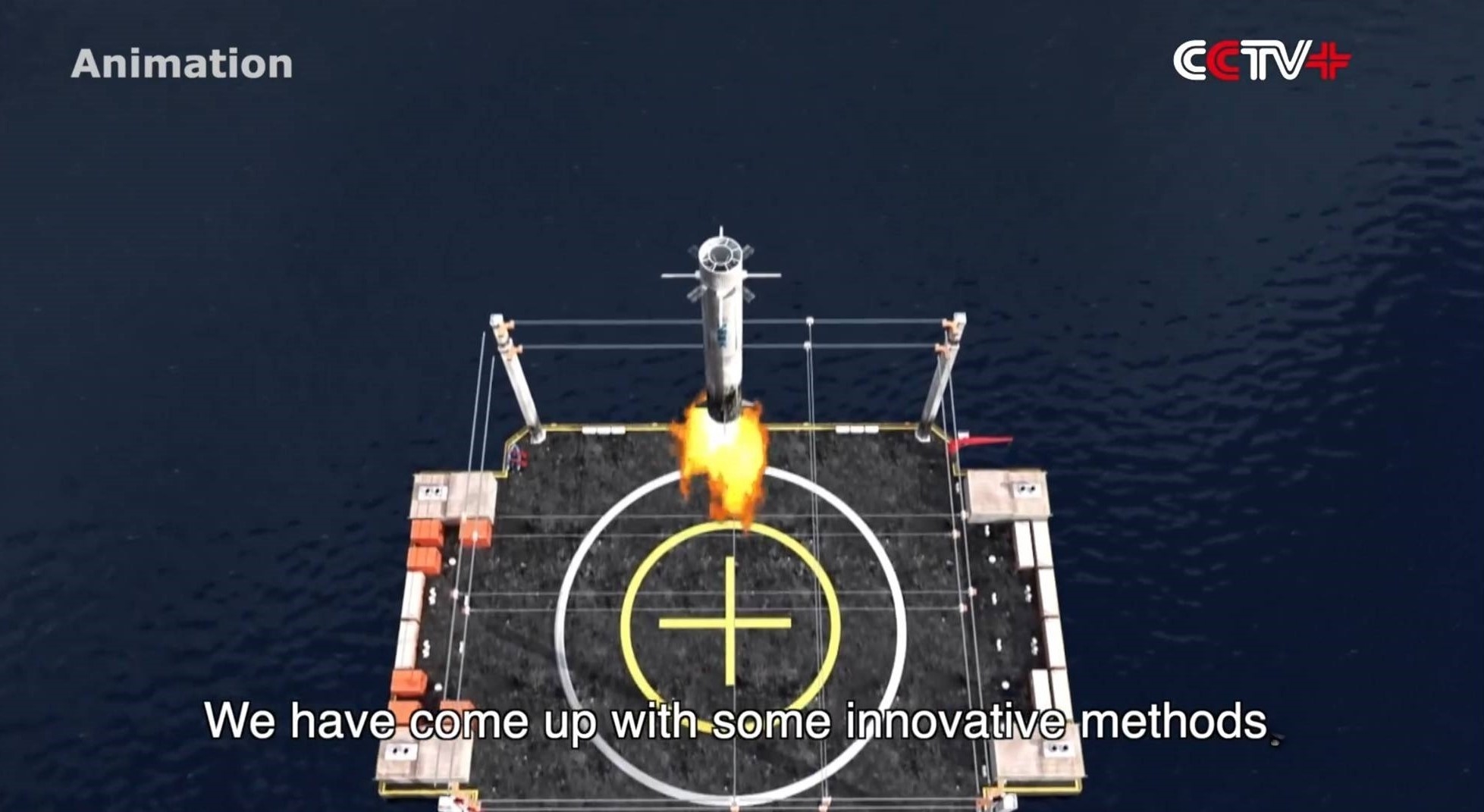
Shades of SpaceX. China Long March-10 stage heads for ocean landing in this artwork.
Image credit: CCTV/Inside Outer Space screengrab
The prototype Long March-10 is roughly 180 feet (55 meters) in length and powered by seven liquid oxygen/kerosene engines in parallel. They produce nearly 1,000 tons of thrust. It currently has the largest single-module thrust among China’s rockets, CASC’s Yang said.
In the future, citing Yang, the Long March-10 rocket will integrate two identical boosters in parallel with its seven-engine core stage, giving it a significantly larger carrying capacity.
Net recovery
Yang told Xinhua that the Long March-10 rocket series will adopt a rocket-ground coordinated recovery solution.
That solution involves “four tethering structures onboard the rocket and a ground-based grid-shaped net recovery device,” Yang said, which will transfer the functions of capture, buffering and stabilization from the rocket to the ground-based net.
That tactic will reduce the onboard complexity while enhancing the rocket’s carrying capacity.

Image credit: CCTV/Inside Outer Space screengrab
Return and recovery
After the Mengzhou spaceship separated, the rocket continued its flight until the first stage reached the predetermined height and speed, at which point its engines were shut down.
As reported by Xinhua, during the unpowered upward glide phase, the rocket continuously adjusted its attitude, shifting from nose-forward to tail-forward, to meet the subsequent ignition requirements.
At an altitude of about 70 miles (110 kilometers), the rocket deployed its four grid fins, getting ready for the return and recovery.

The first stage of the Long March-10 carrier rocket used in a flight test for China’s crewed lunar exploration in future has been successfully fished out and retrieved from the sea, marking China’s completion of its first-ever rocket first-stage booster maritime salvage and recovery mission. Image credit: CCTV/Inside Outer Space screengrab
Powered deceleration
The powered deceleration phase meant use of two engines that were ignited for the second time to decelerate while correcting the rocket’s flight position and attitude.
Xinhua said when the engines shut down and the rocket entered the aerodynamic deceleration phase, it further slowed down by relying on its own drag and the aerodynamic forces generated by the grid fins, while deflecting the fins to adjust its position and attitude.
During the final landing phase, reported Xinhua, three engines ignited successively, and the rocket maneuvered toward the predicted ocean landing site.

Image credit: CCTV/Inside Outer Space screengrab
Controlled splashdown
At about 394 feet (120 meters) above sea level, the onboard tether mechanism was deployed to simulate the capture by a ground-based recovery net system.
When the first stage reached about 16 feet (5 meters) in altitude, the rocket achieved “a quasi-hovering state,” Xinhua stated, before executing a controlled splashdown in the sea.

Image credit: CCTV/Inside Outer Space screengrab
“Rocket reuse can significantly reduce launch costs and increase launch frequency. It is an essential path for large-scale free access to space in the future and provides important support for the progress of China’s space sector,” Yang said.
Go to this video that spotlights first stage recovery operations at:
 Posted in Space News

