 By
By  August 18th, 2025
Image credit: CCTV/Inside Outer Space screengrab
China has made significant progress in its humans-on-the-Moon project, the ability to land two Chinese astronauts on the lunar surface by 2030.
On August 15, the first stage propulsion system of the Long March 10 (CZ-10) launch vehicle was successfully conducted at the Wenchang Spacecraft Launch Site, Hainan Province, China.
A cluster of seven YF-100K engines running on liquid oxygen-kerosene fuel burned for about 35 seconds.
The thrust scale in the test reached nearly 1,000 tons, a record in the history of China’s space program.
A shortened mockup of the first stage of the CZ-10 was used for the test, put through its paces at the new CZ-10 launch pad in Wenchang.
This first static fire test of the Long March-10 follows the successful zero-altitude escape flight test in June of the Mengzhou crewed spacecraft and an August landing and takeoff test of the Lanyue piloted lunar lander, according to the China Manned Space Agency (CMSA).

Zero-altitude escape flight test in June 2025 of the Mengzhou crewed spacecraft.
Image credit: CCTV
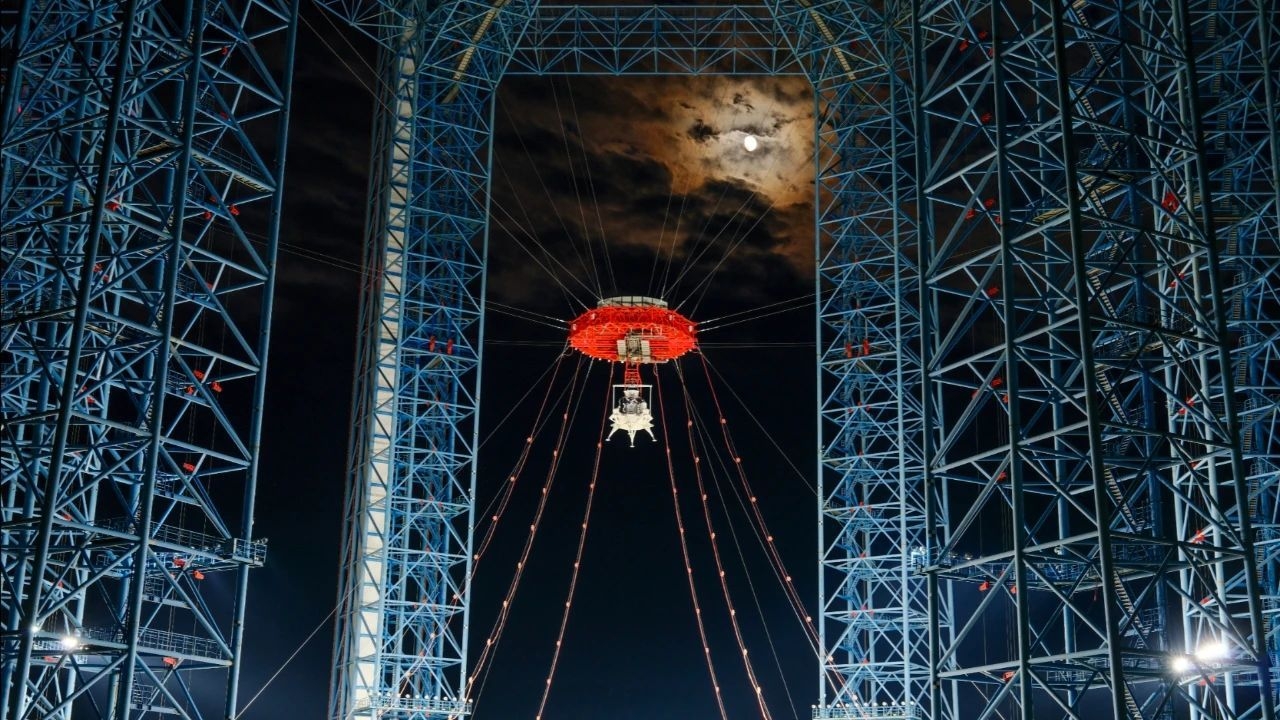
China completed a comprehensive test of its crew-carrying Moon lunar lander Lanyue in north China’s Hebei Province, August 6, 2025. Image credit: CGTN//China Media Group.
Critical steps
Peng Yue, an engineer with the China Aerospace Science and Technology Corporation told China Central Television (CCTV):

Peng Yue, an engineer with the China Aerospace Science and Technology Corporation.
Image credit: CCTV/Inside Outer Space screengrab.
“Conducting a power system test is one of the most critical steps in rocket development. It mainly assesses the thermal and mechanical environment created by simultaneously operating seven engines on a 5-meter-diameter core stage,” Peng said. “It’s also a key step to ensure system compatibility and to mitigate risks ahead of the rocket’s maiden flight.”
The Long March-10 carrier rocket series is developed to serve China’s manned lunar exploration missions, including two configurations — the Long March-10 rocket and Long March-10A rocket.
The Long March-10 rocket will undertake the launch missions of the crewed spacecraft and the lunar lander.

Image credit: CCTV/CNSA/Inside Outer Space screengrab
The Long March-10A will serve the launch missions of the Mengzhou crewed spacecraft and the uncrewed Tianzhou cargo craft in further developing China’s space station program.
For a video of the test, go to:
 Posted in Space News

