 By
By  June 18th, 2021
Credit: CCTV
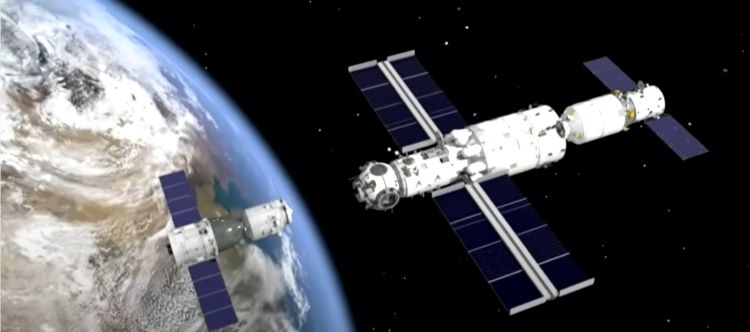
China’s three-person Shenzhou-12 crew is busy at work after spending a night in the Tianhe core module. Chinese astronauts Nie Haisheng, Liu Boming and Yang Hongbo installed Wifi on Friday morning.
In a China Central Television (CCTV) interview, Sun Jun, deputy director of the Beijing Aerospace Flight Control Center said the space trio are setting up various facilities needed, including those for telecommunication, living, cooking and sanitation purposes. Doing so, the crew is laying a basic logistic foundation for long-term, on-orbit life, added Sun.
Credit: CCTV/Inside Outer Space screengrab
“The network in space is connected with the network on Earth. After the Wi-Fi facility is installed, astronauts can communicate smoothly and even have video calls with engineers and with their family members on Earth,” said Sun.

Credit: CCTV/Inside Outer Space screengrab
The crew is unpacking the daily necessities from the cargo ship and is moving more equipment to the core module, tasks that are expected to take about a week. The crew will later carry out space science experiments and on-orbit training, especially to prepare for space walking activities, Sun said.

Credit: GLOBALink/Inside Outer Space screengrab
Spacious home
“I’m envious of their spacious home,” said Yang Liwei, China’s first astronaut to travel into space, congratulating the astronauts of the Shenzhou-12 spaceship upon entering the country’s space station core module.
Shenzhou-12 is China’s seventh crewed mission to space and the first to initiate hands-on construction of China’s space station to be completed late next year.
The Tianzhou-3 cargo craft and the Shenzhou-13 manned spaceship will also be launched later this year to dock with Tianhe, and another three astronauts will then begin a six-month stay in orbit, according to the China Manned Space Agency (CMSA). Based on project plans, the Tianzhou-3 cargo ship will be launched in September to dock with Tianhe, and in October, a Shenzhou-13 three-person team will fly to the module to stay there for six months.

Robotic arm helps on space station construction.
Credit: CCTV/CNSA/Inside Outer Space screengrab
After the five launch missions this year, China plans to have six more missions, including the launch of the Wentian and Mengtian lab modules, two cargo spacecraft and two crewed spaceships in 2022, to complete the construction of the space station.
One of China’s most adventurous space endeavors, the Tiangong (Heavenly Palace) space station will consist of three main components — a core module attached to two space labs — with a combined weight of nearly 70 metric tons. The entire station is set to work for about 15 years.

Credit: CCTV/Inside Outer Space screengrab
Rescue backup
As crews are expected to stay in space for three to six months, there’s a backup rocket and spacecraft ready on the launch pad.
According to Shao Limin, Deputy Technological Manager of the Shenzhou-12 spacecraft at the China Academy of Space Technology, Chinese space engineers are preparing Shenzhou-13 as a backup spacecraft for the Shenzhou-12 space mission, in order to better guarantee astronauts’ safety in the case of any in-space emergency.

Credit: CCTV/Inside Outer Space screengrab
“Shenzhou-13 has been transferred to the launch pad as the backup emergency ship at the same time as we transferred Shenzhou-12,” Shao told CCTV. “If Shenzhou-12 encounters any major problem, “we can launch Shenzhou-13 without crew within 10 days for rescue.”
New videos of space station operations are available from China Central Television (CCTV)/China National Space Administration (CNSA), as well as New China TV/GLOBALink at:
 Posted in Space News

