 By
By  January 19th, 2026
Image credit: CCTV/Inside Outer Space screengrab
China’s uncrewed Shenzhou-20 return capsule parachuted into the Dongfeng landing site in north China’s Inner Mongolia Autonomous Region on January 19 at 09:34 (Beijing Time).
That capsule’s original return date had been delayed due to concerns over tiny cracks found in the capsule’s viewport window, damage thought caused by a high-speed run-in with space debris.
The spacecraft spent 270 days in orbit, verifying its ability to remain docked in orbit for nine months, the China National Space Administration (CNSA) stated.
Porthole crack
“To mitigate the risks associated with the Shenzhou-20 spacecraft’s return, on December 9, 2025, the Shenzhou-21 astronaut crew utilized an extravehicular activity (EVA) to take close-up photos of the Shenzhou-20 return capsule’s porthole using a high-definition camera, further confirming the condition of the porthole crack,” the CNSA added.

Image credit: CCTV/Inside Outer Space screengrab
“Furthermore, in conjunction with the emergency launch of the Shenzhou-22 spacecraft, a porthole crack repair device was expedited and sent to the launch site,” said the CNSA. “Astronauts installed it inside the Shenzhou-20 capsule, effectively improving the spacecraft’s heat protection and sealing capabilities during reentry.”
On-site inspection found that the Shenzhou-20 return capsule’s exterior was “generally normal, and the items inside were in good condition,” the CNSA said.
Alternative spacecraft
An alternative Shenzhou-21 spacecraft was used to safely transport the three Shenzhou-20 crew members to Earth on November 14.
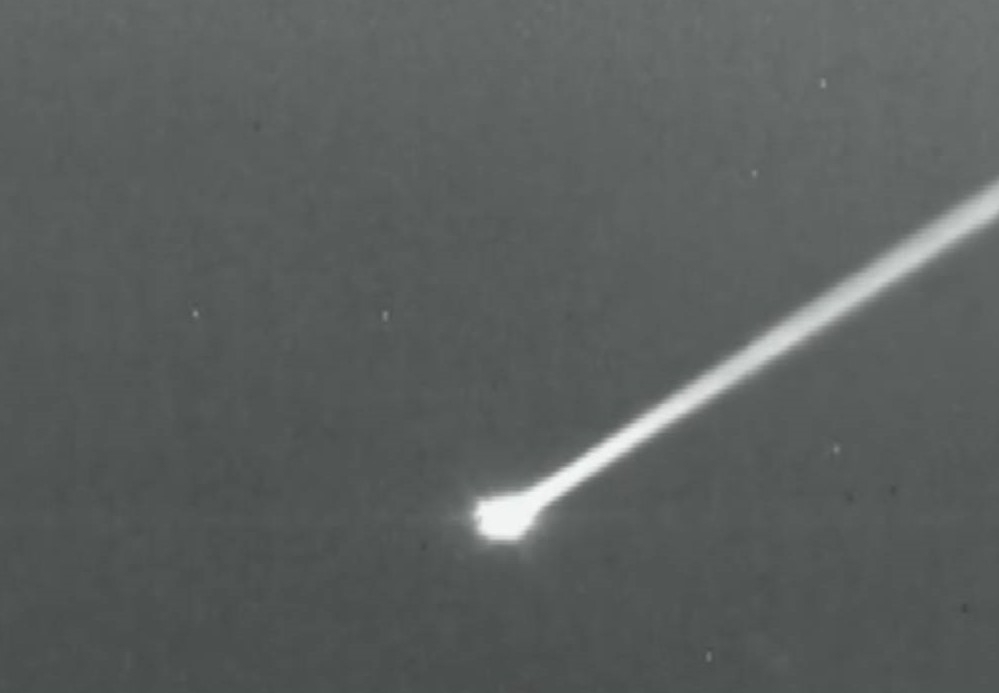
Incoming Shenzhou-20 capsule.
The incident sparked an emergency mission to fly an uncrewed Shenzhou-22 spacecraft to the space station on November 25. Now docked to the orbiting facility, that vessel will serve the Shenzhou-21 crew on their expected return at the conclusion of their six-month mission.
“Currently, the Shenzhou-23 spacecraft, which will take over the rolling backup mission, has arrived at the Jiuquan Satellite Launch Center, and the Long March 2F Y23 carrier rocket is about to be shipped,” the CNSA pointed out. “With the return of the Shenzhou-20 spacecraft, the main tasks of this emergency space operation for the Chinese space station have been successfully completed.”
Frigid temperatures
At the capsule’s Dongfeng Landing Site, search and recovery teams had to cope with extreme weather conditions in the area. Frigid temperatures and strong winds posed challenges in retrieving the return craft.
China Central Television (CCTV) reported that Xu Peng, the on-site commander at the touchdown site, noted that ground search forces made targeted adjustments.

Image credit: CCTV/Inside Outer Space screengrab
“This marks the first time the Dongfeng Landing Site has carried out a spaceship recovery mission during the coldest season of the year, with cold weather posing a test for both our search and rescue teams and equipment. We made special cold-protection preparations in advance to ensure that both personnel and the equipment remained in good condition throughout the mission,” Xu said.
Quick response
Xu also noted another unique factor of this unmanned return recovery operation, placing extra pressure on the ground teams to respond quickly to its touchdown.
Xu said the ground teams deployed new methods, such as drones and other high-tech equipment, to assist in recovery operations.
“Adjustments were made to our recovery forces,” Xu said. “The helicopter unit did not participate in this mission, and the drone and unmanned ground vehicle units made their debut. This new model, combining unmanned search equipment with ground personnel, was applied in the recovery of the uncrewed capsule,” he said.

Xu Peng, the on-site commander at the touchdown site.
Cut the parachute
Xu added that, as the Shenzhou-20 return capsule was unmanned, there was no astronaut to manually separate the parachute.
“As a result, the main parachute did not automatically detach upon landing, and in strong winds, it could have dragged the return capsule along the ground. This requires our ground personnel to reach the landing point and cut the parachute as quickly as possible,” Xu said.

Image credit: CCTV/Inside Outer Space screengrab
Damaged porthole
On-site personnel quickly took steps to protect the damaged porthole on the return capsule upon its landing. That action was driven by a post-landing assessment on the damage the Shenzhou-20 capsule sustained in space.
An on-site inspection confirmed that the exterior of the Shenzhou-20 return capsule was “generally intact” and the items inside were in good condition, the China Manned Space Agency (CMSA) reported.
Retired spacesuit
One of those inside items was a retired Extravehicular Mobility Unit (EMU) B spacesuit used for spacewalks.
That spacesuit garnered a distinguished service period that spanned more than four years in orbit, far exceeding its original design life, reported CCTV. Over that time, the suit had supported 11 Chinese astronauts across eight crewed missions, enabling 20 successful EVAs to be conducted.
For a CCTV video on the recovery of the capsule, go to:
https://www.facebook.com/reel/1810473869665482
Also, go to this video showcasing the current crew aboard China’s space station at:
 Posted in Space News

