 By
By  August 7th, 2025
Image credit: CCTV
China’s crewed Moon lander completed a comprehensive landing and takeoff verification test.
The “Lanyue” lunar lander is undergoing testing at the “extraterrestrial celestial landing test site” in Huailai County, north China’s Hebei Province, reports China Central Television (CCTV).
Lanyue is a crew-carrying descent and ascent vehicle designed for China’s first human lunar exploration mission, set to be attempted before 2030.

Image credit: CCTV/Inside Outer Space screengrab
Test validation
The craft is primarily used for transporting astronauts between lunar orbit and the lunar surface, capable of carrying two astronauts back and forth. It can also carry a lunar rover and scientific payloads, supporting astronauts’ stay and activities on the Moon, CCTV reports.
“During the test, the engine was ignited, simulating the landing of the lunar lander on the Moon and its subsequent takeoff,” added CCTV. “The test validated the lander’s landing and takeoff system, control plan, lunar contact shutdown procedures, and the compatibility of interfaces between subsystems, including Guidance, Navigation, Control (GNC) and propulsion.”

Image credit: CCTV/CMSA/Inside Outer Space screengrab
Landing, takeoff and loitering
Lanyue tests are meant to appraise the performance verification of the lunar lander under different scenarios throughout the landing and takeoff process.
“For instance, during the launch phase, we need to verify its launch payload. So we conducted large-scale mechanical tests to ensure a smooth transition in the extremely complex environment during the launch,” Huang Zhen from China Aerospace Science and Technology Corporation told CCTV.
“The lander will also orbit the Moon for a long period,” Huang added, “so we performed many thermal tests to ensure that it can withstand the thermal environment of the cislunar space.”

Huang Zhen, researcher, China Aerospace Science and Technology Corporation.
Image credit: CCTV/Inside Outer Space screengrab
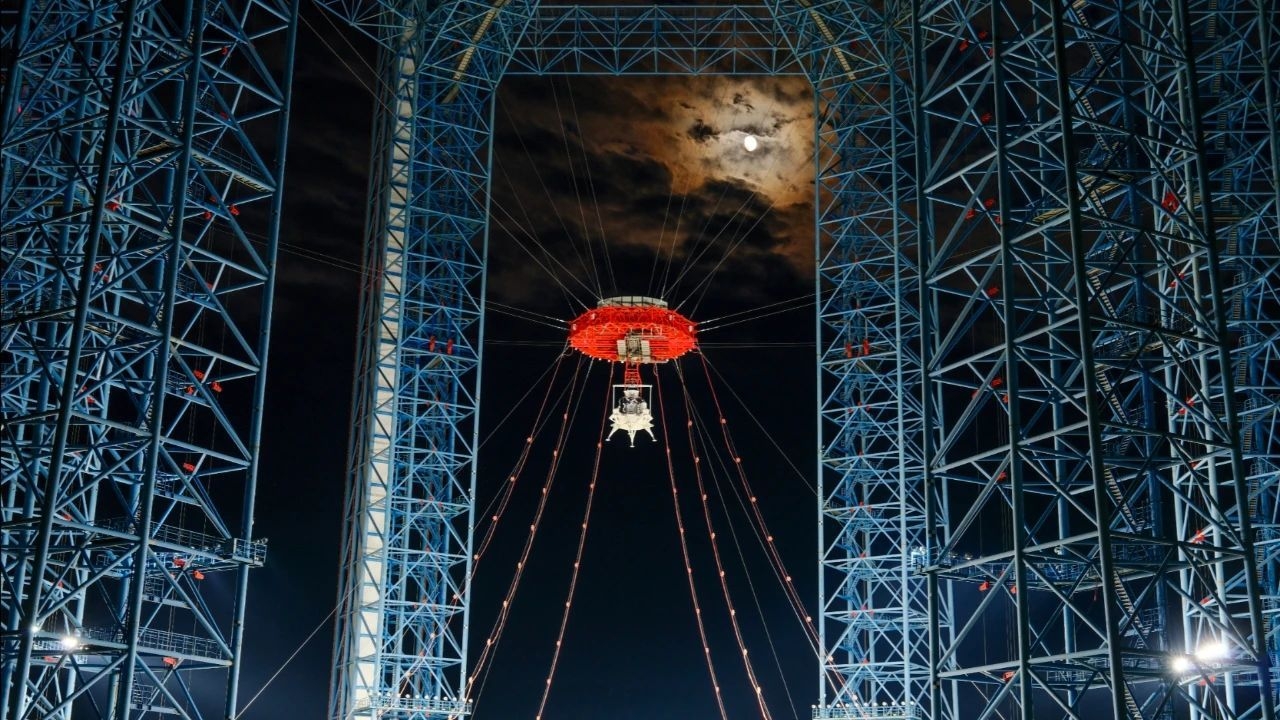
China completed a comprehensive test of its crew-carrying Moon lunar lander Lanyue in north China’s Hebei Province, August 6, 2025. Image credit: CGTN//China Media Group
 Posted in Space News

