 By
By  December 19th, 2020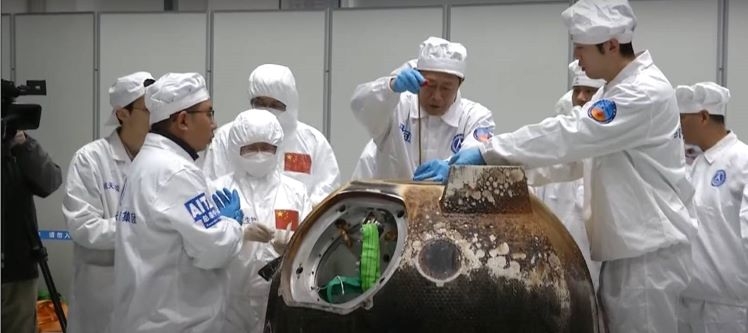
Technicians extract the lunar sample container from the return capsule.
Credit: CCTV/Inside Outer Space screengrab
Fresh from the Moon via China’s Chang’e-5 mission about 3.8 pounds (1,731 grams) of lunar samples have been transferred to the National Astronomical Observatory under the Chinese Academy of Science on Saturday in Beijing.

Credit: CCTV/Inside Outer Space screengrab
The container loaded with the specimens was carefully extracted from the recovered return capsule, and then escorted to the National Astronomical Observatory for opening.

Credit: CCTV

Credit: XinhuaVideo/Inside Outer Space screengrab
The samples are sealed in the nearly vacuum lunar environment. They will be unsealed under vacuum condition in China’s first lunar sample laboratory at the National Astronomical Observatory.
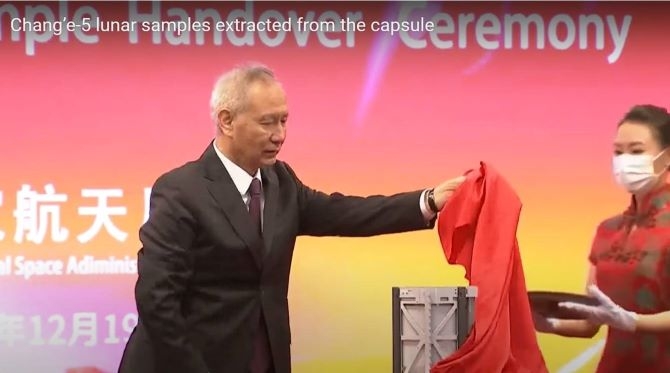
Credit: CCTV/Inside Outer Space screengrab
Hou Jianguo, President of the Chinese Academy of Sciences, addressed a special ceremony, handing over the collectibles to researchers charged with storage, analysis and sample research.
Difficult space mission
The return capsule of Chang’e-5 mission parachuted into north China’s Inner Mongolia Autonomous Region in the early hours of Thursday.
The 8.2 metric ton Chang’e-5 comprised an orbiter, a lander, an ascender and a returner.
The sample return mission was launched on November 24 by a Long March 5 heavy-lift carrier rocket at the Wenchang Space Launch Center in southern China’s Hainan province, setting out on China’s most complex space mission and a first to retrieve lunar samples since 1976.

Photo taking during surface sampling.
Credit: CCTV/Inside Outer Space screengrab
The lander-ascender combination touched down on the north of the Mons Rümker in Oceanus Procellarum, also known as the Ocean of Storms, on the near side of the Moon on December 1st.
The Moon sampling operation was completed on December 2, spanning about 19 hours. Regolith and rock were packed into a vacuum container inside the ascender which blasted off the Moon on December 3, later linking up with the orbiter/returner vehicles and transferring the lunar samples into the reentry capsule.

Fresh samples from the Moon delivered by China’s Chang’e-5 return capsule.
Credit: Xinhua News Video/Inside Outer Space screengrab
The orbiter/returner made two orbital maneuvers after traveling in a near-circular lunar orbit for nearly six days. After the maneuvers, the pair entered a Moon-Earth transfer trajectory on Sunday and began to fly back toward Earth.
Return to Earth
The orbiter/returner separated from each other early on Thursday morning. The reentry capsule with its precious cache of lunar specimens touched down at a preset landing site in Siziwang Banner of the Inner Mongolia autonomous region. It was then airlifted to Beijing, where scientific personnel successfully removed the lunar sample container after related processing work.

Credit: CCTV/Inside Outer Space screengrab
“We have delivered the lunar samples to the research units, hoping they can achieve more results. This is a very important moment for us. We anticipate that with the lunar samples, we can take more resolute steps in building China into a major power in space exploration,” said Hu Hao, chief designer of the third phase of China’s lunar exploration program.
Li Chunlai, deputy chief designer of the third phase of China’s lunar exploration program said that “our ground-based research team will start the work on the storage, preparation and processing of the samples for further research. Lunar samples study is long-term, systemic work, and so there will be more scientific results achieved along the way.”
Go to these newly issued videos that show the lunar sample container and the transfer of the Moon specimens from China National Space Administration (CNSA) to the Chinese Academy of Sciences (CAS) for research.
 Posted in Space News

