 By
By  June 2nd, 2023
Image credit: CMSA/CCTV/Inside Outer Space screengrab
China’s Shenzhou-15 astronauts are slated to return to Earth on June 4, following the transfer of space station control to the newly arrived Shenzhou-16 crew and the country’s second in-orbit crew rotation.
The trio of taikonauts – Fei Junlong, Deng Qingming and Zhang Lu – are slated to touchdown at a Dongfeng landing site in north China’s Inner Mongolia Autonomous Region.
The Shenzhou-15 crew members entered China’s Tiangong (Heavenly Palace) space station on Nov. 30 last year for a six-month stay.

Image credit: CMSA
During their stay in orbit, according to China Central Television (CCTV) the Shenzhou-15 crew completed four extravehicular activities (spacewalks), conducted eight human factors engineering research activities, 28 space medical experiments and 38 science experiments in the fields of life ecology, material science and fluid mechanics, and obtained valuable experimental data.
Duties for the Shenzhou-16 crew — Jing Haipeng, Zhu Yangzhu and Gui Haichao — include performing extravehicular activities, conduct in-orbit tests and experiments, and carry out equipment installation, debugging, maintenance and repair.

Depiction of Shenzhou-16 spacecraft approaching docking port.
Image credit: CCTV/Inside Outer Space screengrab
See-off ceremony
A “see-off ceremony” was staged between the two Shenzhou crews.
“On behalf of the Shenzhou-16 mission crew and after a thorough inspection and review, I have confirmed that there is no problem and will sign,” said Jing Haipeng, Shenzhou-16 commander.
“Then we will now sign for handover confirmation,” said Fei Junlong, Shenzhou-15 commander.
The crew members of Shenzhou-15 and Shenzhou-16 then signed the confirmation letters.
“I wish you full success in fulfilling your next tasks,” said Fei. “We have completed the in-orbit mission of Shenzhou-15. Now I hand over the keys to the space station to you, as arranged,” he noted.
“I thank the Shenzhou-15 crew for laying a good foundation for us,” said Jing.

New Shenzhou-16 crew onboard with Shenzhou-15 astronauts during handover ceremonies.
Image credit: CCTV/CNSA/Inside Outer Space screengrab
Handover process
According to Huang Weifeng, chief designer of China’s manned space program’s astronaut system, the handover process is a crucial step to ensuring the safety of both crews and the success of the upcoming missions.
“We have to ensure a complete handover, covering spacecraft status settings. Devices and equipment must be available to guarantee the normal operation of EVAs as well as astronauts’ healthy living and work, and we must ensure the status of laboratory facilities and equipment and the progress of in-orbit experiments as well as samples and materials,” Huang said in a CCTV interview.
“For each in-orbit rotation, we plan to leave one copy of the confirmation letters in the Tiangong space station, while astronauts bring the original letters back to Earth. For each new crew boarding the space station, they will find the names of their predecessors in the letters. I would call this a ‘historical inheritance,'” Huang added.
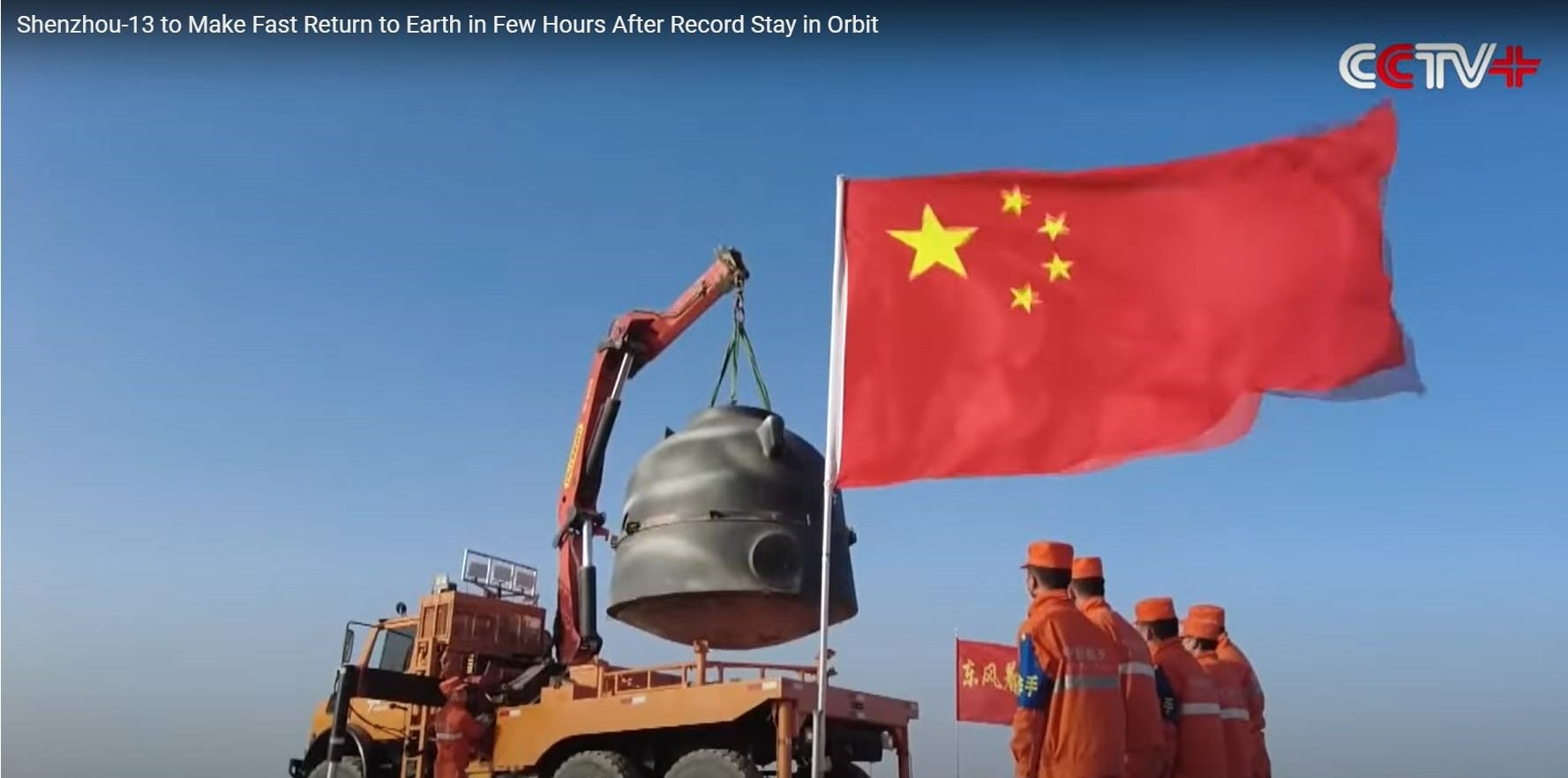
Earlier image shows practicing ground recovery crews at the Shenzhou-13 Dongfeng landing site in north China’s Inner Mongolia.
Credit: CCTV/Inside Outer Space screengrab
System-wide exercise
Meanwhile, the Dongfeng landing site is ready to receive the returning Shenzhou-15 crew. Similarly, at the Jiuquan Satellite Launch Center on Thursday, the last comprehensive system-wide exercise was held for the return of Shenzhou 15.
“After several years of construction, especially the performance of the three missions of searching and rescuing astronauts, the Dongfeng landing site has become more advanced in search and rescue technology with more reliable equipment, better search and rescue planning, and richer experience in organization and performance,” said Bian Hancheng, deputy chief designer of the landing site system of China Manned Space Program.
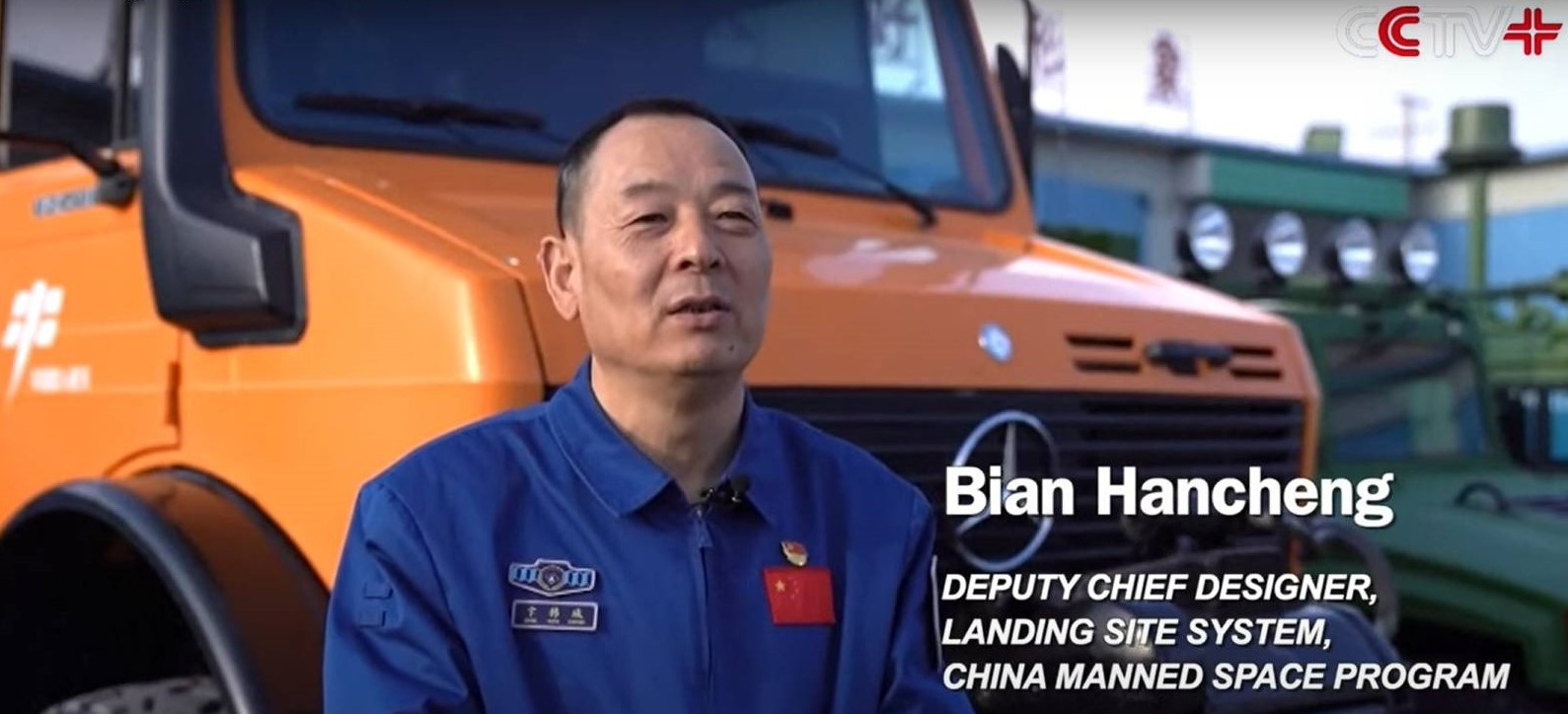
Image credit: CCTV/Inside Outer Space screengrab
“We have the ability and confidence to successfully complete this mission of searching and rescuing the astronauts,” Hancheng told CCTV.
Landing site situation
After receiving the fourth landing forecast, the air team reached the simulated landing site in ten minutes.
“Each of our aircraft is equipped with airborne direction finder, which receives signals from the beacon of the re-entry module to determine its basic direction and distance. The existent direction finders have been upgraded and refit, and they are now strong in receiving signals, accurate in positioning and simple in screen display,” said Li Linzhe, commander of air disposal unit of Shenzhou-15 search and rescue recovery mission.
The on-board optical equipment installed on the ground vehicles can also accurately capture the entire process of the re-entry capsule’s return, from the parachute opening to landing, providing real-time coordinates of the re-entry capsule, including the coordinates of the landing point.
“Through the communication link which transmits data back to the headquarters and from the headquarters to each search team, a network between air and ground is established, which provides a reliable basis for the quick and efficient search of the re-entry capsule in the air and on the ground,” said Li.

Credit: GLOBALink/Inside Outer Space screengrab
Special training
Chen Guodong, on-site disposal commander of the ground team of the Shenzhou 15 search and rescue recovery mission, said his team has conducted special trainings to cope with complex terrains of the landing site, including desert, Gobi, saline-alkali land, and grass lakes.
“Through post trainings, from simple road to complex road, from long-distance training to task exercise, from high visibility to low visibility, we have further improved our driving ability, and make sure we could reach the disposal site safe at the fastest speed,” Chen advised during a CCTV interview.
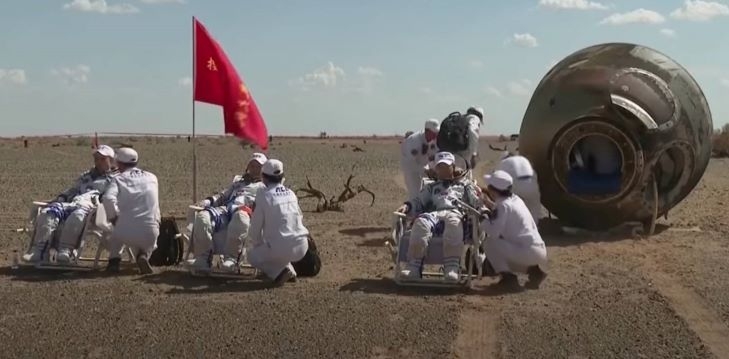
Image credit: CNSA/CCTV/Inside Outer Space screengrab
Comfort for returning crew
Work has also been done to make things more comfortable for the three Shenzhou-15 astronauts to get out of the cabin.
For example, the operation platform next to the returned capsule when it is upright is made of magnesium and aluminum alloy, and is lighter than before. It takes about five minutes for the work team to set up the operation platform. And its slope is smoother, making it more comfortable for astronauts to slide down.
According to CCTV, the landing site system has run two comprehensive search and recovery drills, more than 20 special trainings on tracking and capture, medical supervision and medical insurance, medical rescue and security.
For a video showcasing crew transfer of station tasks, go to:
 Posted in Space News

