 By
By  November 17th, 2022
Artwork depicts T-shape configuration of China space station.
Credit: CNSA/CCTV/Inside Outer Space screengrab
Two China spacewalkers carried out a third extravehicular activity on Thursday, a five-hour long stint as the country’s space station continues to evolve.
This new spacewalk by Chen Dong and Cai Xuzhe was the first to be completed since the orbiting complex took on its T-shape look.
Shenzhou-14 crewmate, Liu Yang, supported the spacewalkers from inside the module.

Two Shenzhou-14 crewmen carry out spacewalk tasks.
Credit: CNSA/CCTV/Inside Outer Space screengrab
It was the first round of EVAs for the crew since the assembly of the station’s basic T-shape configuration earlier this month, and the third overall spacewalk since the current crew began their mission in June.
In the big picture, this new spacewalk was the seventh round of EVAs to be conducted as part of the China’s space station construction process, with two previous crewed missions also fulfilling spacewalk tasks.

Current occupants of China’s station – the Shenzhou-14 crew. Credit: China National Space Administration (CNSA)/China Central Television (CCTV)
Bridge building
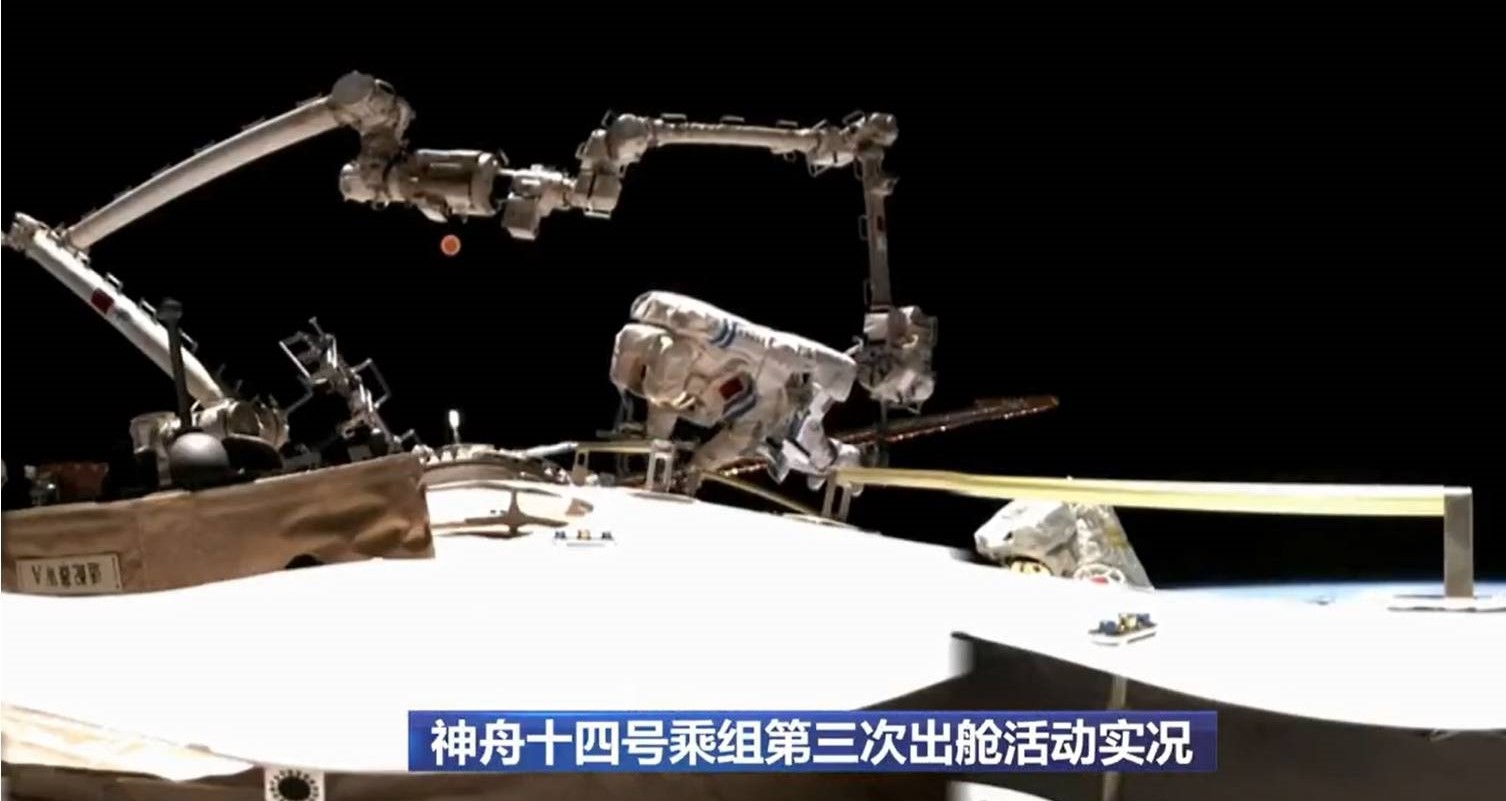
Chen and Cai worked together to install a connection “bridge” between the three station modules that could assist astronauts when crawling outside the module and better stabilize the station’s T-shaped structure. Cai attempted the first cross-module walk using this newly-built bridge, according to China Central Television (CCTV).
Cai, who made his first spacewalk in September, attempted the first cross-module walk using this newly-built bridge.
The astronauts also lifted and fixed a panoramic camera outside the Wentian lab module and added a special mounted assistance handle on the station’s small robotic arm.
Credit: CCTV/Inside Outer Space screengrab
Robotic arms
“This time, Shenzhou-14 set a record of carrying out extravehicular activities in one mission,” said Chen Shanguang, deputy chief designer of the China Manned Space Program.
Credit: CNSA/CCTV/Inside Outer Space screengrab
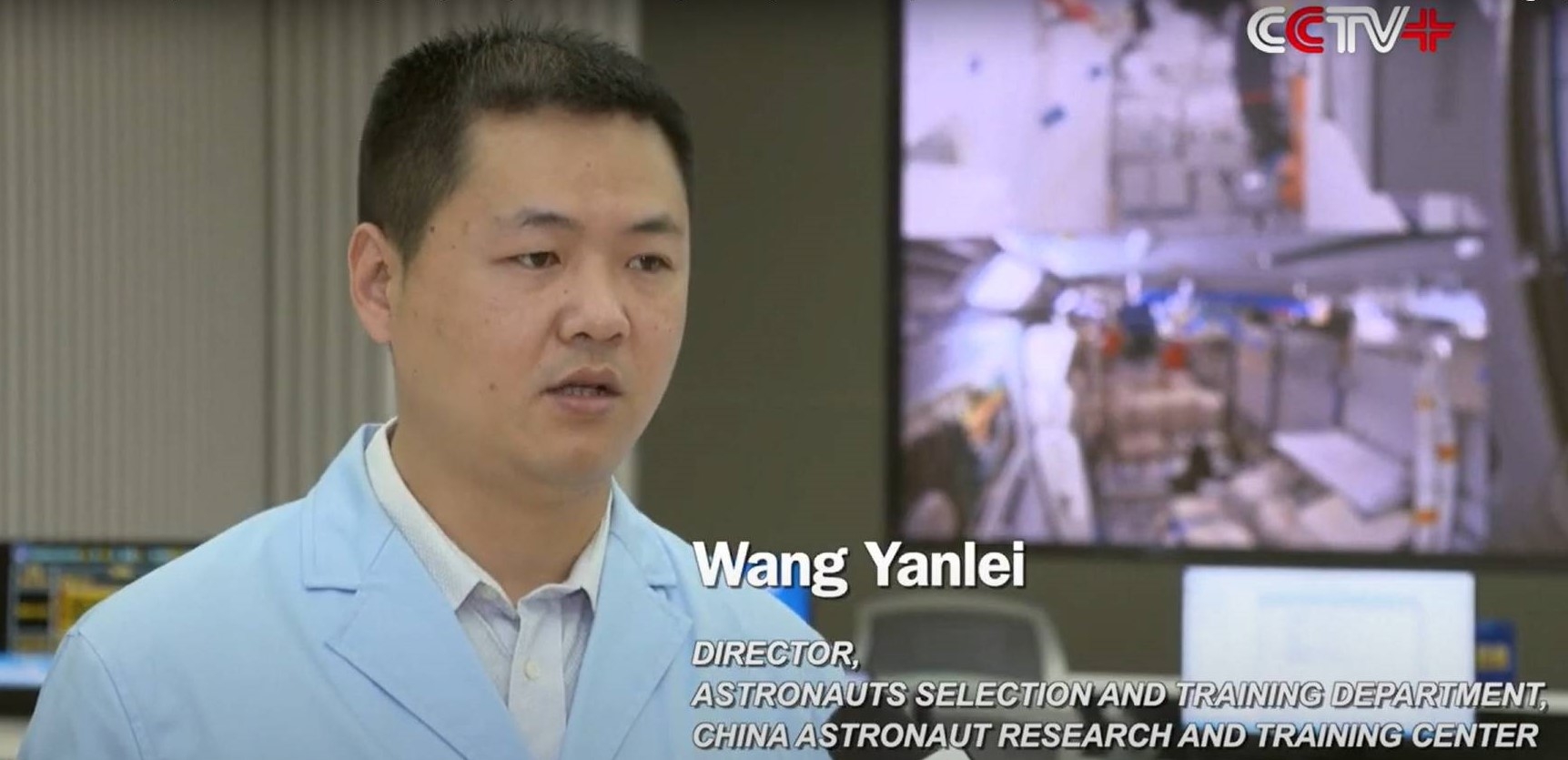
“For the first time, we used two robotic arms, namely the big arm and the small arm to form a combined arm to support the task of extravehicular activities. As the single arm is already very long, so the combined arm will be longer, and its flexibility and rigidity is also different from that of a single robotic arm. And it is our first verification of completing extravehicular activities in such a case,” said Wang Yanlei, director of the astronauts selection and training department of the China Astronaut Research and Training Center told CCTV.
Next crew, handover
The three-person Shenzhou-14 crew members were lofted into Earth orbit last June to start their six-month trek in space, the longest duration for any Chinese manned mission.

Credit: CMG/CCTV/CASC/Inside Outer Space screengrab
During the second half of their six-month stay in orbit, the Shenzhou-14 taikonauts oversaw the arrival of the Mengtian lab that formed the three-module T-shape structure: the core module Tianhe, along with lab modules, Wentian and Mengtian.
The Shenzhou-14 crew will welcome the arrival of the Shenzhou-15 crewed spacecraft at the space station later this month. Once arrived at the station site, the Shenzhou-15 crew members will join the Shenzhou-14 colleagues to complete the facility’s first-ever crew handover, according to CCTV.
The Tiangong space station is on track to be fully up and operating by the end of this year.
To view a new video detailing the third spacewalk of the Shenzhou-14 mission, go to:
 Posted in Space News

