 By
By  October 9th, 2026
Image credit: CCTV/Inside Outer Space screengrab
China is planning to open the country’s space station to other countries, intended to transform the orbital facility into a global research platform.
Yang Liwei, China’s first astronaut and deputy chief designer of the China Manned Space Agency (CMSA), discussed the plan during the now underway 77th International Astronautical Congress in Türkiye’s Mediterranean city of Antalya.
In a China Central Television (CCTV) story, Yang noted that one of two Pakistani astronaut candidates — currently undergoing joint training with their Chinese counterparts – will carry out a short-duration flight mission as a payload specialist on the station in the second half of this year.
To date, 27 Chinese astronauts in 11 crews have been sent to live and work on the Tiangong space station, including the now-orbiting Shenzhou-23 team, who arrived at the outpost in late May.
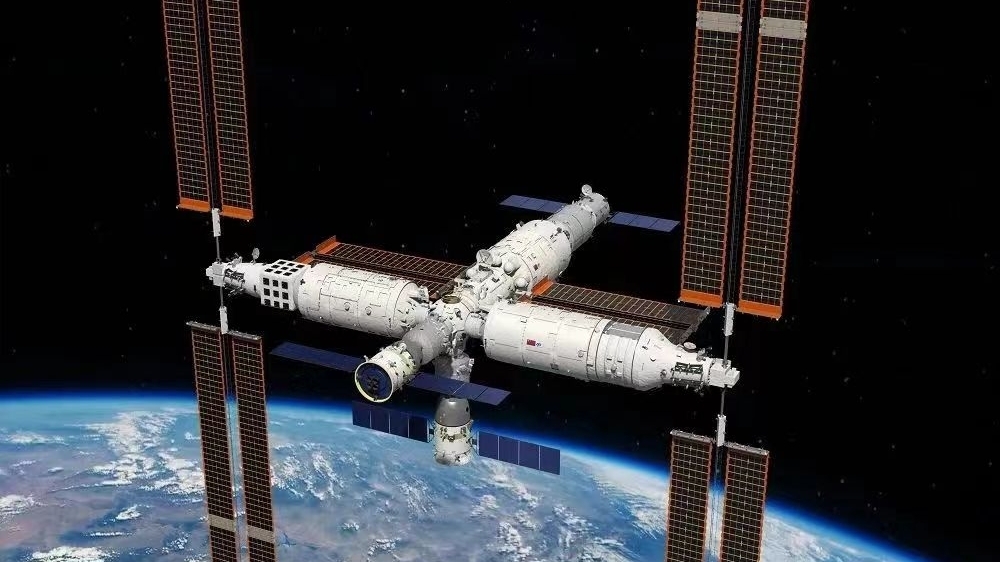
Artwork depicts China’s Tiangong space station.
Image credit: China Manned Space Agency
Human Moon landing work underway
In related news, China Daily reports that China continues on a path to land astronauts on the Moon by 2030. The country is “shifting from a long-term blueprint to tangible reality, with major infrastructure construction and hardware testing being carried out at pace by the nation’s space industry” the state-run news outlet adds.
The CMSA points out they are in full swing to push forward the construction of facilities and equipment required for lunar landing missions at the Wenchang Space Launch Center in Hainan province.
Additionally, building of other ground support systems such as telemetry, tracking, command and communications, is underway, as are preparations for the landing site.

Image credit: CCTV/Inside Outer Space screengrab
Major flight vehicles
Now in full-swing and progressing smoothly CMSA states, is development of major flight vehicles:
- the Long March 10 heavy-lift carrier rocket
- the Mengzhou crew spacecraft
- the Lanyue lunar lander
“A series of critical tests have been completed in succession, including the pad abort and the maximum dynamic pressure escape flight tests for the Mengzhou, the landing and takeoff tests for the Lanyue, and the static ignition and low-altitude flight tests for the Long March 10,” China Daily explains, citing the CMSA.
Chinese space authorities have been training astronauts for lunar expeditions, preparing them for the unique environment on the “silver sphere.” Once on the Moon, the major tasks of the Chinese astronauts will include driving a Tansuo rover to carry out scientific assignments and collect lunar samples.

Image credit: CCTV/Inside Outer Space screengrab
Mars return sample
Viewed as the next step in its deep-space exploration program, China plans to collect martian samples and bring them back to Earth around 2028 via the Tianwen 3 mission. The primary scientific objective of this mission is to look for traces of life on the Red Planet.
Sun Zezhou, an expert on deep space exploration at the China Academy of Space Technology, told CCTV that the sample return Mars effort is challenging.
“At the beginning, we were also quite anxious when we encountered problems. We always had issues on various experiment. When the phone rang, we would feel nervous, thinking it was probably another experiment that didn’t turn out as expected,” Sun said. “We progressed and kept on testing key technologies on the ground. The more problems we encountered, the fewer errors we would face in the future, that is the rule.”
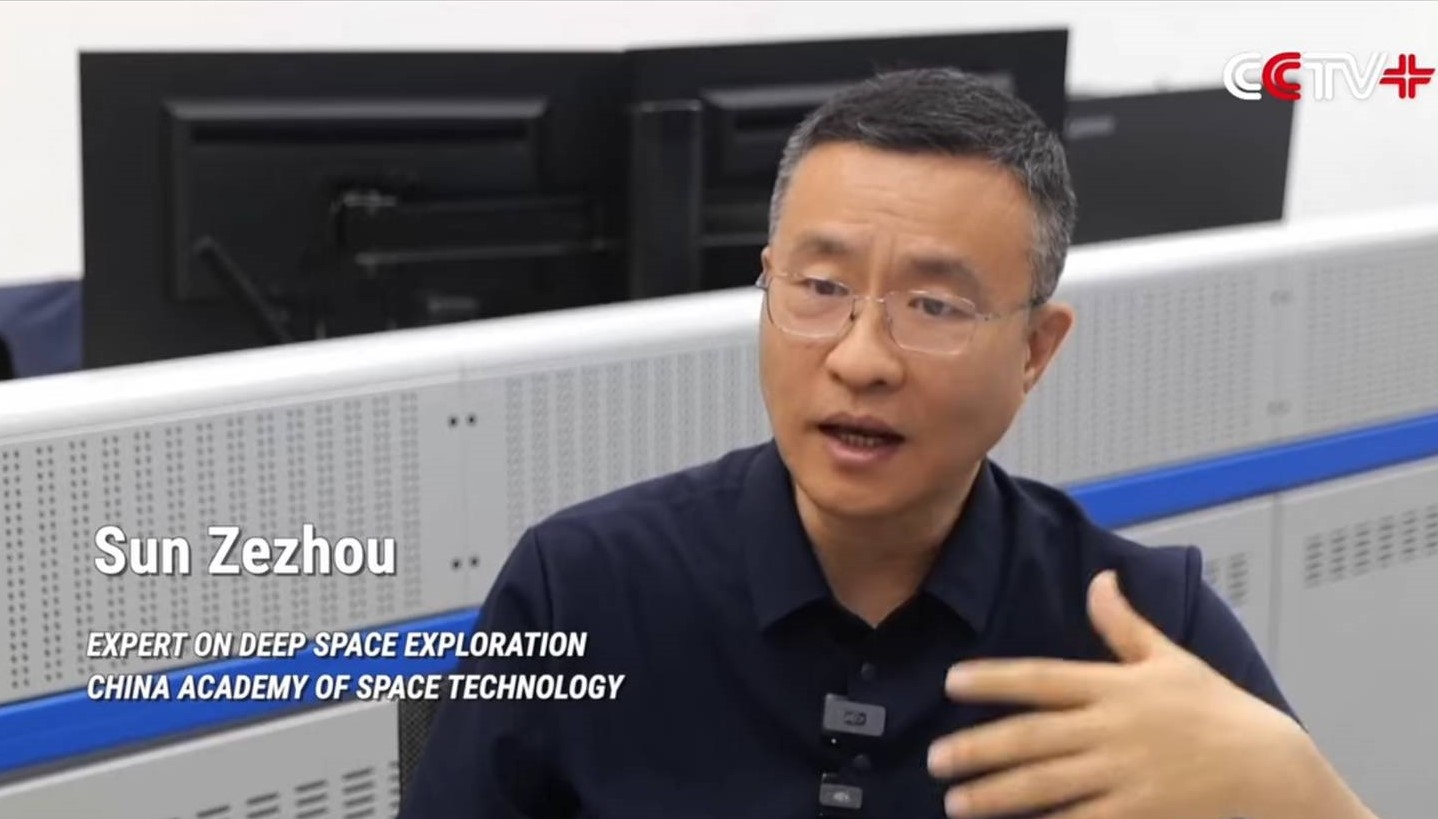
Image credit: CCTV/Inside Outer Space screengrab
Among the planets in the solar system, Mars is the most similar celestial body to Earth, said Sun.
“If we compare Earth as a young adult in its prime, Mars is more like an elder in its twilight years. As for the exploration of Mars, to put it most simply and directly, we want to understand the evolutionary process of our close neighbor and what insights it can offer us,” Sun concluded.
For details on China’s Mars sample return program, go to:
https://www.facebook.com/reel/2164187321174141
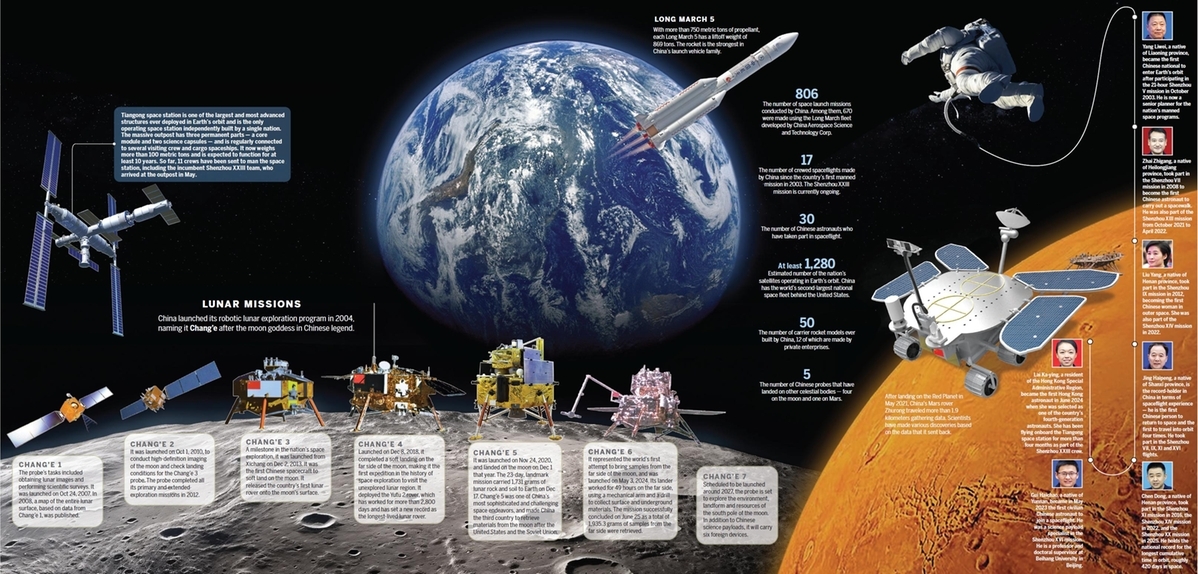
Image credit: China Daily/People’s Daily Online
 Posted in Space News

