 By
By  January 1st, 2023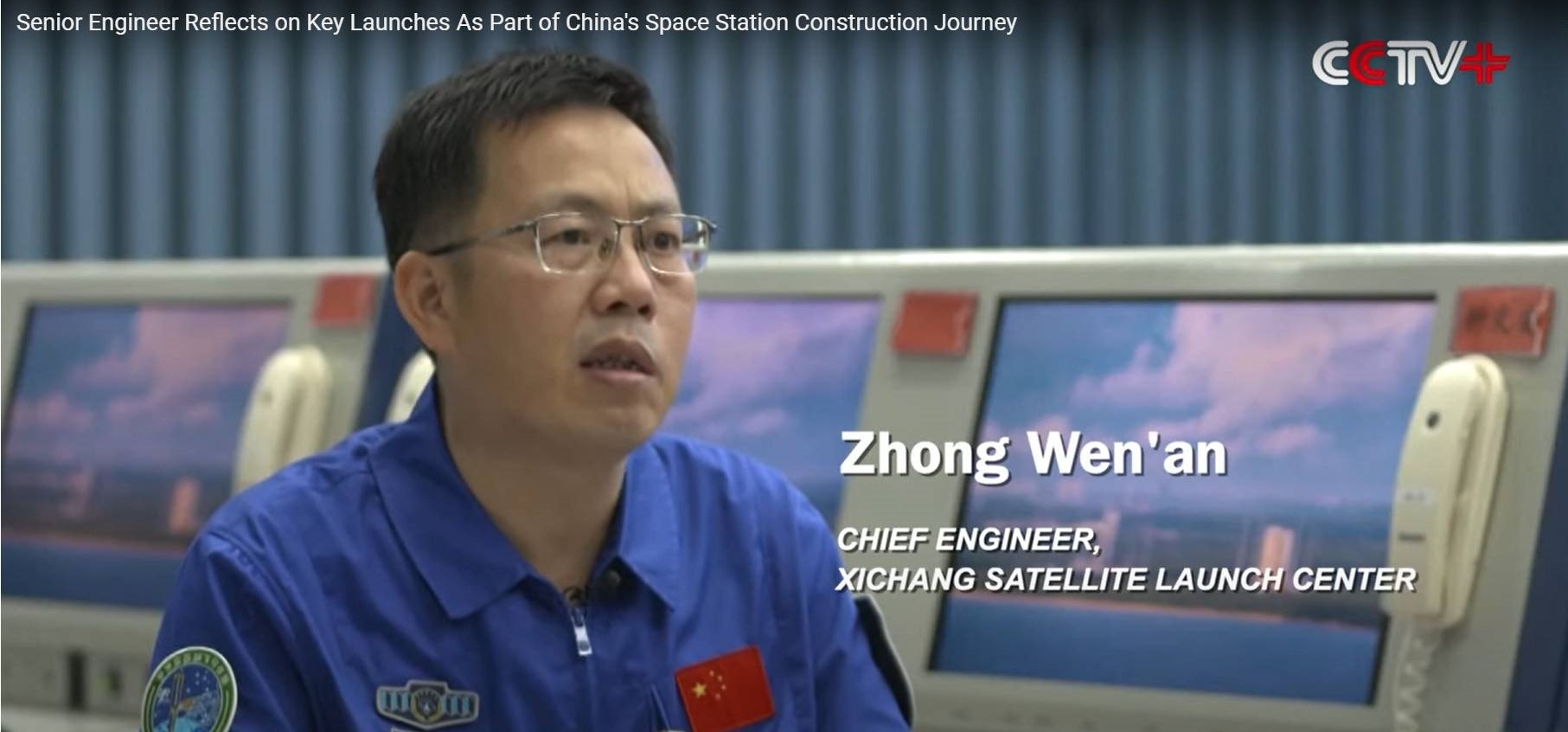
Image credit: CCTV/Inside Outer Space screengrab
China’s Wenchang Satellite Launch Center in the southern Hainan Province is set for an increase in launch rate.
Zhong Wen’an, chief engineer of the Xichang Satellite Launch Center that oversees operations at Wenchang, told China Central Television (CCTV):
“In the near future, Wenchang will see its launch frequency go from between six to eight times a year, to 20 or 30 times a year,” Zhong said. “This is not only a change in quantity but also one in quality. We are also going to add more sites for [the launch of] manned moon-landing missions, heavy rockets and commercial ones. The future of Wenchang is worth looking forward to,” he added.

A Long March-5 booster departs Wenchang launch site.
Credit: CASC
China launched 12 missions related to the building of the space station, with eight of these carried out at Wenchang.
Zhong said that in the future, the launch center is expected to play host to more critical missions on a more frequent scale.
Three-step program
The successful building of the space station is the final goal of China’s “three-step” human space program initiated 30 years ago.
CCTV notes that China’s space station project has completed two phases of the mission objectives: key technology verification and in-orbit construction.

Image credit: Shujianyang Wikimedia Commons, CC BY-SA
During that period of time, the country achieved breakthroughs in regenerative environmental control and life support technology, harnessed flexible solar cell wing driving technology, as well as carry out robotic arm auxiliary module rotation, large assembly control and other technologies.
“I think one of the most important things is that I was determined to make the Chinese space station the most economical space station with advanced technology,” Zhou Jianping, the chief designer of China’s human spaceflight program, told CCTV.

Credit: CCTV/Inside Outer Space screengrab
Station economics
“With respect to the economics of our space station, undoubtedly, it’s the most advanced of all the space stations,” Zhou said. “Thanks to technological advancement, we can dramatically reduce the cost of future supplies to the space station, which is a model of high-quality development.”
The space station is viewed as a new starting point for further space development.
“Our space station will enter the full application stage. It’s safe to say that it is a very important space science research and experiment platform for us to build an innovative country. Our next goal is to conduct manned moon landing in the near future,” Zhou concluded.
 Posted in Space News

