 By
By  December 31st, 2025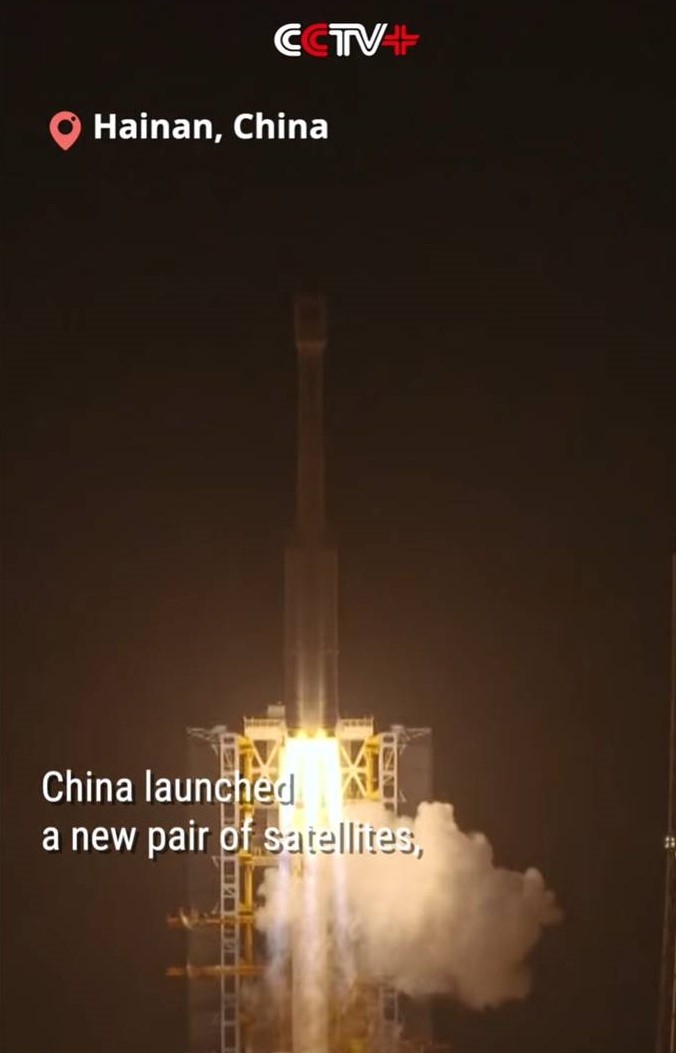
Image credit: CCTV/Inside Outer Space screengrab
As it has repeatedly done throughout 2025, the Philippine Space Agency (PhilSA) issued yet another advisory on spent rocket parts from China falling into drop zones within the Philippine Exclusive Economic Zone (EEZ).
The December 31 PhilSA posting stems from China’s Long March 7A liftoff that day from the country’s Wenchang Space Launch Site in Wenchang, Hainan.
Falling debris
“Unburned debris from rockets, such as the booster and fairing, are designed to be discarded as the rocket enters outer space. While not projected to fall on land features or inhabited areas, falling debris poses danger and potential risk to ships, aircraft, fishing boats, and other vessels that will pass through the drop zone,” explains the PhilSA.
“There is also a possibility for the debris to float around the area and wash toward nearby coasts,” notes the PhilSA advisory.

Estimated drop zones of the Long March 7A launch on December 31, 2025.
Image credit: Philippine Space Agency (PhilSA)
Pair of new satellites
China’s pair of new satellites, Shijian-29A and Shijian-29B, marked a new mission dedicated to “testing advanced technologies for space object detection,” reported China Central Television (CCTV).
These experimental satellites have been used in the past to showcase space capabilities, such as on-orbit refueling.
Recently, in-space imagery of the Shijian-26 satellite was taken by the WorldView Legion satellite and released by Maxar, showing details of the spacecraft.

Image credit: MAXAR Intelligence
Drop zones
PhilSA confirmed the launch of the Long March 7A. Expected debris from the rocket launch was projected to have fallen within the identified drop zones: approximately 45 nautical miles away from Burgos, Ilocos Norte, and 67 nautical miles away from Dalupiri Island, Cagayan; and 64 nautical miles away from Santa Ana, Cagayan, and 76 nautical miles away from Camiguin Norte.
Advice for public
Details of the rocket drop zone were disclosed through a Notice to Airmen (NOTAM) warning of an “aerospace flight activity.” PhilSA disseminated a pre-launch report to relevant government agencies and authorities prior to the launch.
Additionally, PhilSA reports, “the possibility of an uncontrolled re-entry to the atmosphere of the rocket’s upper stages returning from outer space cannot be ruled out at this time.”
As it has done in the past, PhilSA reiterated its advice for the public to inform local authorities if suspected debris is sighted. “PhilSA also cautions against retrieving or coming in close contact with these materials that may contain remnants of toxic substances such as rocket fuel.”
Go to this CCTV video of the launch at:
 Posted in Space News

