 By
By  July 12th, 2023
Image credit: CCTV/Inside Outer Space screengrab
The China Manned Space Agency released Wednesday a preliminary plan for landing a Chinese crew on the Moon before 2030.
The China Manned Space Agency (CMSA) noted use of two carrier rockets to transfer a Moon lander and a crewed spacecraft into lunar orbit. The two would then rendezvous and dock with each other. Crew transfer into the Moon lander would be done in lunar orbit.
After crew touchdown on the Moon and lunar tasks are finished, the explorers would then rocket back into lunar orbit to dock with their orbiting spacecraft for return to Earth.

International Lunar Research Station. Image credit: CNSA
In development
According to China Central Television (CCTV), Chinese researchers are working on the development of the Long March-10 carrier rocket, a new generation of piloted spacecraft, a lunar lander, a lunar landing spacesuit, a wheeled lunar rover for Moon explorers, and other equipment, said Zhang Hailian, deputy chief designer with the CMSA at a space industry forum in Wuhan, capital of central China’s Hubei Province.

Image credit: CCTV/Inside Outer Space screengrab
The lunar rover would weigh 440 pounds (200 kilograms) and can accommodate two taikonauts.

Image credit: China Manned Space Engineering Office
As noted by CCTV, the spacesuit being developed for China’s human Moon effort will have a single working time of no less than eight hours. It will also feature enhanced mobility to help taikonauts walk, climb, squat, drive, and operate machinery on the Moon.
CCTV added that Zhang said China would also explore the construction of a lunar scientific research station, to further systematic and long-term exploration of the Moon.

Image credit: China Manned Space Engineering Office
Trial run
China has completed the sixth trial run for the main rocket engine of its future crewed lunar missions, according to the China Aerospace Science and Technology Corporation in June.
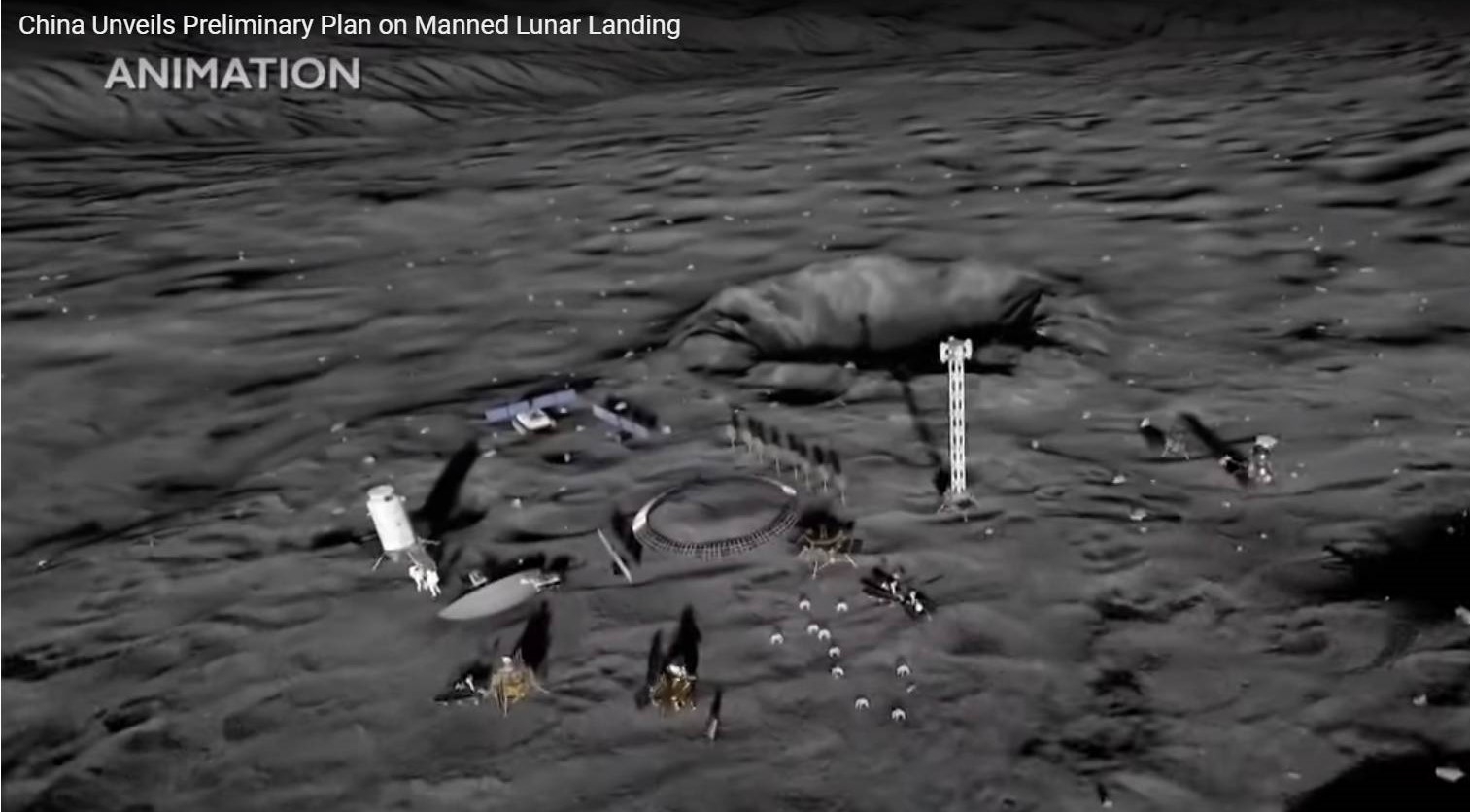
Image credit: CCTV/Inside Outer Space screengrab
The 130-ton class liquid oxygen kerosene rocket engine brought its cumulative test run time to 3,300 seconds after this recent trial, setting a new record for the longest trial of a single 100-tonne class engine in China, said the corporation.
According to CCTV, as the main engine for the country’s future crewed lunar missions, it needs higher comprehensive performance and reliability.
The trial broke the previous record for the longest test run which was achieved less than six months before this latest trial. Meanwhile, the trial working time of the engine exceeded its required mission working time by more than 10 times, which verified its reliability, the corporation said.
 Posted in Space News

