 By
By  March 9th, 2017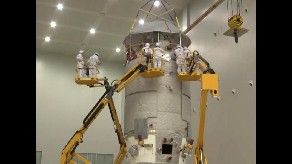
Tianzhou-1 supply ship is being readied for April launch.
Credit: CCTV-Plus
China’s state-run Xinhua news agency reports today that the final preparation for launching China’s first cargo spacecraft has begun.
The Tianzhou-1’s launcher has arrived at the Wenchang space complex.
Second phase
Tianzhou-1 is slated to be rocketed into Earth orbit atop a Long March-7, then dock with the now unoccupied Tiangong-2 space lab. A trio of dockings is planned between the space lab and the resupply vehicle.
Chinese space planners see the Tianzhou-1 mission, if successful, as moving into a second phase of their human space program.

China’s cargo ship will dock with the now-orbiting Tiangong-2 space lab and refuel that facility.
Credit: CMSE
Adding resupply to China’s space abilities is crucial to the country establishing a larger space station in the 2022 time period.
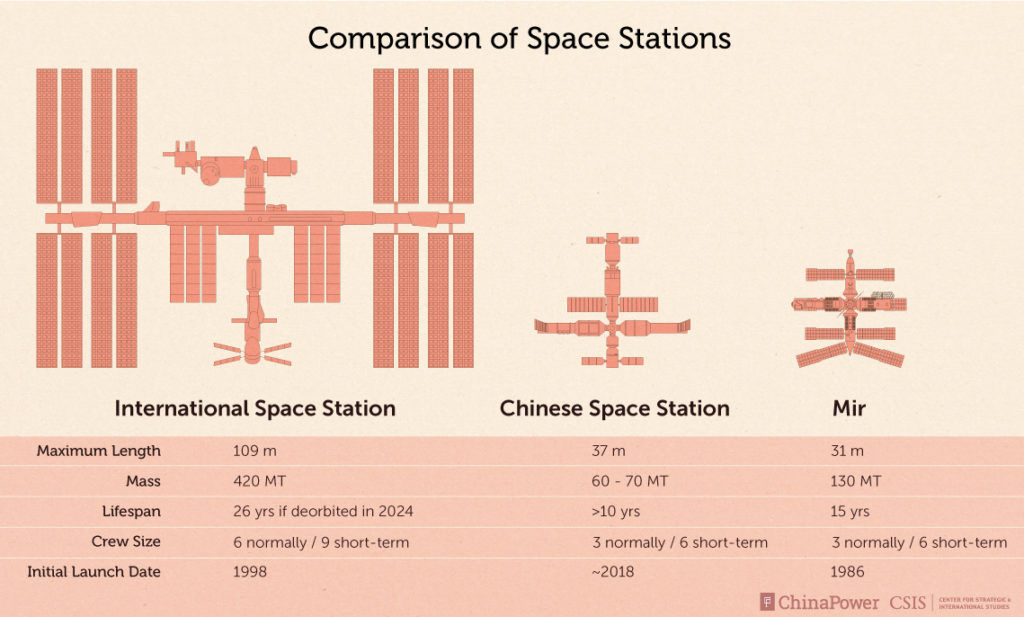
Credit: CSIS
Piloted Moon vehicle
Meanwhile, word is that China is pressing forward on a new piloted spacecraft – a “multi-purpose” crew vehicle capable of supporting human flight to the Moon.
Zhang Bainan, a chief designer of China’s spacecraft systems, is quoted in China’s Science and Technology Daily that the new vehicle can support a crew of six in low Earth orbit and three to four for Moon landing scenarios.
Back in June of last year, the maiden flight of the CZ-7 launch vehicle carried a subscale re-entry capsule of the multi-purpose crew vehicle. The test capsule was recovered in Inner Mongolia after 19 hours of flight in Earth orbit.

China’s prototype test capsule for larger multi-crew vehicle flew last year.
Credit: js7tv.cn
Multi-purpose crew vehicle
As reported by ChinaSpaceReport.com, the China Academy of Space Technology (CAST) has been developing a new-generation multi-purpose crew vehicle for future manned spaceflight missions to low Earth orbit and beyond.
The not-yet-named spacecraft will be capable of carrying 2 to 6 crew members to Earth orbit, the Moon, Lagrange Points, Near Earth Asteroids, and Mars. Two versions of the spacecraft based on the same crew module but with different propulsion systems have been proposed: a 14-tonne mass version for LEO and deep space missions, and a 20-tonne mass version for manned lunar landing, ChinaSpaceReport.com reports.
The multi-purpose crew vehicle will be launched atop the man-rated CZ-7 or CZ-5B launcher. For lunar landing and deep space missions, the spacecraft will need to carry up to 4 crew members. For ferry flights to the LEO space station, the spacecraft is required to carry up to 6.
Based on the concepts of future lunar landing and deep space missions, the spacecraft is required to be capable of operating independently on orbit for at least 21 days, or 2 years if docked with the space station. Two types of service modules can be used by the spacecraft to meet different mission requirements.
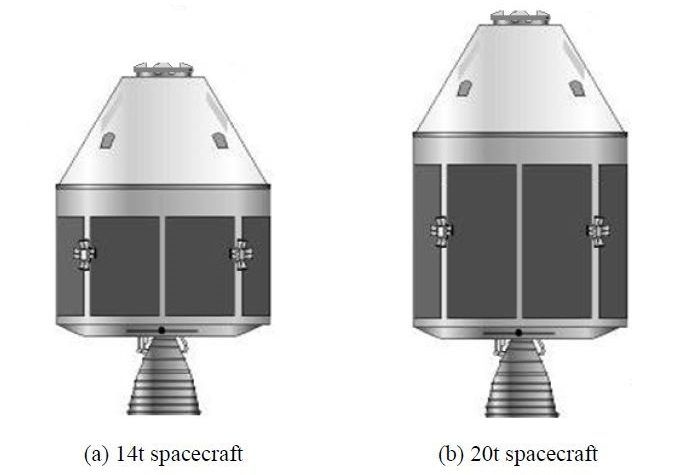
China’s multi-purpose piloted spacecraft, for low Earth orbit, the Moon…and beyond.
Courtesy: ChinaSpaceReport.com (used with permission)
Design features
ChinaSpaceReport.com drew from a Chinese Journal of Aeronautics paper, “Concept Definition of New-Generation Multi-Purpose Manned Spacecraft.”
Some of the proposed design features for China’s multi-purpose crew vehicle include:
— A two-module design, with a large habitable crew module at the front, and an uninhabitable cylindrical-shaped aft service module.
— The crew vehicle is twice the size of the Shenzhou re-entry module, capable of accommodating up to six astronauts.
— The spacecraft can be fitted with two different service modules, with different propulsion systems and propellant capacities.
— Instead of the bell-shaped re-entry module currently used by the Shenzhou spacecraft, the next-generation crew vehicle will have a blunt cone-shaped crew module, similar to that of the Boeing CST-100 or Orion CEV.
— The multi-purpose crew vehicle will be recovered at sea, at a location near the Earth equator off Chinese coast, while the land recovery capability is retained as backup.
Robotic moon mission
Zhang’s comments are prelude to an ambitious robotic lunar landing mission set for later this year.
Chang’e-5 is being readied for liftoff by a Long March-5 boost from Wenchang, a mission focused on landing, then gather lunar materials for return to Earth.

Hu Hao, the chief designer of the third phase of China’s lunar exploration program.
Credit: CCTV-Plus
According to Chinese news services, the over 8-ton Chang’e-5 is comprised of four parts: the “orbiter” “lander” “ascender” and a “returner” – an Earth reentry module.
If successful, the Chang’e-5 mission would be the first lunar sample return to Earth in over 40 years.
 Posted in Space News

