 By
By  November 16th, 2025
Image credit: CCTV/Inside Outer Space screengrab
Preparations for China’s Shenzhou-22 mission has moved into full swing – an action required to assure that the now-orbiting space station crew can be sustained, and in a safe manner.
Zhou Yaqiang, an official with the China Manned Space Agency (CMSA) explains that the mission for launching the Shenzhou-22 spacecraft “has been initiated, with preparations for all systems in full swing, including testing the spacecraft and rocket components and preparing the cargo,” Zhou told China Central Television (CCTV).

Image credit: CCTV/Inside Outer Space screengrab
“The Shenzhou-22 spacecraft is sure to carry supplies. The spacecraft’s cargo-carrying capacity is a highly valuable resource for the manned space program,” Zhou said, “so we will make full use of every opportunity. The Shenzhou-22 spacecraft will mainly deliver food supplies for the astronauts and some equipment for the space station.”
Uncrewed mode
Although not directly stated, it would appear that the Shenzhou-22 will be flown to the Chinese space station in an uncrewed mode.
Doing so would allow replacement of the unfit-for-reentry Shenzhou-20 craft, sure to be discarded uncrewed for trashing within the Earth’s atmosphere at a later date.
After more than a week’s delay, the Shenzhou-20 crew did return to Earth, using the trusted Shenzhou-21 spacecraft.
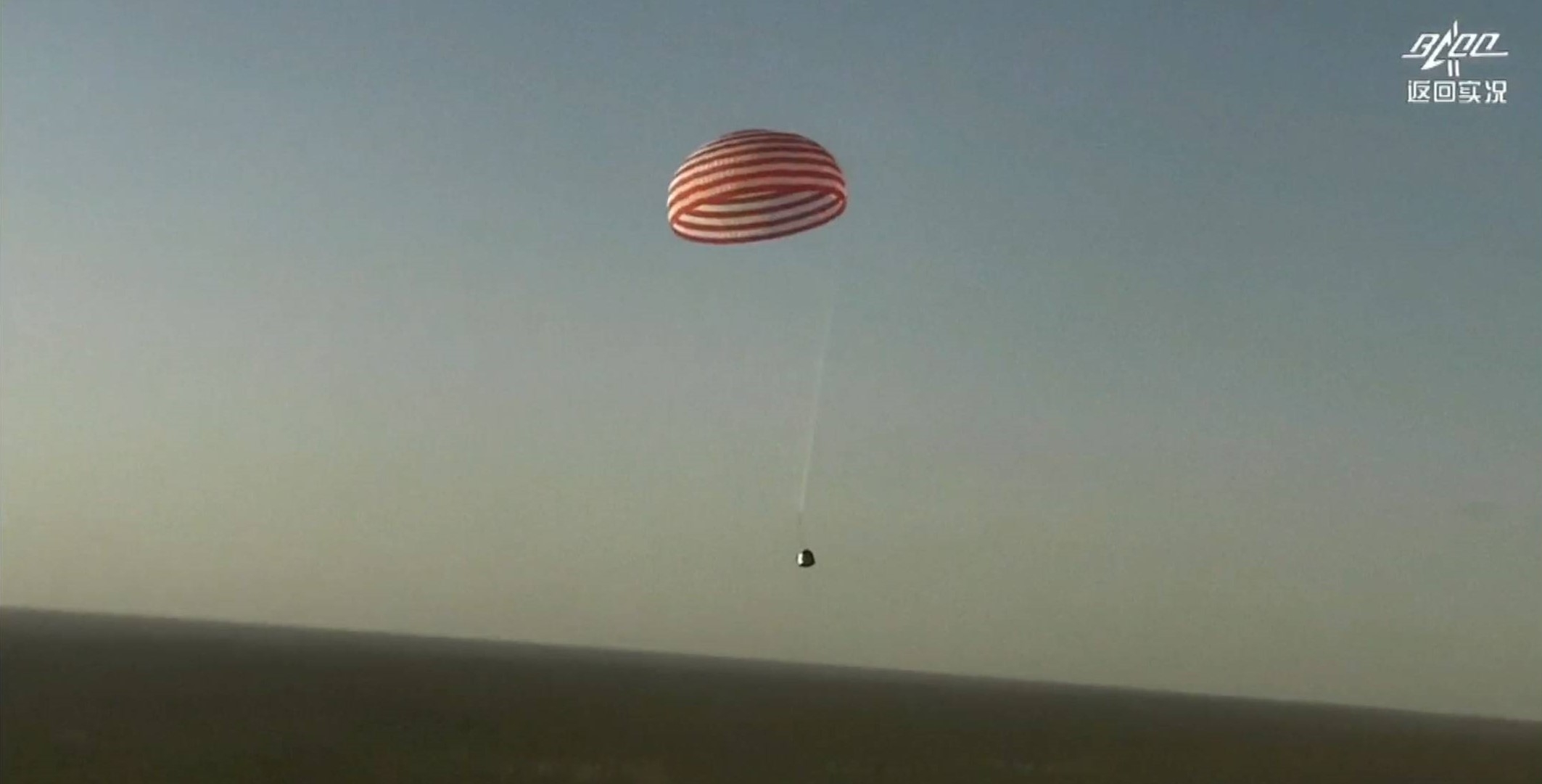
Image credit: CCTV/Inside Outer Space screengrab
Therefore, the current on-orbit crew was left tending a damaged vehicle that has been deemed unsafe for reentry.
Alternative return procedure
Meanwhile, at the Jiuquan launch site, technicians are hurriedly readying a Shenzhou-22 and its booster for flight (likely uncrewed) to the space station.

Meng Fanliang, an engineer at the Jiuquan Satellite Launch Center.
Image credit: CCTV/Inside Outer Space screengrab
According to Meng Fanliang, an engineer at the Jiuquan Satellite Launch Center:
“The return process [of the Shenzhou-20 crew] involved the coordinated efforts of tens of thousands of people across numerous departments and positions.”
Chinese space officials labeled the wave-off and delay to bring the Shenzhou-20 crew back to Earth as the first successful implementation of an “alternative return procedure” in China’s space station program history.
 Posted in Space News

