 By
 November 2nd, 2026
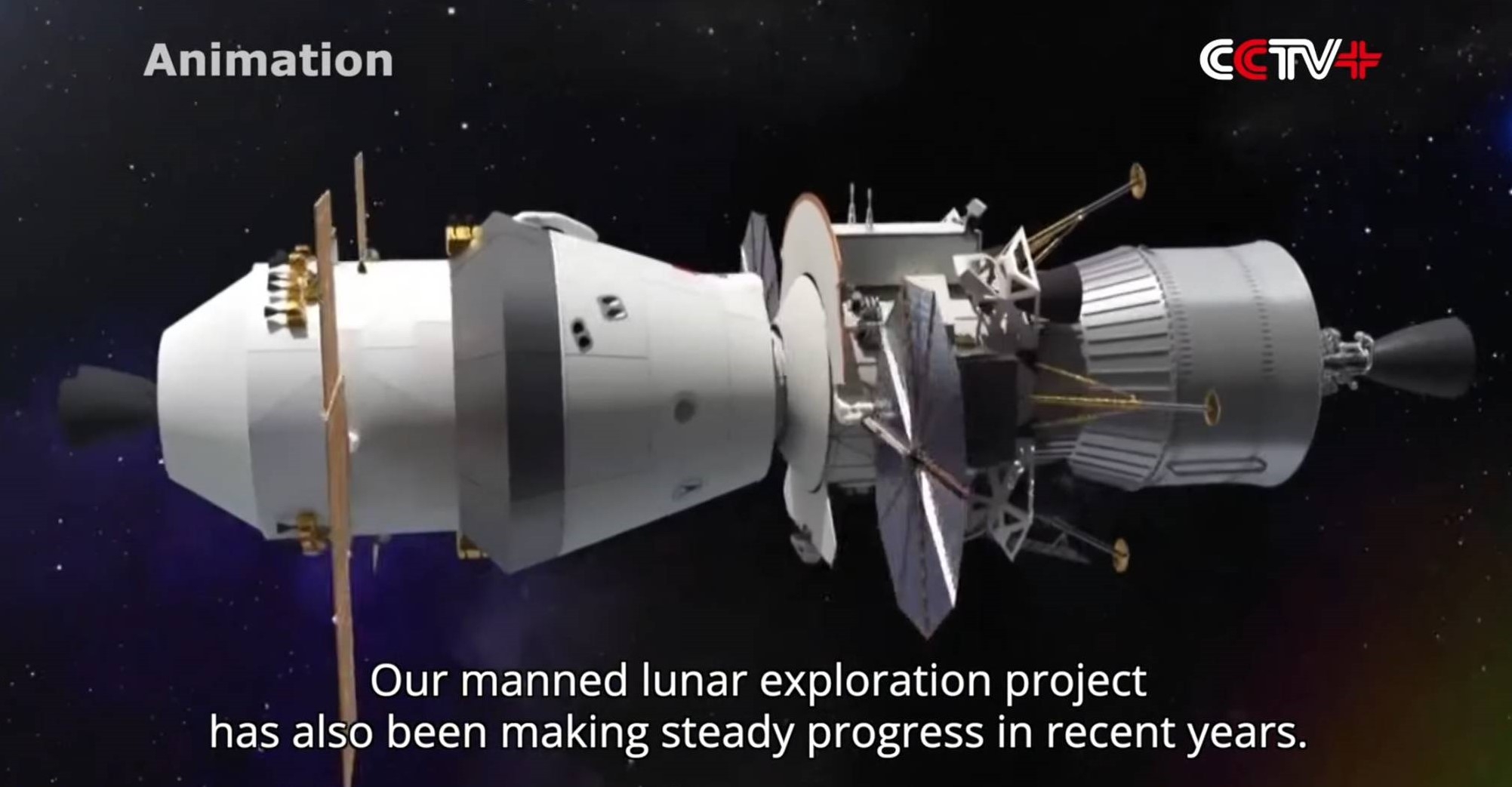
Image credit: CCTV/Inside Outer Space screengrab
China continues to chart its first crewed Moon landing before 2030, detailing current plans last weekend during the Seventh Manned Space Symposium in Beijing.
The two-day symposium drew more than 800 experts and scholars to explore how digital and intelligent technologies can advance human spaceflight.
Uncrewed test flights of the Mengzhou crewed spacecraft and the Lanyue lunar lander are planned ahead of a crewed Moon landing mission.
Safe and reliable
Wang Xiang, deputy chief designer of China’s manned space program, said a trio of astronauts will carry out the Moon mission, with two individuals landing on the lunar surface.
Image credit: CCTV/Inside Outer Space screengrab
“We will use the unmanned Lanyue lunar lander to verify all the key technologies throughout the entire crewed process as much as possible – including launch, entering the lunar orbit, rendezvous and docking with the Mengzhou spacecraft, landing and staying on the lunar surface, taking off again and re-docking with the crewed spaceship Mengzhou, so as to make sure the crewed flight will be safe and reliable,” Wang told China Central Television (CCTV).
Two Long March-10 carrier rockets will launch the Lanyue lunar lander and the Mengzhou spaceship in succession, then the two will conduct a rendezvous and docking in lunar orbit.
The Mengzhou can carry three astronauts between Earth and lunar orbit, with two of them riding the Lanyue lunar lander between lunar orbit and the lunar surface.

Image credit: CCTV/CMSA
China’s Moon landing initiative will carry out, as planned, the Long March-10 carrier rocket technology verification flight, the first flights of the Mengzhou spaceship and the Lanyue lunar lander, and important missions such as the robotic Chang’e-7 lunar lander.
Near-Earth validation
“When planning, we follow two principles,” Wang told CCTV. “First, for any task to be performed in lunar orbit, we will utilize the space station to conduct validation in near-Earth orbit whenever possible; second, for any crewed mission, we will try to fly it in an unmanned state first.”
To be utilized is the near-Earth version of the Long March-10 rocket to launch the near-Earth version of the Mengzhou spacecraft to perform space station missions in near-Earth orbit, added Wang, to validate the rocket’s basic technologies and the critical re-entry and return phases of the spacecraft.
“Then, we will use the lunar version of the Long March-10 rocket to launch the lunar version of the Mengzhou spacecraft to execute the lunar landing mission. This is a validation process for the rocket: near-Earth first, then the Moon,” said Wang.
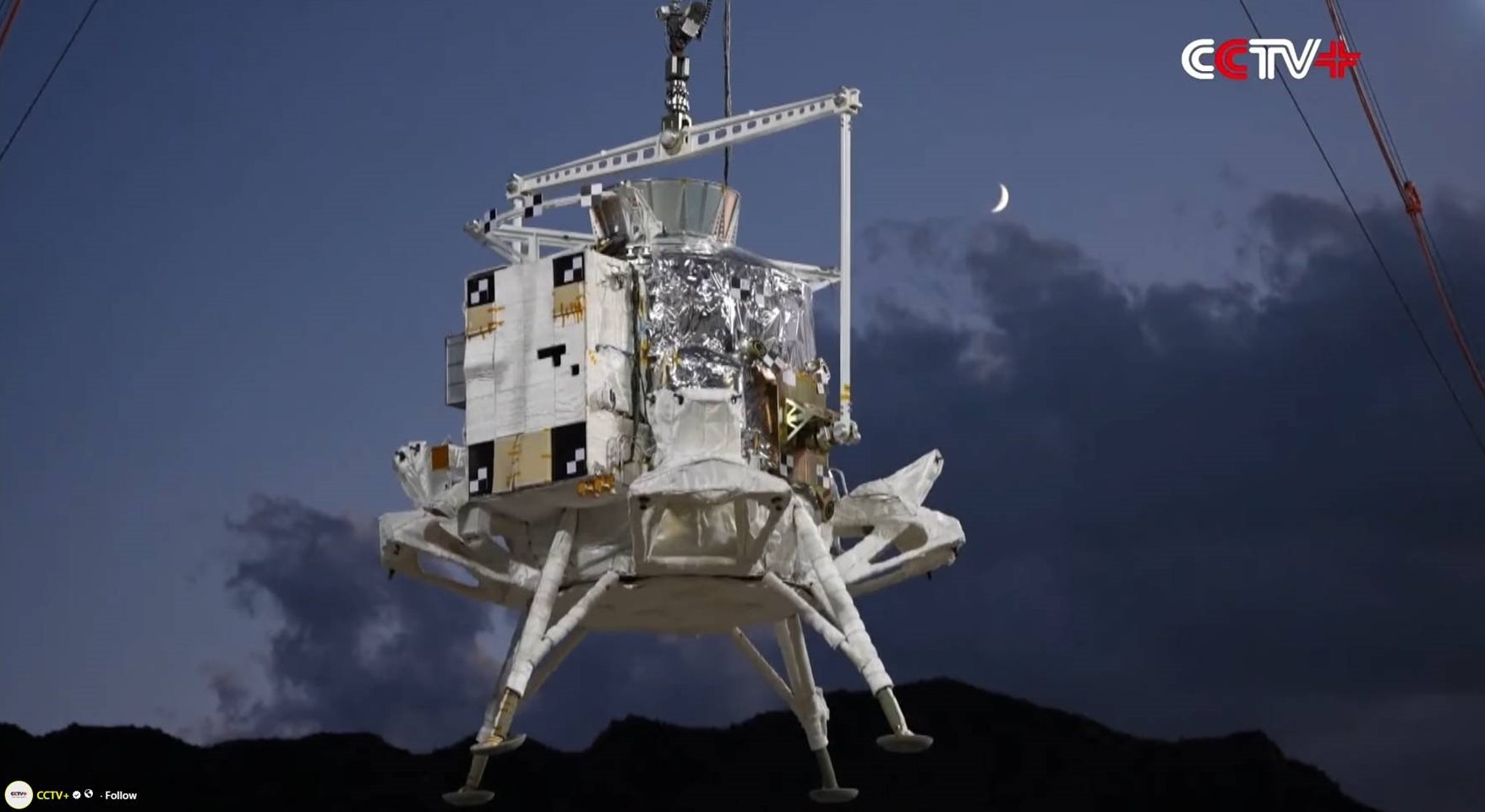
Lanyue lunar lander.
Image credit: CCTV/Inside Outer Space screengrab
Uncrewed Lanyue lander
The uncrewed flight mission of the Lanyue lander will allow for on-site collection of critical environmental data, including first-hand measured information on lunar surface temperature, lunar dust conditions, and the in-orbit performance of the spacecraft.
Wang said that the uncrewed flight mission of the Lanyue lander is also soliciting secondary payloads nationwide.
For a single mission, the total mass of the carried payloads will not exceed 50 kilograms, and the total power consumption will not exceed 100 watts.
“Because it is an unmanned mission, we will have some surplus resources, and we must make full use of them. Through a selection process, we will choose scientific experiment projects that are meaningful and necessary to be conducted on the Moon,” said Wang. “It is like giving them a ‘free ride’ to the Moon to conduct corresponding scientific experiments or technical explorations, achieving the goal of benefiting multiple parties with a single flight,” said Wang.
For a video detailing China’s current humans to the Moon program, go to:
 Posted in Space News

