 By
By  January 31st, 2026
A schematic diagram showing the planned location of the Sun-Earth L5 point for the “Xihe-2” spacecraft.
Image credit: Nanjing University
China has announced its intention to send its Xihe-2 probe to the Sun-Earth L5 point between 2028 and 2029.
Xihe-2 would carry out three-dimensional observations of the sun from entirely new wavelengths and perspectives, explains Fang Cheng of the School of Astronomy and Space Science at Nanjing University.
The probe would maintain orbital stability without consuming excessive energy, and is being designed to have a lifespan as long as 7 years.
Forecasting duties
From its Sun-Earth L5 position, Xihe-2 would observe solar active regions and perform forecasting duties, eyeing harmful space weather such as solar flares and coronal mass ejections. The spacecraft would provide more preparation time for any responses here on Earth.
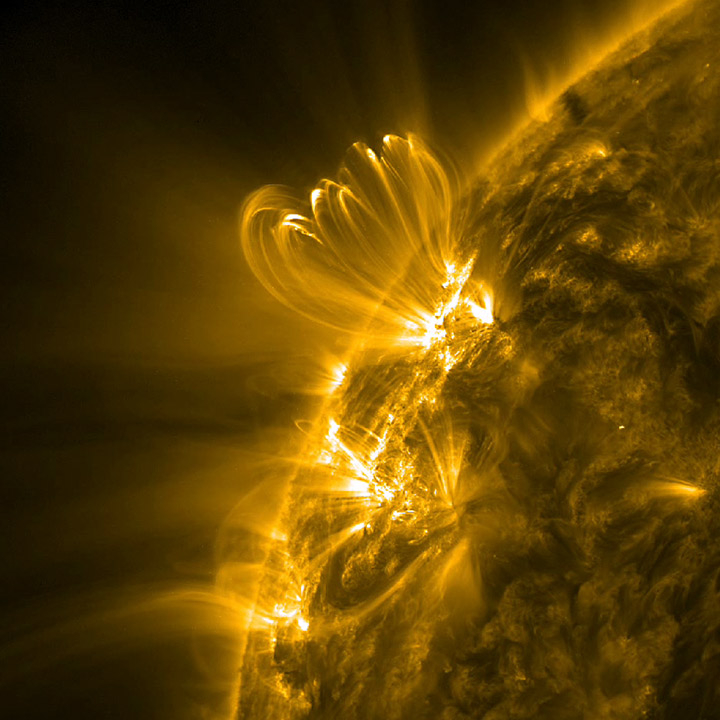
Earth’s Sun can toss out powerful solar storms that can impact infrastructure on Earth’s surface, in near-Earth orbit, including astronaut travel to and from the Moon and Mars.
Image credit: NASA’s Solar Dynamics Observatory, or SDO – NASA’s Living With a Star Program
“To date, humans have launched more than 70 solar probes, the vast majority of which are located along the Sun-Earth line, a few orbit the Sun, and no probe has yet stayed at the Sun-Earth L5 point. Therefore, ‘Xihe-2’ will provide humans with a completely new ‘observer’ perspective for studying the Sun,” said Li Chuan, chief designer of the Xihe spacecraft’s scientific and application system and professor at the School of Astronomy and Space Science of Nanjing University
Space-based solar exploration
Xihe-1 was lofted into Earth orbit in October 2021, China’s first solar exploration scientific and technological experimental satellite. That spacecraft opened the era of China’s space-based solar exploration.
According to the Xinhua News Agency, Xihe is the mother of the sun in the Classic of Mountains and Seas, the goddess who controls the rising and setting of the sun in the Chu Ci, and also an official title in ancient China for observing celestial phenomena and formulating calendars.
 Posted in Space News

