 By
By  September 30th, 2023
China’s Chang’e-6 lunar sample return mission elements.
Credit: CNSA
China Moon exploration planners are detailing the country’s next robotic lunar probe mission, the Chang’e-6 to be launched around 2024.
This Moon lander is to set down in the south pole-Aitken Basin on the lunar far side and gather lunar samples, then rocket the specimens to Earth.
According to the China National Space Administration (CNSA), Chang’e-6 operations are to be supported by a newly developed lunar relay satellite Queqiao-2, or Magpie Bridge-2, to be in position within the first half of 2024.
Similar to the successful Chang’e-5 return sample probe, Chang’e-6 will consist of four components: an orbiter, lander, ascender and Earth re-entry module. The Chang’e-6 will seek to retrieve one to two kilograms (4.4 pounds) of lunar samples.
If the mission succeeds, Chang’e-6 will mark the first returned samples from the Moon’s far side.

Photo taking during Chang’e-5 surface sampling.
Credit: CCTV/Inside Outer Space screengrab
International payloads
China has launched five lunar exploration spacecraft since 2007. The most recent mission, the Chang’e 5, landed on the Moon in December 2020, rocketing back to Earth 1,731 grams of lunar rocks and soil.
In addition, the Chang’e 4 mission deployed the Yutu 2 lunar rover, still operating for nearly five years, earning its stripes as the world’s longest-operating lunar rover.
“Chang’e-6 will collect samples and back to the Earth after that, so it won’t stay too long on the surface of the Moon,” said Tang Yuhua, deputy chief designer of Chang’e-7 mission with the Lunar Exploration and Space Program Center of the CNSA.
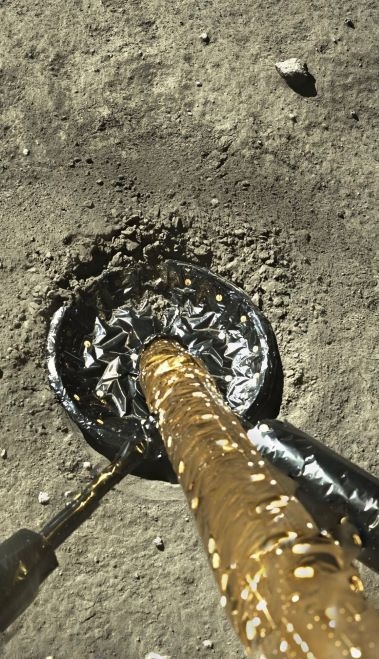
Landing leg of Chang’e-5 lander.
Credit: CNSA/CLEP
CNSA added that the Chang’e-6 lunar mission will carry payloads from France to detect radioactive gas radon, an Italian laser corner reflector to calibrate radar systems, a European Space Agency-provided negative ion detector, and a CubeSat, a square-shaped miniature satellite from Pakistan.
Near, far side differences
China Central Television (CCTV) reports that, originally, Chang’e-6 served as backup to the Chang’e-5 mission in case of failure.
The Queqiao-2 relay satellite is necessary to provide relay communication services as the Chang’e-6 lander, due to its far side site, will not have a direct communication link with Earth, said Wang Qiong, deputy chief designer of the Chang’e-6 mission.

Chang’e-5 return capsule holding lunar specimens.
Credit: National Astronomical Observatories, CAS
“There are very big differences between the near and far side of the Moon. The far side of the Moon is basically the ancient lunar crust and the lunar highlands, and many scientific discoveries will be found there,” said Li Chunlai, deputy chief designer of the third-phase lunar exploration project.

Wang Qiong, deputy chief designer of the Chang’e-6 mission.
Image credit: CCTV/Inside Outer Space screengrab
Wang added that for scientific considerations, “we need to obtain samples from different ages and regions. For engineering considerations, we mainly focus on the feasibility of the project. First, the slope must be relatively gentle, and second, it must be relatively flat, making it easy to land.”
Research station
As planned, the fourth phase of China’s lunar exploration program, including the Chang’e-6, Chang’e-7, and Chang’e-8 missions, is aimed to initially build a basic model of an international lunar scientific research station at the Moon’s south pole.
The Moon’s south pole is a region of extreme low temperature and complicated terrain containing low-lying crater pits and towering peaks. The intense sunlight and possible water ice existing in permanently shadowed regions is viewed as important to establishing a station at that location.

International Lunar Research Station. Image credit: CNSA
“There are some highlands in the south pole with very good lighting conditions. They may be covered by light for 70 to 80 percent of the time throughout the year. These locations are very conducive to scientific exploration. On the other hand, there are sunken pits in permanent shadows in the south sole. In these pits, there is no sunlight all year round. Scientists believe that water ice may exist in these places,” said Wang.
Countries around the world now regard the Moon’s south pole as a focus area for exploration, added Wang. “In the future, there will be multiple missions from many countries, such as the United States, Japan, and China, that have to land in the south pole. Therefore, the Moon’s south pole will become more and more crowded, and more and more detection modules will work here,” Wang told CCTV.

Credit: CNSA/CCTV/Inside Outer Space screengrab
Humans to the Moon
Meanwhile China is now developing a new carrier rocket and crewed spacecraft as part of its goal to land astronauts on the Moon by 2030. That booster, the Long March-10, is reportedly to make its inaugural flight in 2027.
Rong Yi, a rocket expert with the China Academy of Launch Vehicle Technology (CALT) under the China Aerospace Science and Technology Corporation (CASC), told CCTV that the Long March-10 uses liquid hydrogen, liquid oxygen and kerosene as propellants. It has a total length of about 92 meters; a takeoff weight of about 2,187 tons; a takeoff thrust of about 2,678 tons, and will have a carrying capacity of no less than 27 tons to be hurled on an Earth-Moon transfer orbit.

Rong Yi, chief designer of Long March-2F carrier rocket at China Academy of Launch Vehicle Technology (CALT).
Image credit: CCTV/Inside Outer Space screengrab
“At present, various research and development works are being advanced in an orderly and rapid manner. The typical feature of the carrier rocket is that it uses non-toxic liquid oxygen kerosene as propellant. The rocket has a core diameter of 5 meters and is bundled with a 5-meter-diameter booster. Therefore, its future carrying capacity for the Earth-Moon transfer orbit will be 27 tons, which is more than three times higher than that of the Long March-5,” said Rong, chief designer of Long March-2F carrier rocket at CALT.
The new piloted spacecraft is modular in design, consisting of an escape tower, a return capsule and a service module to meet the needs of near-Earth and deep space missions, CCTV reports.
 Posted in Space News

