 By
By  December 25th, 2020
China’s space station to be operating in the 2020’s. Credit: CCTV
China is set to launch the core module of the country’s first space station in the first half of next year.

Zhou Jianping, chief designer of China’s manned space project.
Credit: CCTV/Inside Outer Space screengrab
“We’ve basically completed the development of the core module of the space station as well as the Long March-5B Y2 rocket which will carry the module in the launch. The tests are in the final stage. We’ll start the verification of key technologies and the construction work of China’s space station next spring,” Zhou Jianping, chief designer of China’s manned space project told China Central Television (CCTV).
After the core module is orbited, China will launch the Tianzhou-2 cargo spacecraft and the piloted Shenzhou-12 spacecraft. The astronaut crew will stay in space for several months before the launch of Tianzhou-3 and the piloted Shenzhou-13.
Credit: CMS/CCTV/Inside Outer Space screengrab
Verification testing
“During this period, we will carry out comprehensive verification of the new technologies of the space station, including astronauts’ spacewalk, robotic arms and energy technologies,” Zhou said in a China Daily report.
Following the completion of all verification work and the start of using key technologies, two more cargo spacecrafts and two additional piloted missions are to be launched.

Testing of Tianhe core module.
Credit: China Manned Space Agency (CMS)
The astronauts for the four flights of constructing the space station have been chosen and are undergoing training.
The space station is expected to be finished around 2022.
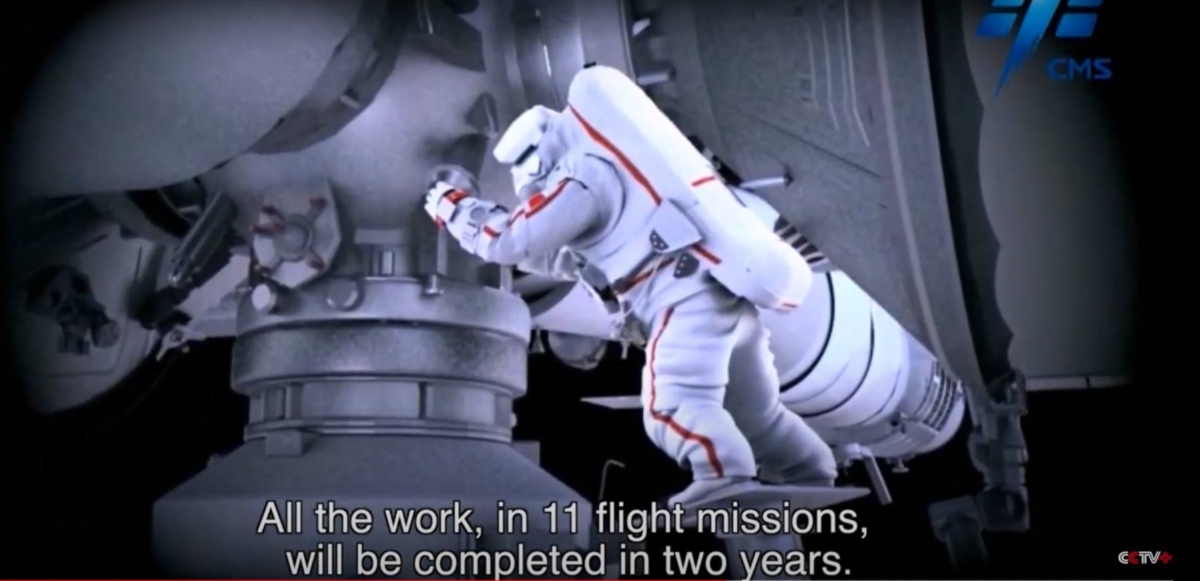
According to the schedule, CCTV adds, “China will conduct 11 spaceflight missions in the next two years to complete the building of Tiangong, a space station that is independently constructed and operated by China, together with multiple retrieval missions and verification of key on-orbit technologies.”
 Posted in Space News

