 By
By  April 12th, 2024
Pre-launch photo of lunar relay satellite.
Image credit: CCTV/CNSA/Inside Outer Space screengrab
The China National Space Administration (CNSA) announced on Friday the Queqiao-2 completed a communication test on April 6, linking up with the already on the Moon Chang’e-4 far side lander/rover hardware.

Image credit: CCTV/Inside Outer Space screengrab
Additionally, the new relay spacecraft communicated with the Chang’e-6 lunar probe still here on Earth and expected to be launched next month. This far side lander — in a historic first if successful – is built to snag, bag and rocket back to Earth select lunar specimens, similar in technological scope of the Chang’e-5 Moon sampler mission.
Meanwhile, two communication and navigation technology test satellites, Tiandu-1 and Tiandu-2, also completed near-moon braking and entered their respective circumlunar orbits.

Tiandu-1 and Tiandu-2 subsatellites are to trial-run lunar communications technology.
Image credit: DSEL
Long life span
“The success of the Qiaoqiao-2 mission means it can provide relay communication services for more probes to be launched for lunar surface exploration missions,” Xiong Liang, one of the developers for Queqiao-2 satellite, told China Central Television (CCTV).

Image credit: CCTV/Inside Outer Space screengrab
China’s Queqiao-2, weighs about 1.2 tons and is in a highly elliptical orbit to perform Earth-Moon communications tasks. Queqiao-2 was launched on March 20, and then entered its target highly elliptical orbit on April 2 after midway correction, near-Moon braking and orbital maneuvering around the Moon.
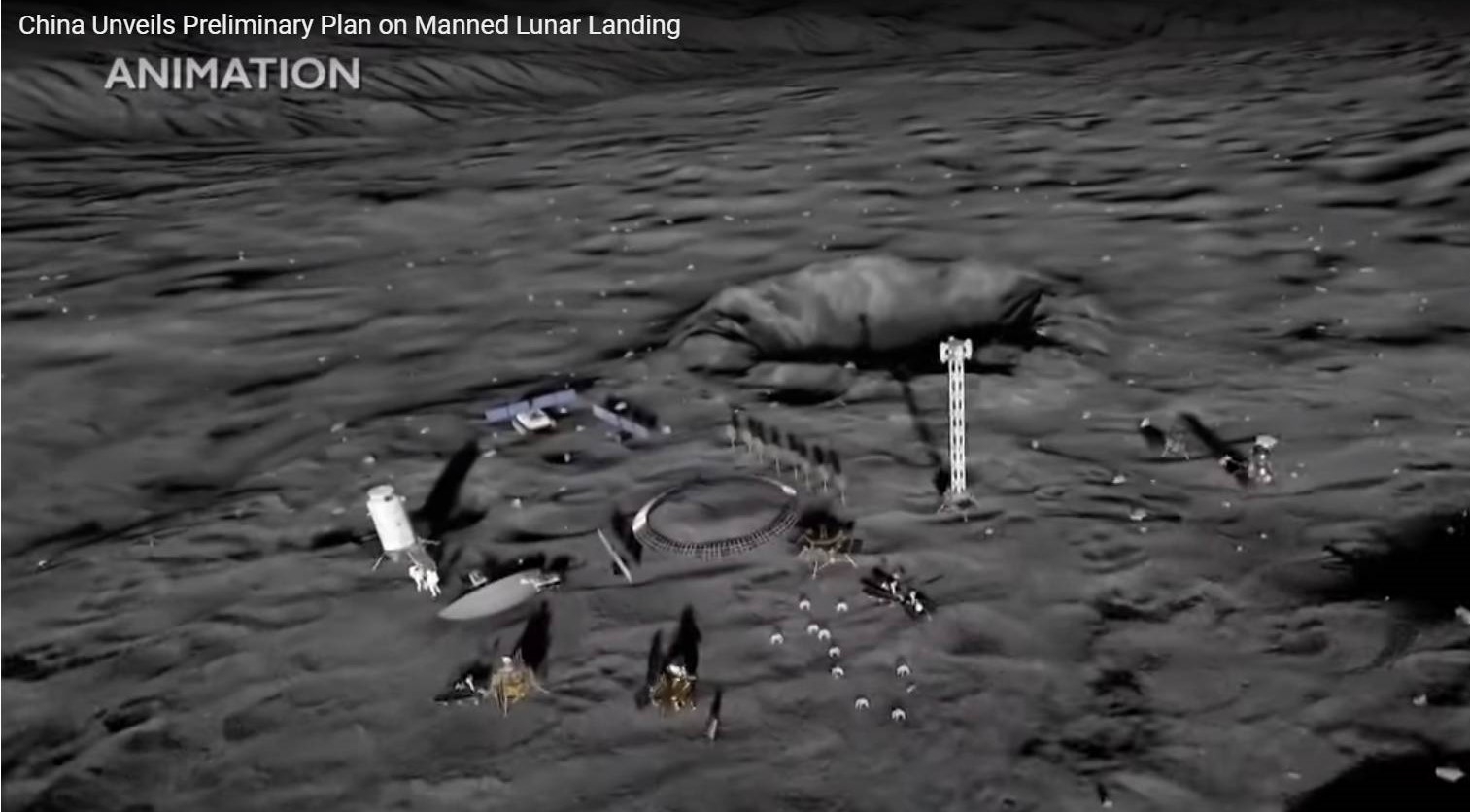
Artist’s view of International Lunar Research Station to be completed by 2035. Credit: CNSA
“Considering its long-term space mission, Queqiao-2 is designed with a long life span of eight years in order to complete all its missions,” Zhang Kuang, an engineer with the Beijing Aerospace Flight Control Center, told CCTV.
The Chang’e-6 is expected to be launched in the first half of 2024, reports CCTV.
China’s Chang’e-7 is to head moonward around 2026, with Chang’e-8 to be launched in a projected 2028 time period. These back-to-back Moon explorers signal the start up of orchestrating China’s lunar research station activities.
Go to this informative video at:
https://www.facebook.com/NewsContent.CCTVPLUS/videos/976621627182476/

Image credit: CNSA/CCTV/Inside Outer Space Screengrab
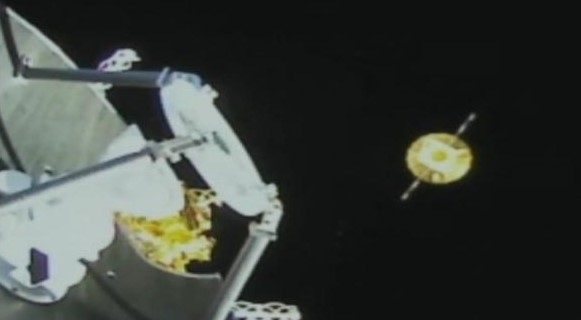
China’s Queqiao-2, or Magpie Bridge-2, is released from a Long March 8 carrier rocket.
Image credit: CNSA

Early image captured on April 8 by Tiandu-2, an experimental satellite launched on Queqiao-2 mission.
Image credit: CNSA
 Posted in Space News

