 By
By  October 10th, 2020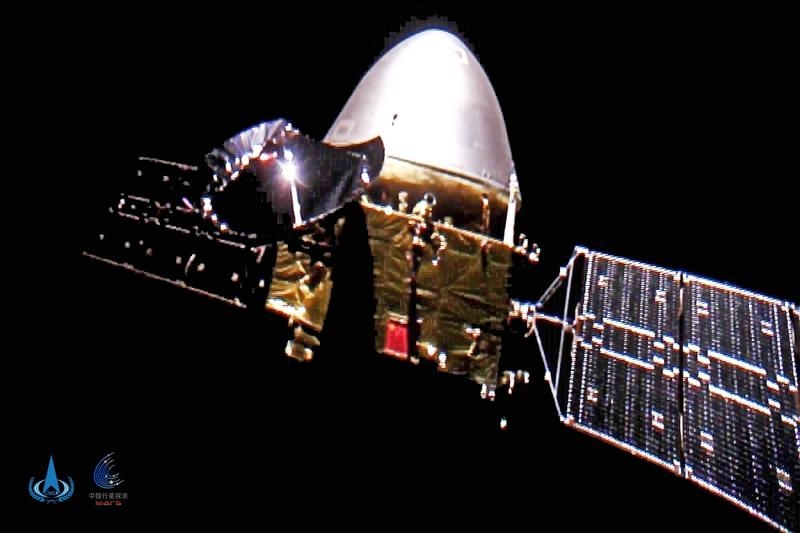
En route China Mars probe Tianwen-1 is seen in this post-launch selfie taken by an ejected micro-camera.
Credit: CNSA/CLEP
China’s Tianwen-1 Mars spacecraft performed a major in-flight trajectory adjustment on Friday night.
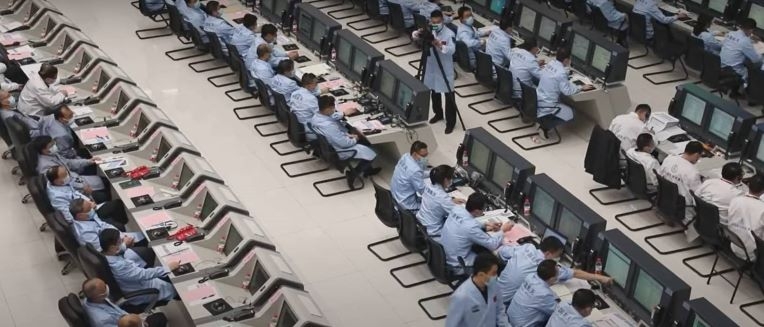
Credit: New China TV/XinhuaVideo/Inside Outer Space screengrab
The roughly eight-minute (480 seconds-plus) main engine burn was commanded by ground controllers at the Beijing Aerospace Control Center.
The Mars probe’s main engine produces 3,000 newtons of thrust power.

Credit: New China TV/XinhuaVideo/Inside Outer Space screengrab
Transfer trajectory
China Daily reports that the craft will continue traveling about four months in an Earth-Mars transfer trajectory toward the red planet and will conduct two to three more orbital corrections before entering Mars’ gravitational field, citing sources at the China National Space Administration.
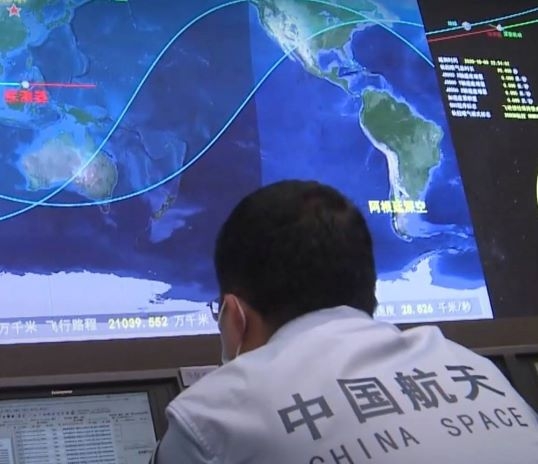
Credit: CCTV Video News Agency/Inside Outer Space screengrab
Tianwen-1 is expected to be captured by Mars’ gravity at the beginning of 2021.
“The biggest challenge in tonight’s operation was that the 3,000-newton-thrust engine would need to work for a relatively long period of time under very high pressure and temperature,” said Rao Wei, project manager for Tianwen-1 at China Academy of Space Technology, adding that the long-distance control and tracking was also a major challenge, reports China Daily.
By Friday night, Tianwen-1 had traveled more than 210 million kilometers, Rao said, adding that the spacecraft is in good condition. The probe has previously performed two midcourse orbital corrections.
Credit: CCTV Video News Agency/Inside Outer Space screengrab
Orbital inclination
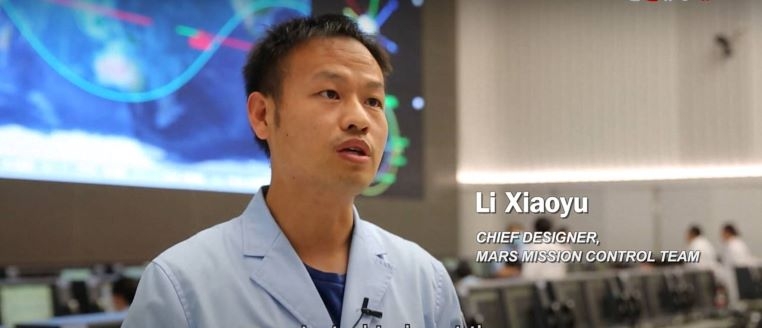
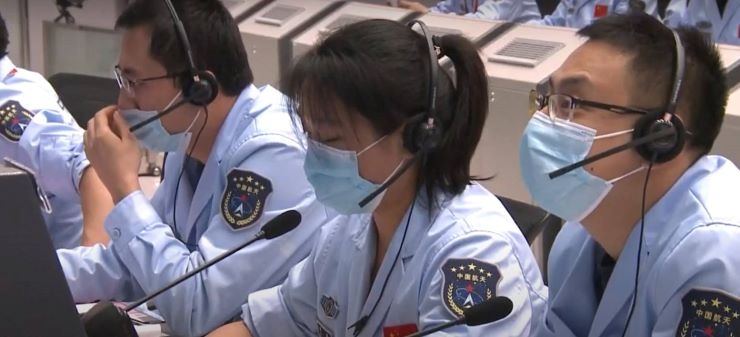
Li Xiaoyu, chief designer, Mars Mission Control Team, told China Central Television (CCTV): “According to the time sequence of the flight procedure, we started to input these instructions and data in batches from three days before the maneuver.”
Credit: CCTV Video News Agency/Inside Outer Space screengrab
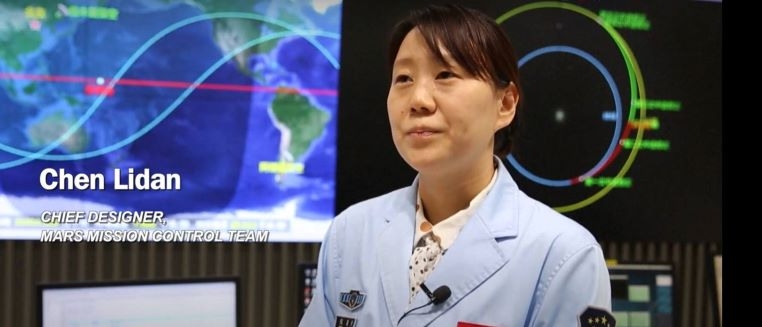
The current orbital inclination of Mars is about 1.8 degrees, said Chen Lidan, a chief designer of Mars Mission Control Team. “For the current orbit of Tianwen-1, the inclination is about 1 degree. That is to say, the mission is getting farther from Mars while it is flying, so we have to adjust the inclination, mainly to adjust orbital inclination.”
Credit: CCTV Video News Agency/Inside Outer Space screengrab
Cui Xiaofeng, head, Mars Mission Control Team, added that the main tasks in the flight progress are self-checks of the various equipment on the probe, including the lander segment. “The self-check can confirm that they are in normal working condition, so that the subsequent work is able to be correctly implemented,” Cui said in a XinhuaVideo interview.

Credit: CCTV Video News Agency/Inside Outer Space screengrab
May landing
China launched Tianwen-1 on July 23 from the Wenchang Space Launch Center in Hainan province.
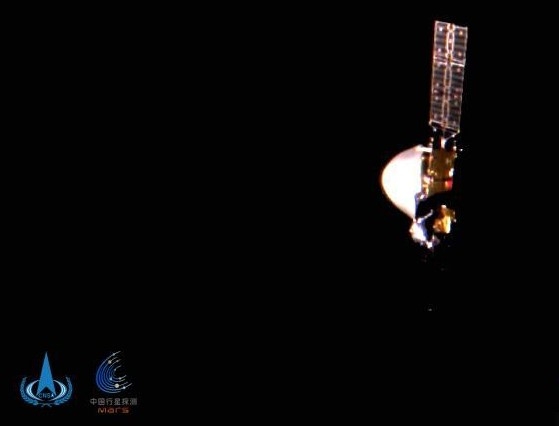
China Mars probe Tianwen-1 is seen in this post-launch selfie taken by ejected micro-camera.
Credit: CNSA/CLEP
The 5-metric-ton spacecraft is a three-in-one vehicle, consisting of an orbiter, lander, and rover.
After locking into Mars orbit in February, the mission’s key objective is to soft-land the lander/rover around May 2021 on the southern part of Mars’ Utopia Planitia.
Go to these videos that spotlight China’s Tianwen-1’s latest maneuver at:
New China TV
https://www.youtube.com/watch?v=ByjyafqFN0U
CCTV Video News Agency
 Posted in Space News


How does the orbit parameter prior to engine firing compares with the new orbit parameter after engine firing?
To reach mars with the desired precision how do you account for the increasing importance of planet mars as the spacecraft is getting closer to the red planet?
What is the value of the delta V, speed variation, to succeed this last manoever.