 By
By  December 28th, 2024
Image credit: CCTV/Inside Outer Space screengrab
China has approved new lunar sample research applications from institutions, permitting them to borrow samples returned by both the country’s Chang’e-5 and Chang’e-6 missions.
According to China’s Xinhua news agency, a total of 8,550.4 milligrams of lunar samples will be lent to 18 researchers from 16 research institutions, such as the China University of Geosciences (Beijing), the University of Hong Kong, the Macau University of Science and Technology, Beihang University and Wuhan University – among others.

Image taken during the 2020 mission of Chang’e-5 lunar sample mission.
Image credit: CNSA/CLEP
Back-to-back missions
The country’s Chang’e-5 mission in December 2020 brought to Earth about 1,731 grams of lunar samples.
China’s Chang’e-6 lunar mission collected 1,935.3 grams of samples from the far side of the Moon, parachuting those specimens to Earth on June 25 of this year.

China’s Chang’e-6 lander/ascender in far side sampling scenery.
Image credit: CNSA/CLEP
Research station
China is also set to construct an international lunar research station (ILRS) with a network linking the moon’s south pole, equator and far side.
The ILRS is a scientific experimental facility, projected to be built in two phases: a basic model to be built by 2035 within the lunar south pole region, and an extended model to be built by about 2050, according to space planners.
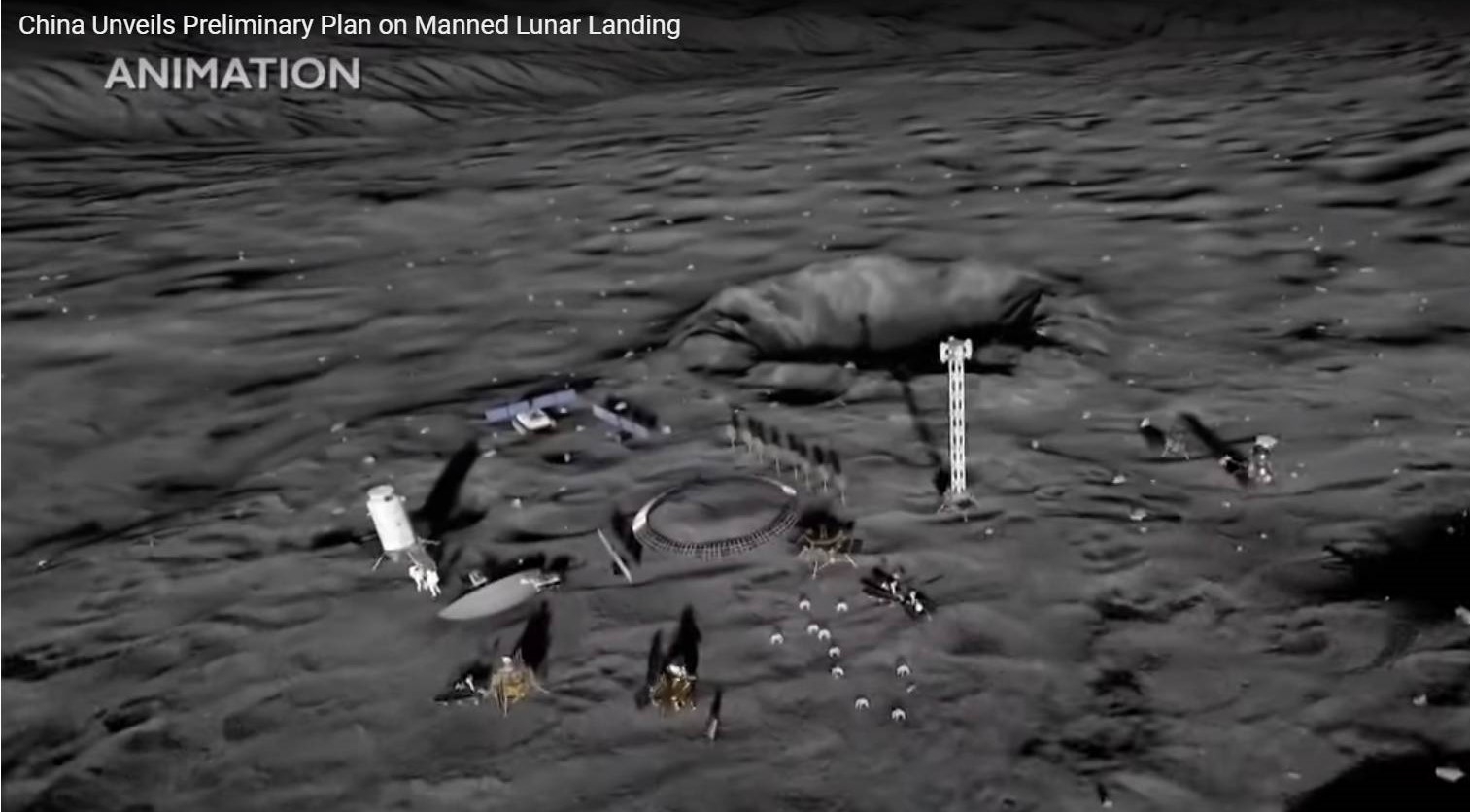
Artist’s view of International Lunar Research Station. Image credit: CNSA
Exhibition opens
Meanwhile, an exhibition featuring Chang’e-5 lunar samples was opened to the public today in Beijing.
In addition to 0.6 grams of lunar soil brought back by the Chang’e-5, the exhibition also showcases lunar samples collected by U.S. Apollo 17 moonwalkers and lunar meteorites from Northwest Africa, highlighting their use in appraising the Moon’s formation and evolution.
Go to this video that spotlights the Beijing lunar exhibit at:
 Posted in Space News

