 By
By  November 12th, 2022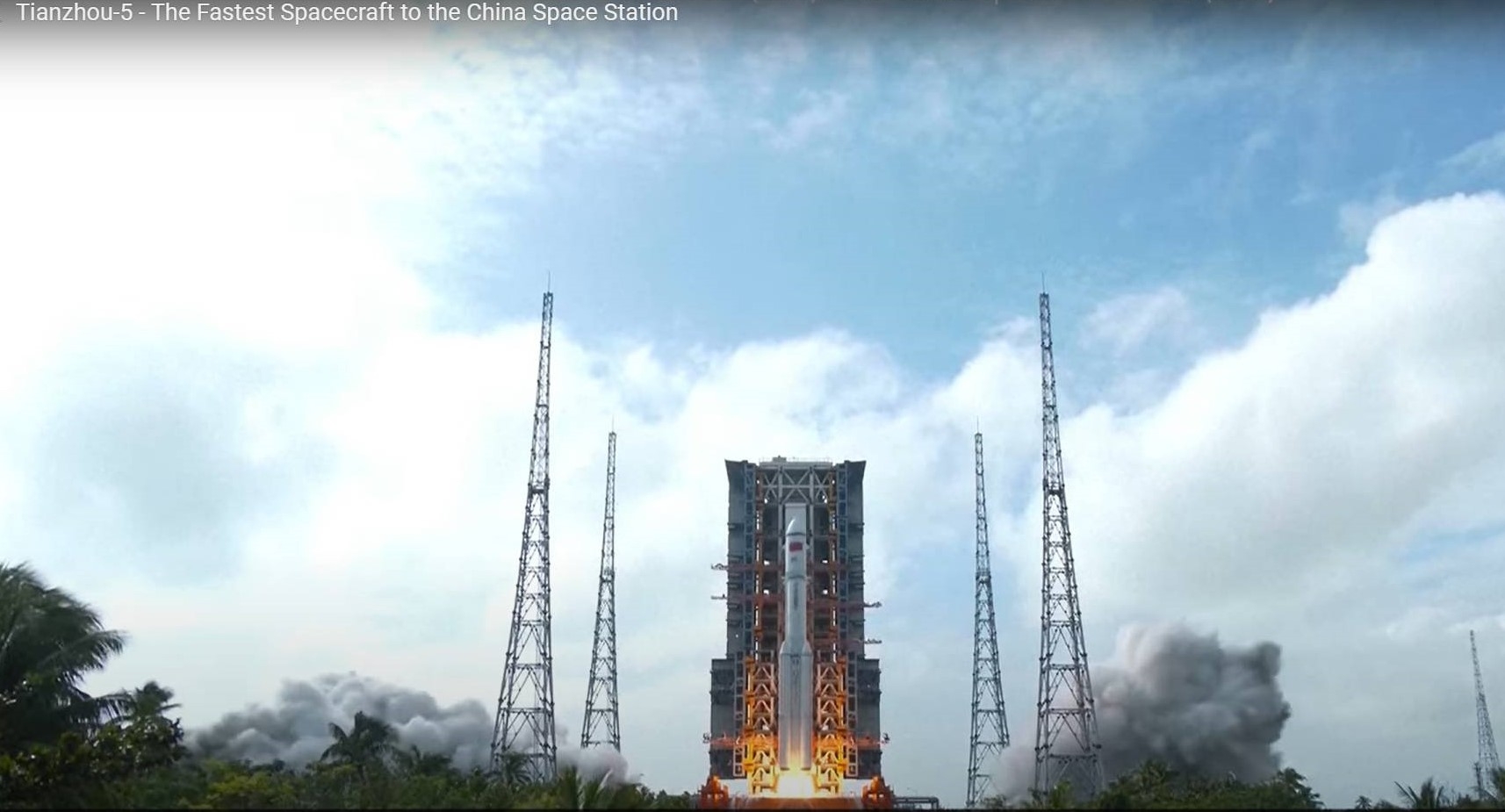
Credit: CCTV/Inside Outer Space screengrab
Another milestone in China’s construction of the country’s space station was reached on Saturday – the launch, rendezvous and docking of the uncrewed Tianzhou-5 cargo craft.
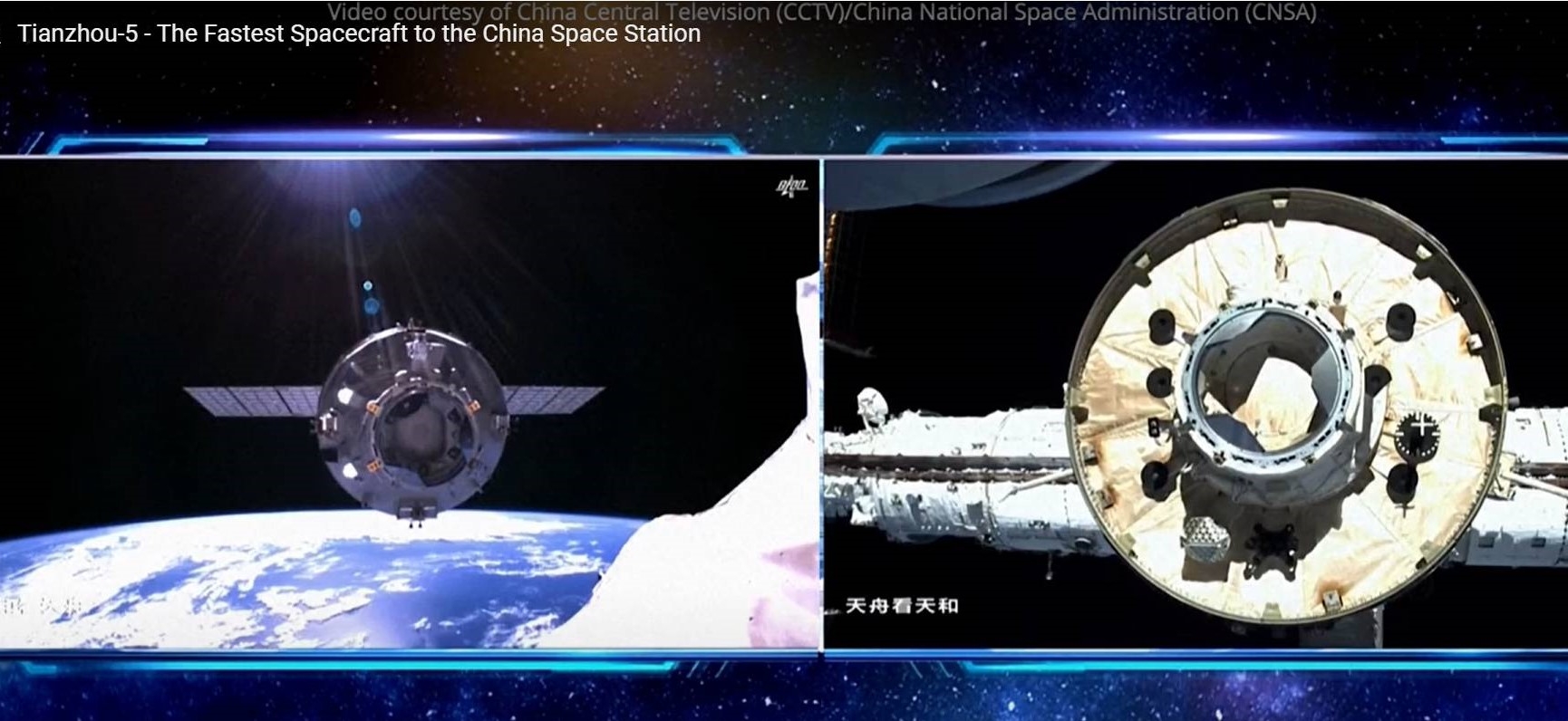
The Tianzhou-5 was launched via a Long March-7 Y6 rocket from the Wenchang Spacecraft Launch Site in the southern island province of Hainan, and carried out an auto-pilot latch up with the rear docking port of the Tianhe space station core module.
Fast track
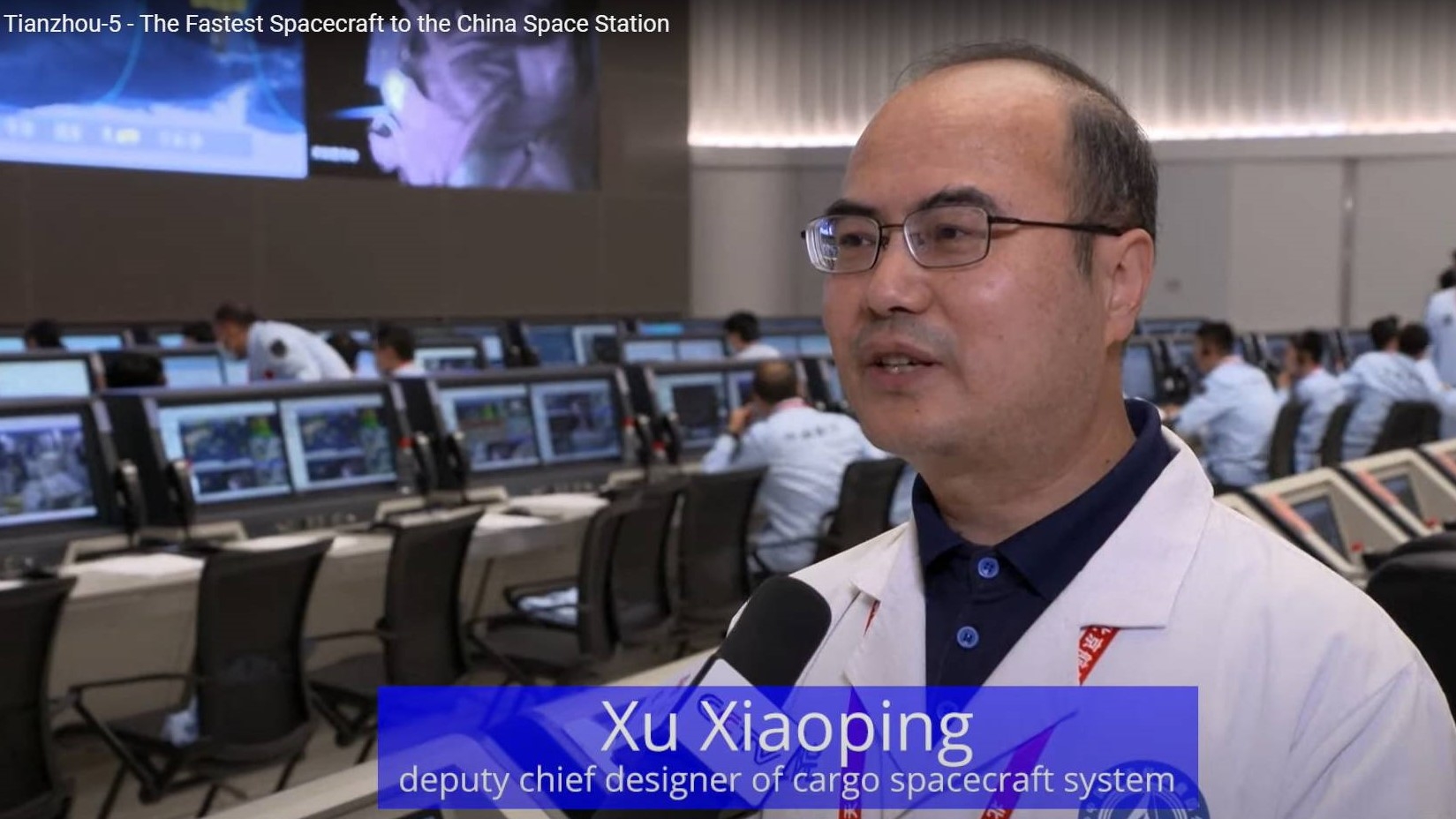
“This is the first time we completed fast automated rendezvous and docking in two hours,” said Xu Xiaoping, deputy chief designer of the cargo spacecraft system, the Fifth Academy of China Aerospace Science and Technology Corporation.
Credit: CNSA/CCTV/Inside Outer Space screengrab
“The whole rendezvous and docking process took about two hours, which is the fastest rendezvous and docking technology in the world,” Xu told China Central Television (CCTV).
Credit: CCTV/Inside Outer Space screengrab
The cargo spacecraft is loaded with around 5 tons of supplies, mainly equipment for scientific experiments. Onboard the supply vessel, around 5 tons of goods and materials, a manifest that includes 1.4 tons of propellant for the space station complex.
Also onboard are test projects including a science popularization satellite, a space hydrogen and oxygen fuel-cell system, and broad-energy-spectrum high-energy particle detection equipment.
These new supplies will help support three yet-to-be-launched astronauts on the upcoming Shenzhou-15 mission for their six-month orbital stay.

Credit: CCTV/Inside Outer Space screengrab
Speeding up the procedure
“In the beginning, the rendezvous and docking would take two or three days. And then the time was reduced to 6.5 hours when we launched the Tianzhou-3 and the Tianzhou-4. This time, the Tianzhou-5 completed the fastest rendezvous and docking. Our technologies have been improved step by step through each launch,” said Zhang Zhenhua, deputy chief designer of the cargo spacecraft system at the China Academy of Space Technology.
Two measures were utilized to shorten the time of Tianzhou-5’s docking, greatly speeding up the procedure compared to a past 6.5-hour process.
First, the multi-turn flight in the process of long-range guidance was cut to half a turn, according to CCTV. Multiple orbit changes were reduced to two integrated maneuvers, thereby reducing this process from about four hours to about one hour.

Credit: CCTV/Inside Outer Space screengrab
Second, the number of mooring points in the close-range autonomous control segment was reduced, which cut the duration of this process from over two hours to about 40 minutes.
World record
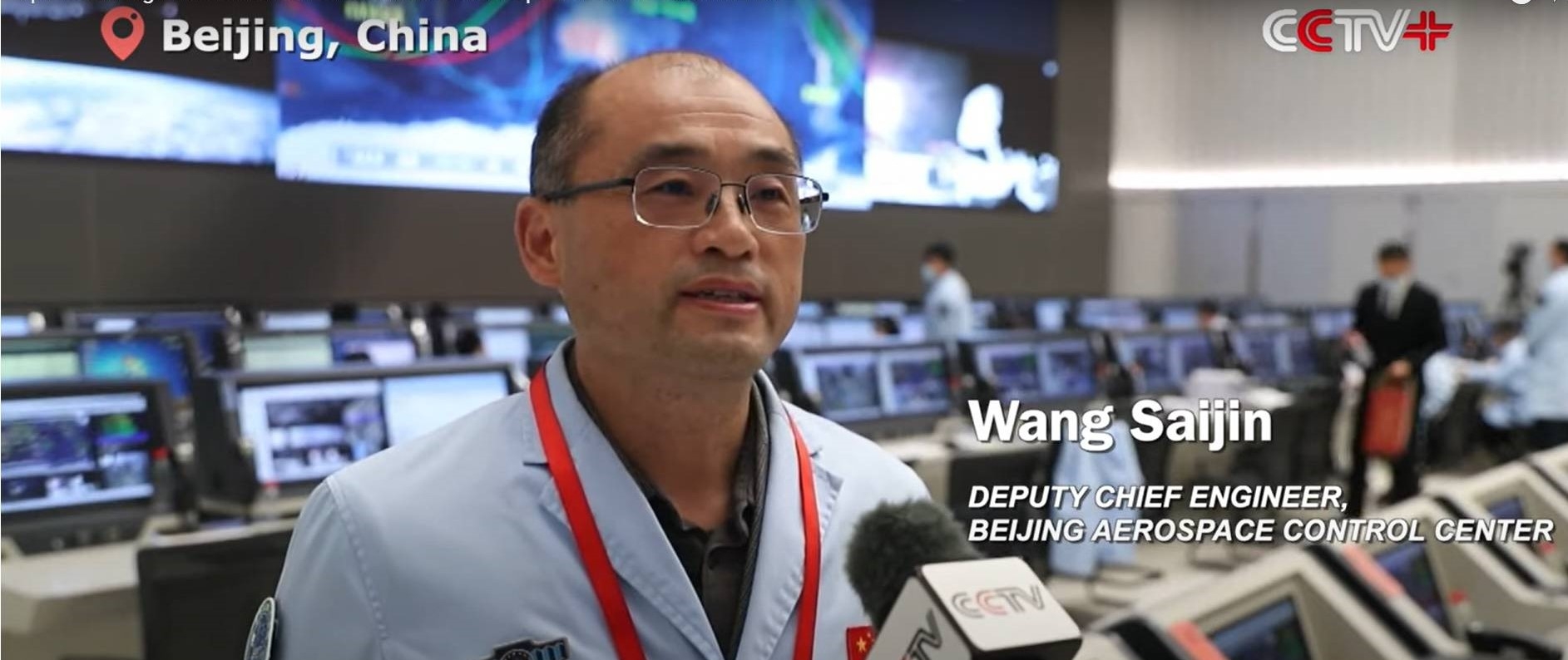
“On the one hand, the accuracy of launching rocket into orbit was required to be higher,” said Wang Saijin, deputy chief engineer of the Beijing Aerospace Control Center. “On the other hand, there was higher requirement for the thrust calibration of the cargo spacecraft engine. It is also very important that we implemented the phase modulation control of the Tiangong space station complex to ensure higher-precision phase modulation control and meet the requirement the orbit injection accuracy,” Wang told CCTV.
Credit: CCTV/Inside Outer Space screengrab
Xu Xiaoping, deputy chief designer of the cargo spacecraft system at the Fifth Academy of China Aerospace Science and Technology Corporation, added:
“This is also the first time that China’s cargo craft has completed a fast automated rendezvous and docking in about two hours, setting a world record. It is of great significance to promoting China’s space rendezvous and docking to a higher level, and to enhancing the emergency supply capacity for the space station,” Xu said.

China’s space station expected to be completed around 2022.
CMS/Inside Outer Space screengrab
Up next: first in-orbit crew rotation
China launched the space lab module Mengtian on Oct. 31, taking the construction of the country’s space station into the final stage, on track for complex completion by year’s end.
With the core module Tianhe and lab modules Wentian and Mengtian, the space station has formed a three-module T-shape structure. Such a structure is the planned layout at the space station’s completion. There has been indication of adding more structure to the complex in the future.
The country plans to launch the Shenzhou-15 crewed spaceship later this year. The Shenzhou-14 and Shenzhou-15 crew members will conduct the first in-orbit crew rotation in China’s space history.
To view an array of videos of the launch and docking of the Tianzhou-5 cargo spacecraft, go to:
 Posted in Space News

