 By
By  November 16th, 2022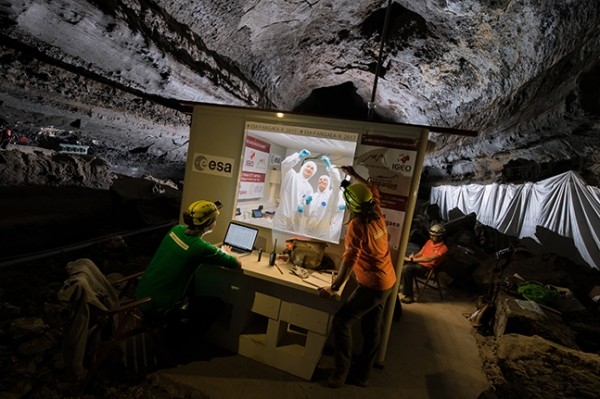
Real-time DNA sequencing in a lab installed in the Corona Lava Tube (Lanzarote, Canary Islands, Spain) in the framework of the ESA PANGAEA-X 2017 Astronaut training program. ESA astronaut Matthias Maurer is inside the lab module with co-author Ana Miller.
Credit: ESA
Until the last two decades, the potential for caves beyond Earth was principally theoretical.
Today, databases of subsurface access points (SAPs) exist for the Moon and Mars.
Across the solar system, 3,545 SAPs have been identified on 11 planetary bodies with “speleogenic processes” identified on another four bodies. Speleogenesis is the origin and development of caves.
Cave-forming processes
A new research paper – “Planetary Caves: A Solar System View of Processes and Products” – showcases six cave-forming processes beyond Earth that have been identified.
These processes include volcanic (cryo and magmatic), fracturing (tectonic and impact melt), dissolution, sublimation, suffusion, and landslides.
“As more orbiter and fly-by platforms with high-resolution instrumentation probe the solar system, our knowledge regarding caves beyond Earth will become more robust—culminating with the robotic and perhaps human exploration of caves on the Moon and Mars,” the paper notes.

Location of candidate caves in the Tharsis region on Mars.
Credit: USGS
Mars underground
According to Jut Wynne, assistant research professor of cave ecology at Northern Arizona University and lead author of the paper:
“Caves on many planetary surfaces represent one of the best environments to search for evidence of extinct or perhaps extant lifeforms,” Wynne said in a university statement.
“For example, as Martian caves are sheltered from deadly surface radiation and violent windstorms, they are more likely to exhibit a more constant temperature regime compared to the surface, and some may even contain water ice. This makes caves on Mars one of the most important exploration targets in the search for life,” Wynne said.
To view the paper – “Planetary Caves: A Solar System View of Processes and Products” – go to:
https://agupubs.onlinelibrary.wiley.com/doi/10.1029/2022JE007303
 Posted in Space News

