Archive for the ‘Space News’ Category
 Author:
  January 22nd, 2025
What Are UFOs? – Can science reveal the secrets of mysterious objects seen in our skies?
That’s the central theme of a new NOVA program premiering tonight, January 22, at 9 pm on PBS television stations.
“For decades UFOs have captivated the public, even as many scientists saw them as too taboo to investigate. Now, after highly publicized sightings of unidentified objects by Navy pilots, UFOs are moving out of the shadows and into the light, as NASA pledges to study them scientifically,” explains A NOVA statement.
Investigating the strange objects
“So what does science have to say? Though some are identified as balloons or drones, weather phenomena, or optical illusions, others remain mysterious. Could they be the result of secret new technology developed by other governments – or our own? And what would it take for alien engineers to traverse vast distances to send probes or visit Earth from other solar systems?”

Credit: DOD/U.S. Navy/Inside Outer Space screengrab
The Corporation for Public Broadcasting’s NOVA series is a primetime science series focused on “demystifying the scientific and technological concepts that shape and define our lives, our planet, and our universe.”
What Are UFOs? This television production explores the evidence, as astrophysicists and engineers use new technologies to investigate the strangest objects in our skies.
For this broadcast, go to this free access documentary at:
https://www.pbs.org/wgbh/nova/video/what-are-ufos/?
 Posted in

ESA’s LightShip tug promises to open a market of low-cost missions to Mars for a broader community.
Image credit: ESA
The European Space Agency is sparking a new initiative, one that aims at small-scale missions to explore the Red Planet.
An element of the ESA LightShip propulsion tug concept is engaging select groups to independently scope out what a small, low-cost Mars satellite platform looks like as a LightShip passenger.
ESA’s LightShip is a propulsive tug, or interplanetary transfer service. It would provide the propulsive nudge for a passenger spacecraft to transfer to Mars and enter Mars’ orbit.
LightShip would also host the Mars Communication and Navigation Infrastructure (MARCONI) offering a dedicated data relay service.

Image credit: ESA
Potential passengers
The four consortia – led by Argotec, Deimos Space, Politecnico di Milano with SITAEL, and Redwire respectively – will explore the potential of passenger spacecraft platforms that could be delivered to Mars by the LightShip propulsive tug.
Explains Claire Parfitt, Mars Exploration Study Team Lead in ESA’s Directorate of Human and Robotic Exploration and technical officer of the activity: “ESA’s LightShip concept aims to open up access to Mars for a wider community than is usually the case.”
Moreover, Parfitt added, “the nature of LightShip is such that it makes us open to international partnerships as well.”

The Red Planet as seen by Europe’s Mars Express.
Image credit: ESA/D. O’Donnell – CC BY-SA IGO
The LightShip concept kicks off an ESA Explore2040 strategy for future Mars missions. “In 2026, we plan to use the results from this study to investigate full exploration mission concepts. Those concepts could be future passenger candidates for LightShip,” said Parfitt in an ESA statement.
Use cases
In the main LightShip study, “use cases” to support missions to the Moon, asteroids, and other destinations are to be appraised.
According to ESA, further development of the mission will depend on decisions made at the next ESA Council at Ministerial Level in November 2025.
If given the go-ahead, the first LightShip mission is foreseen in 2032, with subsequent launch windows open in 2035 or 2037.
Future LightShip missions will carry different passenger spacecraft to be decided by the science and exploration communities.

Image credit: NASA
Paradigm shifts
ESA’s LightShip initiative would seem compatible with a NASA report issued late last year: Expanding the Horizons of Mars Science – A Plan for a Sustainable Science Program at Mars – Mars Exploration Program 2024-2044.
NASA released the document that calls for programmatic paradigm shifts in further exploration of the Red Planet over the next 20 years. Those paradigm shifts underscored in the document include lower-cost Mars missions.

A range of less-expensive landers, rovers and aerial vehicles are foreseen to help advance a sustainable human presence on Mars.
Image credit: Keck Institute for Space Studies (KISS)/Chuck Carter (Used with permission)
Eric Ianson, then Director of the NASA Mars Exploration Program (now retired) states in that report there’s need to “challenge conventional thinking and look to new and creative solutions for the exploration of Mars.”
This can include “seeking lower-cost science investigations, strengthening our infrastructure around Mars, seeking new enabling technologies, and creating an environment that broadens participation in Mars exploration,” Ianson explains.

Image credit: CCTV/Inside Outer Space screengrab
The trio of crewmembers onboard China’s Tiangong space station will soon begin spacewalking tasks. According to the China Manned Space Agency (CMSA), the Shenzhou-19 crew is moving forward on preparations for their second set of extravehicular activities (EVAs).
According to the CMSA, the three astronauts — Cai Xuzhe, Song Lingdong and Wang Haoze — are “creating optimal conditions for the upcoming spacewalk.”
In a video released on Monday, the crew is shown conducting checks of their spacesuits and practicing mechanical arm operations in orbit.

Image credit: CCTV/Inside Outer Space screengrab
Rehearsing spacewalk duties
Two crew members are assigned the spacewalk duties, rehearsing their tasks in their spacesuits inside the space station.
Shenzhou-19 astronauts arrived at Tiangong in late October.
As noted by China Central Television (CCTV), in their first EVAs on December 17, Cai Xuzhe and Song Lingdong set a new world record for the longest single spacewalk, spending nine hours outside the orbital outpost. Tasks included the installation on the space station of protection devices against space debris.
For a video describing their preparations for the upcoming spacewalk, go to:

A historical “uh-oh” space exploration moment in 2004 as the Genesis return capsule suddenly met Utah desert at nearly 200 miles per hour. Image credit: NASA
In the beginning…there was a thud. It was an unwanted sound and one that resonated around the world.
Think back over 20 years ago to September 8, 2004. That’s when NASA’s Genesis return sample capsule slammed into an isolated part of the U.S. Army’s Dugway Proving Ground in Utah. It was an unintended, full-stop, smashing occasion.

Image credit: NASA
But now, over two decades later, call it “late breaking” news.
For more information, go to my new Space.com story – “20 years after crashing in the Utah desert, NASA’s Genesis mission is still teaching us about solar wind” – at:

Image credit: NASA/JPL-Caltech

Image credit: NASA

Image credit: SpaceX
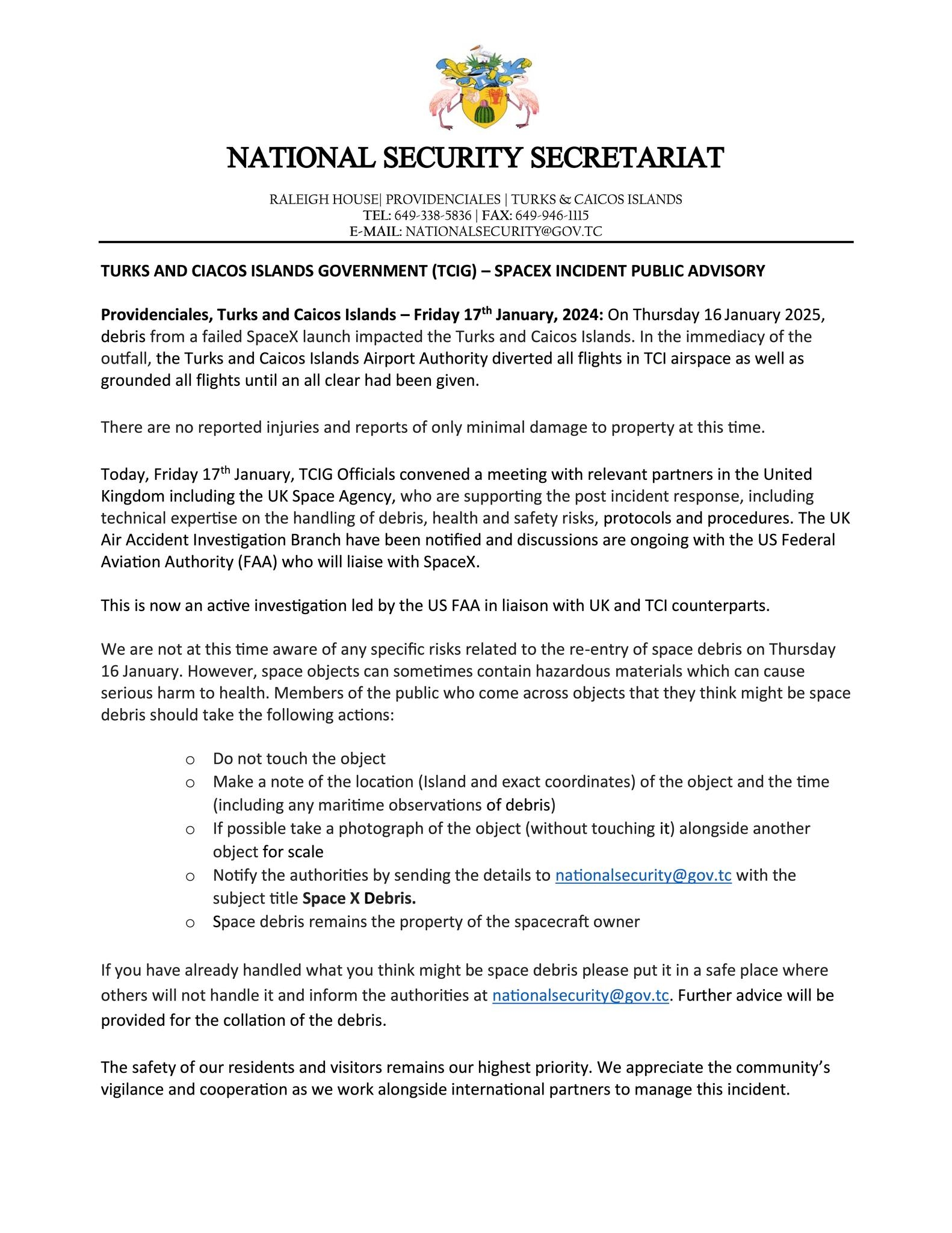
The Federal Aviation Administration (FAA) is requiring SpaceX to perform a mishap investigation into the loss of the Starship vehicle during launch operations on January 16.
“There are no reports of public injury, and the FAA is working with SpaceX and appropriate authorities to confirm reports of public property damage on Turks and Caicos.”
During the Starship 7 destructive event, the FAA activated a Debris Response Area and briefly slowed aircraft outside the area where space vehicle debris was falling or stopped aircraft at their departure location.

Starship 7 leftovers arc into the Atlantic near the Turks and Caicos Islands.
Image credit: Dean Olson
Several aircraft requested to divert due to low fuel levels while holding outside impacted areas, said the FAA in a statement, called preliminary and subject to change.
Root cause
As background, the FAA mishap investigation is designed to enhance public safety, determine the root cause of the event, and identify corrective actions to avoid it from happening again.
“The FAA will be involved in every step of the SpaceX-led mishap investigation process and must approve SpaceX’s final report, including any corrective actions,” the FAA stated. “A return to flight is based on the FAA determining that any system, process, or procedure related to the mishap does not affect public safety.”
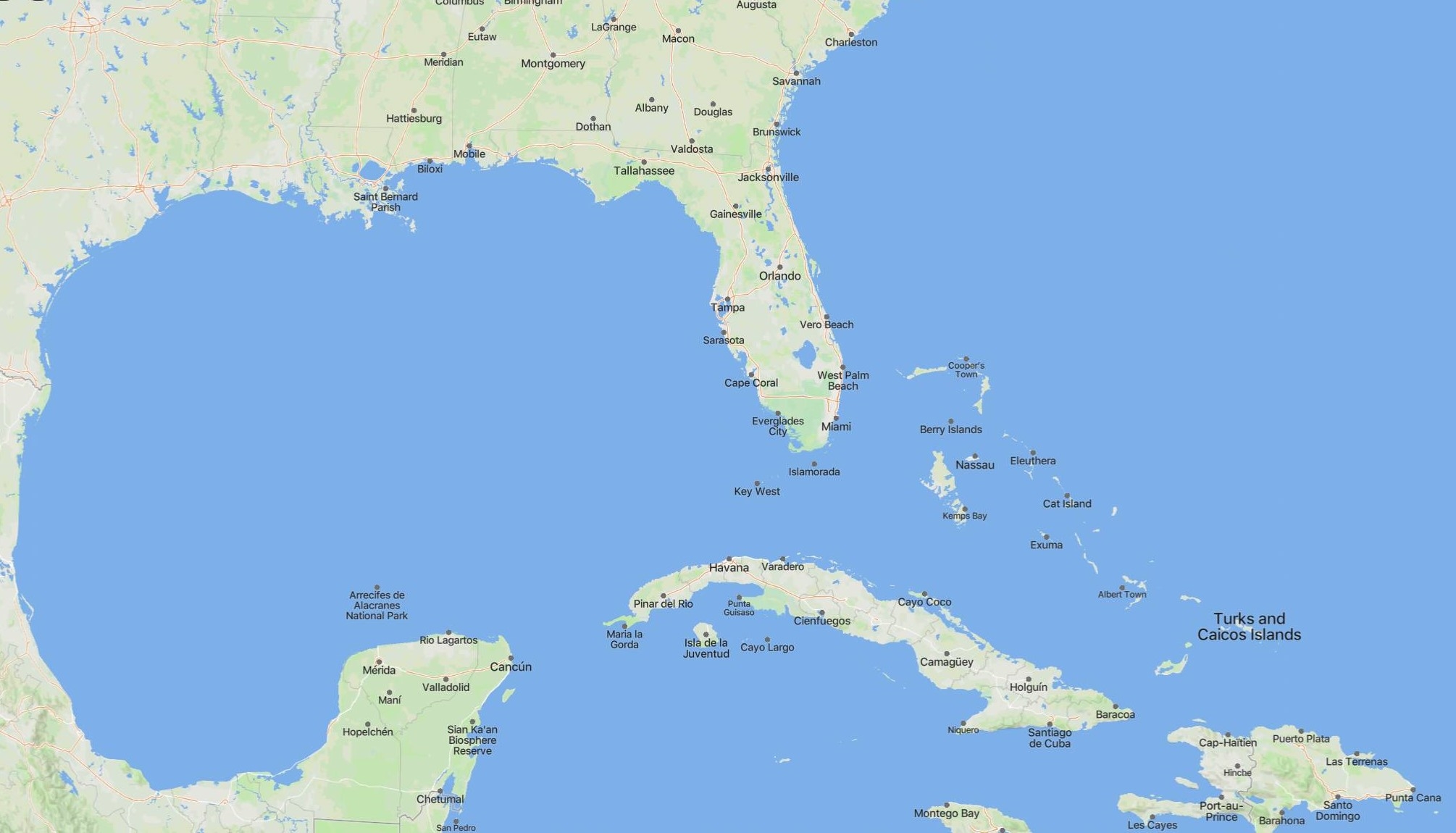
Image credit: Mapcarta/Inside Outer Space screengrab
Sonic booms
In addition, the FAA noted that a Debris Response Area is activated “only if the space vehicle experiences an anomaly with debris falling outside of the identified closed aircraft hazard areas. It allows the FAA to direct aircraft to exit the area and prevent others from entering.”
Meanwhile, Johns Hopkins University (JHU) seismologists report that they recorded sonic booms caused by the explosion of SpaceX’s Starship rocket, which were strong enough to be felt in the Caribbean.
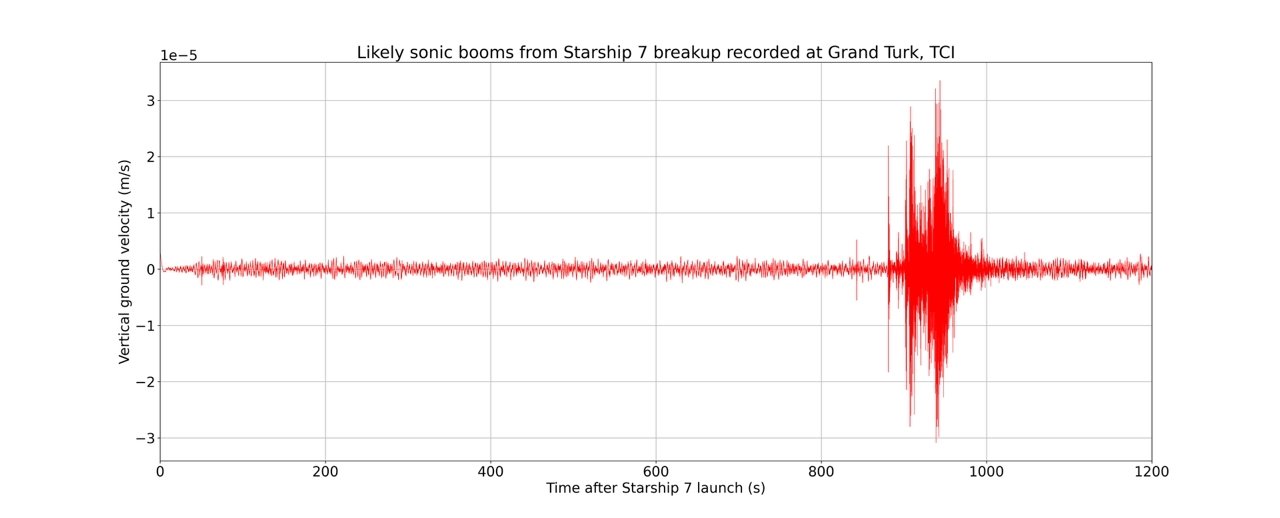
Image credit: JHU
Go to Scott Manley’s excellent and detailed video of the flight test at:
SpaceX’s New Starship Upgrade Puts On Amazing Show As Space Debris
Image credit: SpaceX
The seventh flight test of the SpaceX Starship took place on Thursday, January 16.
Departing from the SpaceX Starbase site in Texas, the Elon Musk “MAGA rocket” mission ended with the destruction of the Starship 7 test vehicle, with debris arcing into the Atlantic near the Turks and Caicos Islands.
The Super Heavy booster/Starship did separate with the booster returning to Starbase, A major milestone of the program was achieved for the second time as the Super Heavy booster was captured and cradled by the launch tower’s “chopstick” arms.

Image credit: SpaceX/Inside Outer Space
Preliminary indication
However, the flight of Starship 7 ran into difficulty, leading to its destruction.
Shortly after the failure, SpaceX chief rocketeer, Elon Musk posted this statement: “Preliminary indication is that we had an oxygen/fuel leak in the cavity above the ship engine firewall that was large enough to build pressure in excess of the vent capacity.”
Musk added that “apart from obviously double-checking for leaks, we will add fire suppression to that volume and probably increase vent area. Nothing so far suggests pushing next launch past next month.”
Starship 7 leftovers arc into the Atlantic near the Turks and Caicos Islands.
Image credit: Dean Olson
Assessing the operation
Regarding the Starship 7 reentry in the Caribbean, the Federal Aviation Administration (FAA) stated that airline traffic was delayed at Miami International and Fort Lauderdale-Hollywood International airports due to the rocket launch anomaly.
The FAA stated that it “briefly slowed and diverted aircraft around the area where space vehicle debris was falling” and is “assessing the operation.”
Rapid unscheduled disassembly
According to SpaceX, following stage separation, the Starship upper stage successfully lit all six Raptor engines and performed its ascent burn to space.
“Prior to the burn’s completion, telemetry was lost with the vehicle after approximately eight and a half minutes of flight. Initial data indicates a fire developed in the aft section of the ship, leading to a rapid unscheduled disassembly.”
In a post-launch announcement, SpaceX stated that the Starship flew within its designated launch corridor as intended, “to safeguard the public both on the ground, on water and in the air.”

Image credit: SpaceX
Debris hotline
As intended, any surviving Starship 7 debris were to have fallen into that designated hazard area, adding that “if you believe you have identified a piece of debris, please do not attempt to handle or retrieve the debris directly. Instead, please contact your local authorities or the SpaceX Debris Hotline at 1-866-623-0234 or at recovery@spacex.com
According to SpaceX, the booster and ship for Starship’s eighth flight test “are built and going through prelaunch testing and preparing to fly as we continue a rapid iterative development process to build a fully and rapidly reusable space transportation system.”
For launch replay, go to:
https://www.spacex.com/launches/mission/?missionId=starship-flight-7

Image credit: NASA
Earth’s Moon has been selected as a site to preserve artifacts from robotic and human exploration, such as the Apollo 11 lunar landing site within the Sea of Tranquility – home of the first off-Earth footprints by humans planted there in 1969.
The World Monuments Fund announced today 25 new sites on their 2025 World Monuments Watch. The locations represent 29 countries across five continents…and now the Moon.
International agreements
The addition of the Moon on the 2025 Watch is a step that advocates for international agreements and protection of lunar heritage sites.

NASA’s Lunar Reconnaissance Orbiter has used its high-powered camera system to provide looks at the Apollo 11 landing site. The remnants of Neil Armstrong and Buzz Aldrin’s historic first steps on the surface are seen as dark paths around the Lunar Module (LM), Lunar Ranging RetroReflector (LRRR) and Passive Seismic Experiment Package (PSEP), as well as leading to and from Little West crater.
Image credit: NASA/GSFC/Arizona State University
Indeed, the achievement by Apollo moonwalkers acknowledges the movement of our ancestors out of Africa more than 300,000 years ago and into the solar system.
For details on the declaration by the World Monuments Fund, go to my new Space.com story — “Moon selected as historical preservation site to protect lunar heritage” – at:

Image credit: CCTV/Inside Outer Space screengrab
China’s Shenzhou-19 crew — Cai Xuzhe, Song Lingdong, and Wang Haoze – have been carrying out an array of space station assignments, including an in-orbit test for a pipe inspection robot.
The three-person crew was rocketed to the country’s space station on October 30 for a six-month mission.
As reported by China Central Television (CCTV), the astronauts placed the robot in a simulated pipe, powered it up, and initiated the inspection task. Upon completion, the robot returned to the entrance of the pipe for retrieval by the astronauts.

Image credit: CCTV/Inside Outer Space screengrab
CCTV adds that this experiment is designed for automatic pipeline inspection at the space station.
Brainwave music
The Shenzhou-19 trio also employed EEG equipment and software for various tests, including studying the relationship between brainwave music intervention and long-term spaceflight.

Image credit: CCTV/Inside Outer Space screengrab
In studying bone and muscle, the crew used different equipment to gather data on plantar pressure, joint kinematics, and motion images from running and resistance exercises under different loads, mapping the relationships between motion parameters and plantar pressure,” CCTV notes.
Additionally, motion trackers and heart rate monitors are in use by the crew, furthering studies focused on the impact of the space environment on human body.
Emergency drill
The crew and ground researchers last week conducted a system-wide pressure emergency drill, simulating the entire response process for an internal pressure loss in the space station. That drill gauged emergency response skills and enhanced space-to-ground coordination, CCTV reports.
For an inside look at China’s station crew and work underway, go to:
https://www.facebook.com/share/v/1BZdxgjga4/

Image credit: CMSA

Artist concept highlighting the novel approach proposed by the 2025 NIAC awarded selection of Lunar Glass Structure (LUNGS): Enabling Construction of Monolithic Habitats in Low-Gravity Environmentlithic Habitats in Low-Gravity Environment. Image credit:
Martin Bermudez/Skyeports LLC/NASA
Want to build glasshouses on the Moon?
Consider this idea: a large-scale, monolithic lunar glass habitat in a low-gravity environment. This approach involves on-the-spot melting of lunar glass compounds to fabricate a large spherical shell structure.
The concept is considered a “significant departure” from current habitat construction methods.
This novel approach is just one of NASA’s just announced selections of 15 visionary ideas for the space agency’s NASA Innovative Advanced Concepts (NIAC) program.
Chosen from companies and institutions across the United States, the 2025 Phase I awardees represent a sweeping range of aerospace concepts.

Image credit: NIAC/NASA
Explains Clayton Turner, associate administrator for NASA’s Space Technology Mission Directorate (STMD) in Washington, D.C.: “From developing small robots that could swim through the oceans of other worlds to growing space habitats from fungi, this program continues to change the possible.”
Visionary ideas
And the awardees are:
1)
Phillip Ansell, University of Illinois, Urbana, Illinois
Hydrogen Hybrid Power for Aviation Sustainable Systems (Hy2PASS)
2)
Ryan Benson, ThinkOrbital Inc., Boulder, Colorado
Construction Assembly Destination
3)
Martin Bermudez, Skyeports LLC, Sacramento, California
Lunar Glass Structure (LUNGS): Enabling Construction of Monolithic Habitats in Low-Gravity Environment
4)
Christine Gregg, NASA Ames Research Center, Moffett Field, California
Dynamically Stable Large Space Structures via Architected Metamaterials
5)
Gyulaz Greschik, Tentguild Engineering Company, Boulder, Colorado
The Ribbon: Structure Free Sail for Solar Polar Observation

Artist concept of Exploring Venus with Electrolysis (EVE)
Image credit: Michael Hecht/NASA
6)
Michael Hecht, Massachusetts Institute of Technology, Cambridge, Massachusetts
Exploring Venus with Electrolysis (EVE)
7)
Robert Hinshaw, NASA Ames Research Center, Moffett Field, California
MitoMars: Targeted Mitochondria Replacement Therapy to Boost Deep Space Endurance
8)
Ben Hockman, NASA Jet Propulsion Laboratory, Pasadena, California
TOBIAS: Tethered Observatory for Balloon-based Imaging and Atmospheric Sampling

Artist concept highlighting Inflatable Starshade for Earthlike Exoplanets concept. Image credit: John Mather/NASA
9)
John Mather, NASA Goddard Space Flight Center, Greenbelt, Maryland
Inflatable Starshade for Earthlike Exoplanets
10)
Marco Quadrelli, NASA Jet Propulsion Laboratory, Pasadena, California
PULSAR: Planetary pULSe-tAkeR
11)
Selim Shahriar, Northwestern University, Evanston, Evanston, Illinois
SUPREME-QG: Space-borne Ultra-Precise Measurement of the Equivalence Principle Signature of Quantum Gravity
12)
Saurabh Vilekar, Precision Combustion, North Haven, Connecticut
Thermo-Photo-Catalysis of Water for Crewed Mars Transit Spacecraft Oxygen Supply Precision Combustion
13)
Kimberly Weaver, NASA Goddard Space Flight Center, Greenbelt, Maryland
Beholding Black Hole Power with the Accretion Explorer Interferometer
14)
Ryan Weed,m Helicity Space LLC, Pasadena, California
Fusion-Enabled Comprehensive Exploration of the Heliosphere

Artist concept of LEAP – Legged Exploration Across the Plume.
Image credit: Justin Yim/NASA
15)
Justin Yim, University of Illinois, Urbana, Illinois
LEAP – Legged Exploration Across the Plume
Bring concepts to life
These Phase 1 grants to the NIAC researchers, known as fellows, “will investigate the fundamental premise of their concepts, identify potential challenges, and look for opportunities to bring these concepts to life,” explains NIAC in a NASA statement.
For more information on these NIAC Phase 1 awards, go to:
https://www.nasa.gov/news-release/nasa-awards-2025-innovative-technology-concept-studies/

Glad to be on the January 10th episode of This Week In Space podcast: Episode 143 — King Starship – Will 2025 be SpaceX’s Game-Changing Year?
This episode comes fully-equipped with details on the upcoming flight of the SpaceX Starship on its 7th test flight…and what next? I join made-in-space colleagues, Rod Pyle and Tariq Malik as we look into the space crystal ball.
Go to:

