Archive for the ‘Space News’ Category
 Author:
  April 17th, 2019
Israel’s Beresheet lunar lander imagery taken before crash landing on April 11.
Credit: SpaceIL and Israel Aerospace Industries (IAI)
A preliminary investigation of what caused Israel’s Beresheet crash landing on the Moon April 11 has found it appears that a “manual command” was entered into the spacecraft’s computer.
“This led to a chain reaction in the spacecraft, during which the main engine switched off, which prevented it from activating further,” according to a SpaceIL and Israel Aerospace Industries (IAI) statement.
Teams continue to investigate further, in order to understand the full picture of what occurred during the mission, the statement explains. “In the coming weeks, final results of the investigation will be released.”

Lunar Reconnaissance Orbiter (LRO).
Credit: NASA/GSFC
LRO lookout
Meanwhile, Researchers are on the lookout for a NASA piggyback experiment that could have survived the destructive April 11 crash landing of Israel’s lunar lander, Beresheet.
There will be repeat attempts to target the crash site by NASA’s Lunar Reconnaissance Orbiter (LRO).

Crash landing survivor? NASA Goddard Space Flight Center/MIT Laser Retro-reflector Array (LRA) for Lunar Landers.
Credit: SpaceIL/Courtesy Xiaoli Sun/GSFC
Along with high-power camera sweeps, LRO will be using an onboard Lunar Orbiter Laser Altimeter (LOLA), trying to detect a NASA-provided laser retro-reflector array in the Beresheet wreckage zone.
Called the NASA Goddard Space Flight Center/MIT Laser Retro-reflector Array (LRA) for Lunar Landers, the ball-shaped device was located on the top side of the Israeli lander.
Laser beaming
The size of a computer mouse, LRA is composed of eight mirrors made of quartz cube corners that are set into a dome-shaped aluminum frame. That array is lightweight, radiation-hardened and long-lived.

NASA experiment after installation (the array is mounted on the top of the spacecraft, lower left, at about 7 o’clock position).
Credit: SpaceIL/Courtesy Xiaoli Sun/GSFC
From the high-flying LRO, laser beams generated by LOLA would strike the device and then are backscattered from the lunar surface. For each laser beam, LOLA measures its time of flight, or range.
Overhead passes
While there will be many attempts to target the wreckage, LRO is only directly over the site twice per month, and one of those will be in darkness (not an issue for the laser), explains Massachusetts Institute of Technology’s David Smith, the principal investigator for LOLA and an emeritus researcher at NASA Goddard in Greenbelt, Maryland.
“But the site can be viewed on several passes around the ‘overhead’ pass by looking off to the side or forward or backward. This requires the spacecraft to slew or roll to see the target,” Smith adds. “That’s a decision that LRO makes to ensure there are no issues with regard to constraints on pointing close to the sun or star cameras being able to see the stars (and not the lunar surface),” he said, so the process requires requests for slew and role magnitudes and directions to the LRO project for a specific observation time.

Integrated on Israeli lunar lander, a NASA scientific payload consisting of a small Lunar Retroreflector Array (LRA).
Credit: NASA/Goddard Space Flight Center
Pointing requests
This is normal procedure, Smith said, but typically there’s need to submit pointing requests about a week in advance. That allows the LRO project to check on pointing abilities (there are limits) of LRO and on thermal effects and spacecraft solar array pointing for charging the batteries.
“It may take 10 to 15 minutes for the spacecraft to turn to the desired direction and another 15 minutes to return to its normal nadir mode for just a few seconds of observations,” Smith told Inside Outer Space.

The Israeli lunar spacecraft weighed only 1,322 pounds, or 600 kilograms.
Credit: Eliran Avital
“I am sure the project will start to attempt observations as soon as possible,” Smith said. LRO’s camera system and the laser are co-boresighted, “so when the camera slews to take an image the laser altimeter automatically goes with it and will attempt to make a range observation at the same time.”
At a speed of over 3,300 miles per hour (1.5 kilometers per second), the whole LRO observation period is over in a few seconds, Smith said.

Last image from failed Beresheet lunar lander, at a distance of 9 miles (15 kilometers) from the surface of the Moon.
Credit: SpaceIL and Israel Aerospace Industries (IAI)
 Posted in

Credit: NASA
NASA’s plan to plant boots on the Moon is underway – and the call is to send astronauts to the Moon’s South Pole by 2024. The floors of polar craters there reach frigid temperatures because they’re permanently in shadow.
“The South Pole is far from the Apollo landing sites clustered around the equator, so it will offer us a new challenge and a new environment to explore as we build our capabilities to travel farther into space,” says Steven Clarke, deputy associate administrator of the Science Mission Directorate at NASA Headquarters in Washington. The South Pole region contains ice and may be rich in other resources, he adds.

The Sun beats endlessly on the peaks of the south pole’s Shackleton crater, but its cold depths may not have seen light for 2 billion years.
Credit: NASA/Goddard Space Flight Center
Habitat shacks for Shackleton?
Of particular interest in that area is Shackleton crater, a 12 miles (19 kilometers) in diameter feature. The low-temperature interior of this crater functions as a cold trap that may imprison and freeze volatiles shed during comet impacts on the Moon.
Water availability on the Moon can further deep space human exploration, potentially useful for drinking, cooling equipment, breathing and making rocket fuel for missions farther into the solar system – ideally to Mars.

Credit: NASA/GSFC/SVS
Questions remain
Still, what needs to be determined is the quality and quantity of lunar water ice. Furthermore, if there, how hard will it be to extract and utilize this valuable resource, and at what economic cost?
“The way to unravel the water-ice mystery is to go to the surface of the lunar south pole (or both poles) and measure the composition of the surfaces in question. Getting a definitive answer about the nature of lunar water would be game changing,” explained the late Paul Spudis – a leader in looking for water ice reserves on the Moon.

Newly developed extraction technique for the Moon, thermal mining, makes use of mirrors to exploit sun-shy, water ice-laden polar craters.
Credit: School of Mines/Dreyer, Williams, Sowers
Additionally, areas near Shackleton crater are bathed in sunlight for extended periods of time, over 200 Earth days of constant illumination. Unrelenting sunlight is a boon to future explorers, allowing them to harvest sunlight in order to light up a lunar base and power on-site equipment.

Credit: StartRocket
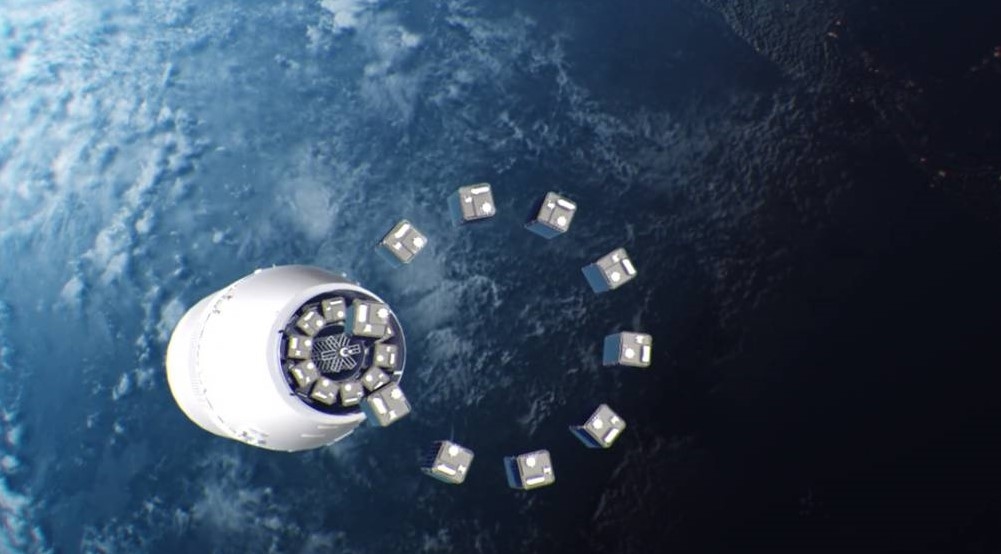
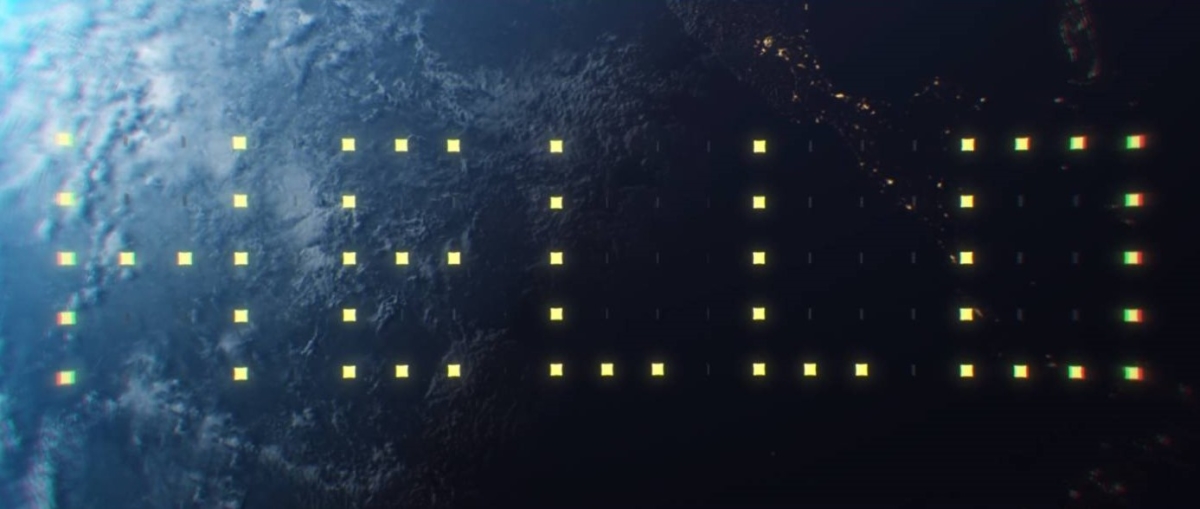
A Russian entrepreneurial group – StartRocket — has got its eyes on the sky – to create an in-orbit system that would allow advertisements, logos, special product offerings and messages to be constantly posted.
Making use of a cluster of cubesats, the orbital display can reach a potential audience of 7 billion – everyone on the planet. The display orbits at roughly 250 – 310 miles (400-500 kilometers) altitude and would deliver 3 to 4 messages/images a day.
Credit: StartRocket/Screengrab: Inside Outer Space
Vlad Sitnikov is project leader of this space startup, bringing to the table 20 years of advertising skills.

Credit: Start Rocket/Screengrab: Inside Outer Space
Sky branding
The dream, according to the group, is to follow artist Andy Warhol’s observation: “The most beautiful thing in Tokyo is McDonald’s. The most beautiful thing in Stockholm is McDonald’s. The most beautiful thing in Florence is McDonald’s. Peking and Moscow don’t have anything beautiful yet.”
The group’s website explains “Space has to be beautiful. With the best brands our sky will amaze us every night. No ugly place there after this.”
Start Rocket expects to collect $25 million for the first round of investment until October 1, 2019 with the goals: product developing and design research (engineering and main tech solution developing), test main formation specifications, two first cubesats, control mission station, ground tests, fixing, airworthiness certificates, orbit technology demonstration, result and tests analysis.
Credit: StartRocket/Screengrab: Inside Outer Space
Cost of the orbital display operating time slot after the formation deploy is $200k for 8 hours.
Number of applications
According to the group’s website, there are a number of applications for display orbit:
- Displaying complementary messages or images from the orbit during global events for entertaining purposes.
- Bringing necessary information to the public on a broad-based perception level: from the simplest to the most complicated: such as logos and special product offers from brands.
- When phones don’t work, during zero visibility, power cuts and catastrophical emergencies – government can use the display for urgent notifications for the population.
For more information on their plans, go to:
For updated information, go to this Jeff Foust story:
Pepsi Drops Plans to Use Orbital Billboard
https://www.space.com/pepsi-drops-orbital-billboard-plans.html

Credit: CGTN
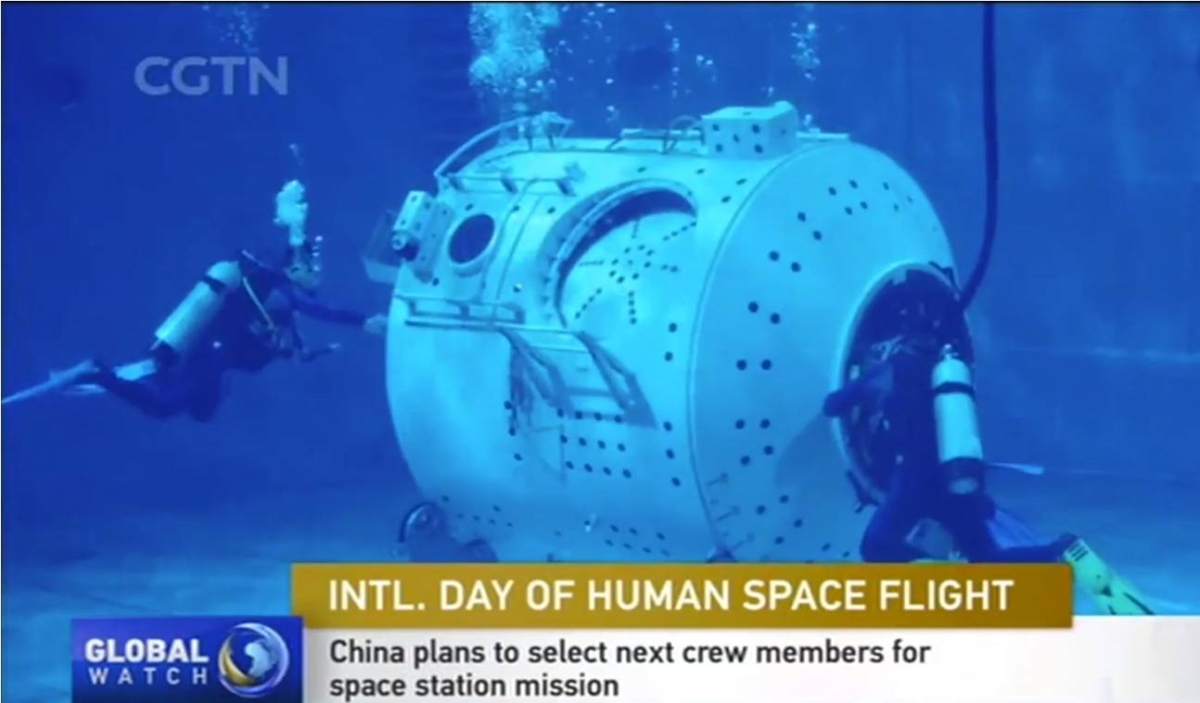
China is on the verge of selecting new crew members for its space station program.
To date, a total of 11 taikonauts or Chinese astronauts have gone into space.
Credit: CGTN
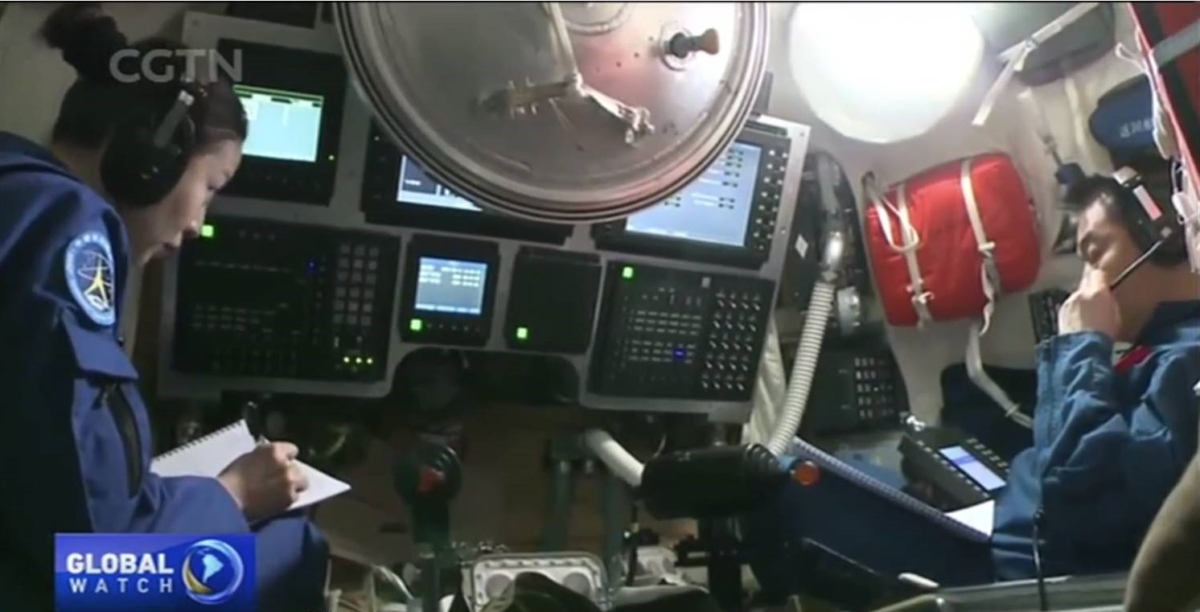
As reported by China Global Television Network (CGTN), Huang Weifen, who is in charge of training taikonauts, explains that China plans to select three individuals for its first crewed space station mission.
There are 16 active taikonauts in the current two groups. Only three will be selected to take part in the first piloted space station mission.
Credit: CGTN
Huang said as Chinese future space missions expand, they can even help train and cultivate other countries’ astronauts. She believes there will be more international cooperation on astronauts training and selection.

Credit: CGTN
China is planning to assemble its crewed space station next year. The orbital outpost is scheduled to become fully operational around 2022, according to the CGTN video. Since Chinese astronauts will spend at least three months on a space station mission, they are also expected to solve more emergencies.
To view the CGTN video on taikonaut training, go to:
https://news.cgtn.com/news/3d3d414e3363544f33457a6333566d54/index.html
Crash landing survivor? NASA Goddard Space Flight Center/MIT Laser Retro-reflector Array (LRA) for Lunar Landers.
Credit: SpaceIL/Courtesy Xiaoli Sun/GSFC
A NASA piggyback experiment may have survived the April 11 crash landing of Israel’s Moon lander, Beresheet. Overflight of the crash site by the U.S. space agency’s Lunar Reconnaissance Orbiter (LRO) should provide imagery of the impact area.
Additionally, an LRO-carried Lunar Orbiter Laser Altimeter (LOLA) will attempt to detect a NASA-provided laser retro-reflector array in the Beresheet wreckage zone. Called the NASA Goddard Space Flight Center/MIT Laser Retro-reflector Array (LRA) for Lunar Landers, the ball-shaped device was located on the top side of the Israeli lander.
NASA experiment after installation (the array is mounted on the top of the spacecraft, lower left, at about 7 o’clock position).
Credit: SpaceIL/Courtesy Xiaoli Sun/GSFC
Smaller than a computer mouse, LRA is composed of eight mirrors made of quartz cube corners that are set into a dome-shaped aluminum frame. That array is lightweight, radiation-hardened and long-lived.
From the high-flying LRO, laser beams generated by LOLA would strike the device and then are backscattered from the lunar surface. For each laser beam, LOLA measures its time of flight, or range.
Detection attempts
“Yes, we believe the laser reflector array would have survived the crash although it may have separated from the main spacecraft body,” the Massachusetts Institute of Technology’s David Smith, the principal investigator for LOLA and an emeritus researcher at NASA Goddard in Greenbelt, Maryland. LOLA will begin planning observations early next week, he said.
“Of course we do not know the orientation of the array, it could be upside down, but it has a 120 degree angle of reception and we only need 1 of the 1/2″ cubes for detection, but it has certainly not made it any easier,” he told Inside Outer Space.

NASA’s Lunar Reconnaissance Orbiter (LRO).
Credit: NASA/Goddard Science Visualization Studio (SVS)
The Lunar Reconnaissance Orbiter project is proceeding with attempting to image the crash site with the Lunar Reconnaissance Orbiter Camera system, LROC for short, Smith said. Also, the LRO-carried laser altimeter will be making attempts to get a return from the array as originally planned, he said.
NASA is interested in dotting the Moon with many such retro-reflectors in the future. These would serve as permanent “fiducial markers” on the Moon, meaning future craft could use them as points of reference to make precision landings.
The Israeli lunar spacecraft weighed only 1,322 pounds, or 600 kilograms.
Credit: Eliran Avital
Chain of events
Preliminary data supplied by the engineering teams of SpaceIL and Israel Aerospace Industries (IAI) suggests a technical glitch in one of Beresheet’s components triggered the chain of events on April 11 that caused the main engine of the spacecraft to malfunction.
Without the main engine working properly, it was impossible to stop Beresheet’s velocity. The Moon lander overcame the issue by restarting the engine. However, by that time, its velocity was too high to slow down and the landing could not be completed as planned.
Israel’s Beresheet lunar lander imagery taken before crash landing on April 11.
Credit: SpaceIL and Israel Aerospace Industries (IAI)
According to SpaceIL and IAI, preliminary technical information collected shows that the first technical issue occurred at 8.7 miles (14 kilometers) above the moon. At 492 feet (150 meters) from the lunar terrain, connection with the spacecraft was lost completely. At that time, Beresheet was moving vertically at 310 miles per hour (500 kilometers per hour), headed for an inevitable collision with the lunar surface.
The Beresheet spacecraft, whose name means “genesis” or “in the beginning” in Hebrew, was launched on February 21.
Meanwhile, the dream goes on! Morris Kahn, SpaceIL Chairman, the non-profit company that built Beresheet, announced today the launching of a follow-on lunar lander: Beresheet 2.0.
Go to video at:
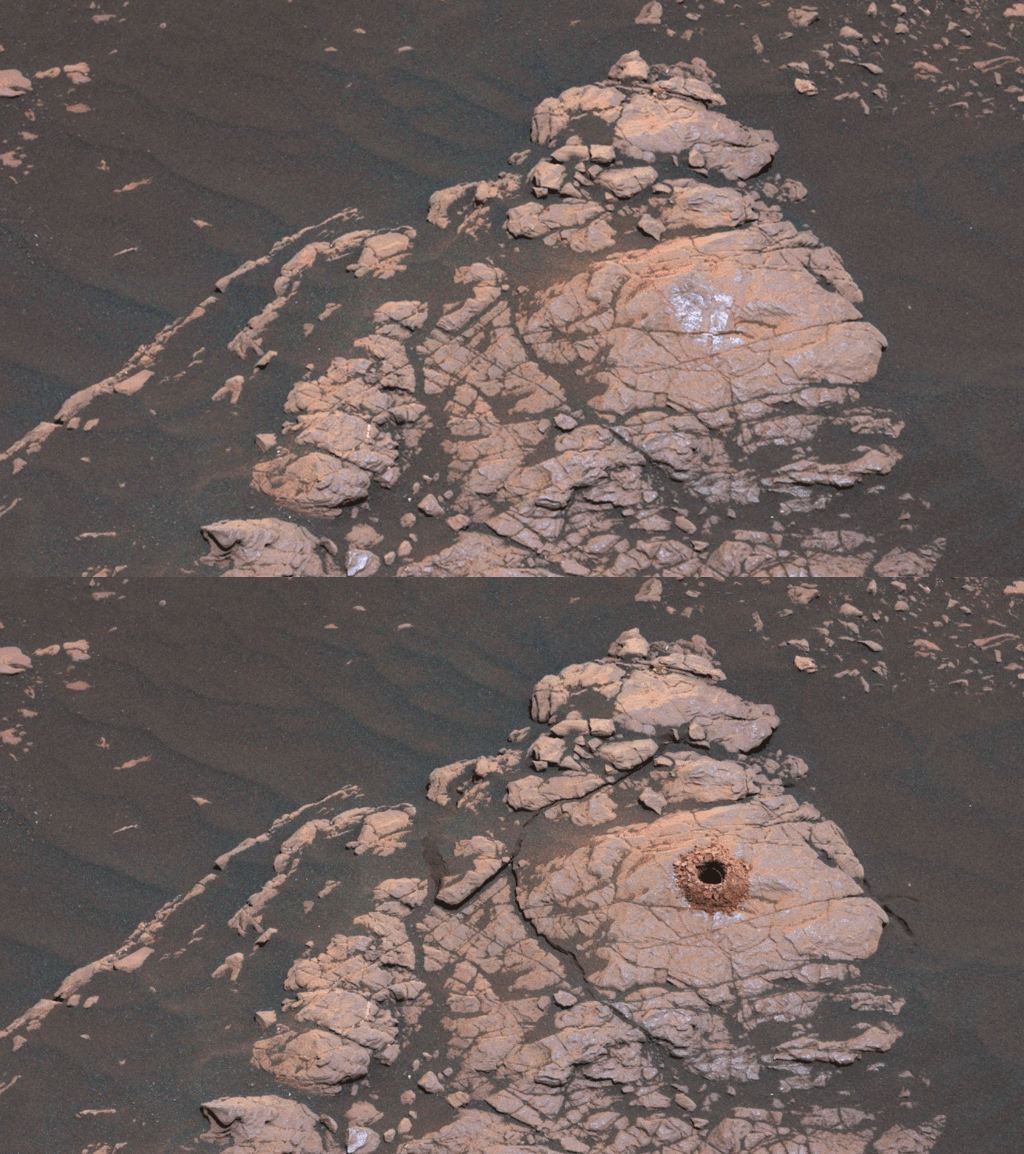
Click on image to produce before/after drilling. Credit: NASA/JPL-Caltech/MSSS
NASA’s Curiosity Mars Rover is now performing Sol 2376 science duties.
The Mars robot continues the sequence of drill activities at “Aberlady” reports Vivian Sun, a planetary geologist at NASA/JPL in Pasadena, California,
Mars researchers will be collecting Alpha Particle X-Ray Spectrometer (APXS) data of the dump pile with two offset observations “to better understand any compositional variations, which are hinted at by the color variations observed in the drill fines,” Sun adds.

Curiosity Front Hazcam Right B photo taken on Sol 2376, April 13, 2019.
Credit: NASA/JPL-Caltech
Also planned is performing another Chemistry & Mineralogy X-Ray Diffraction/X-Ray Fluorescence Instrument (CheMin) integration to further refine the mineralogic analyses for Aberlady.
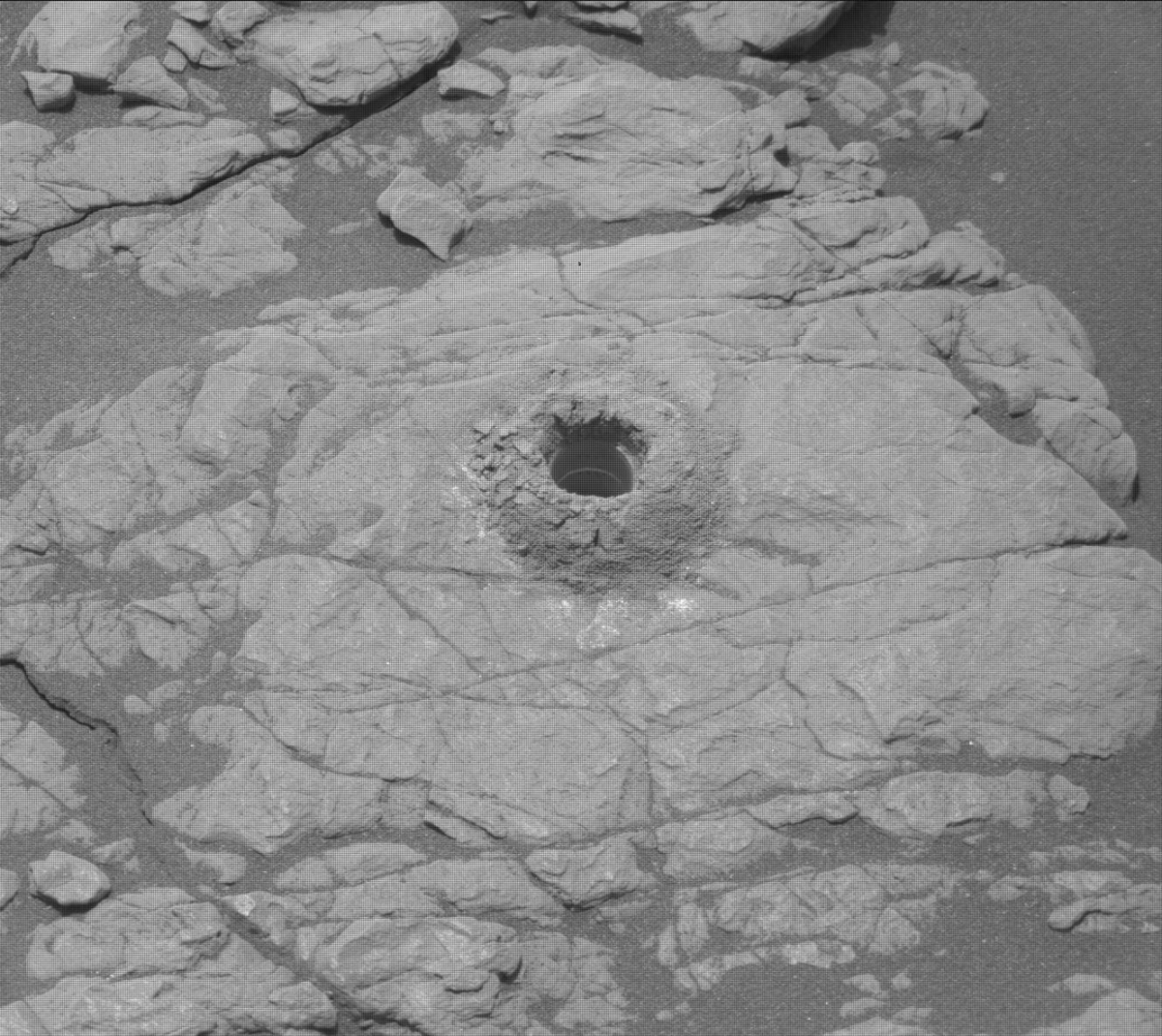
Mastcam Right Sol 2374 image acquired on April 11, 2019.
Credit: NASA/JPL-Caltech/MSSS
Dump pile photos
Images will be taken by Curiosity’s Mars Hand Lens Imager (MAHLI) images of the dump pile and the drill hole.
“Discussions of whether we should drill again near our current workspace or drive away and drill elsewhere are still ongoing,” Sun explains, “but to cover our bases we planned an APXS and MAHLI observation of “Seil” for reconnaissance on potentially drillable bedrock.”
Many of the robot’s remote sensing activities were designed to characterize the compositional variability of the bedrock in this region.

Navcam Left B photo taken on Sol 2376, April 13, 2019.
Credit: NASA/JPL-Caltech
Possible meteorite fragment
On the plan is producing a series of ChemCam Laser Induced Breakdown Spectroscopy (LIBS) rasters on “Glen Water,” “Ben Vane,” “John O Groats,” and “Kirkcaldy,” as well as their corresponding Mastcam documentation images.
“We also planned a ChemCam target on a possible meteorite fragment called ‘Lumphanan.’ This observation is unusual because ChemCam targets are usually limited to within approximately [23 feet] 7 meters distance of the rover mast, as data quality decreases at longer distances. Lumphanan is more than [30 feet] 9 meters from the rover mast, but we decided to use this measurement as a long distance calibration activity,” Sun notes.
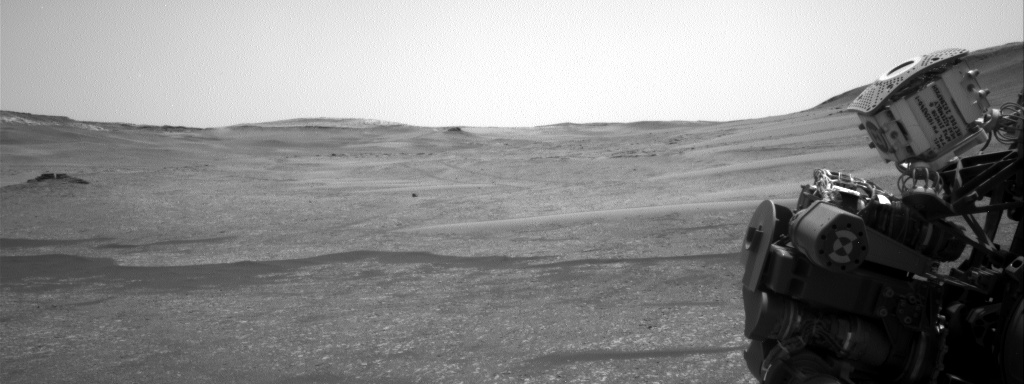
Navcam Right B image acquired on Sol 2376, April 13, 2019.
Credit: NASA/JPL-Caltech
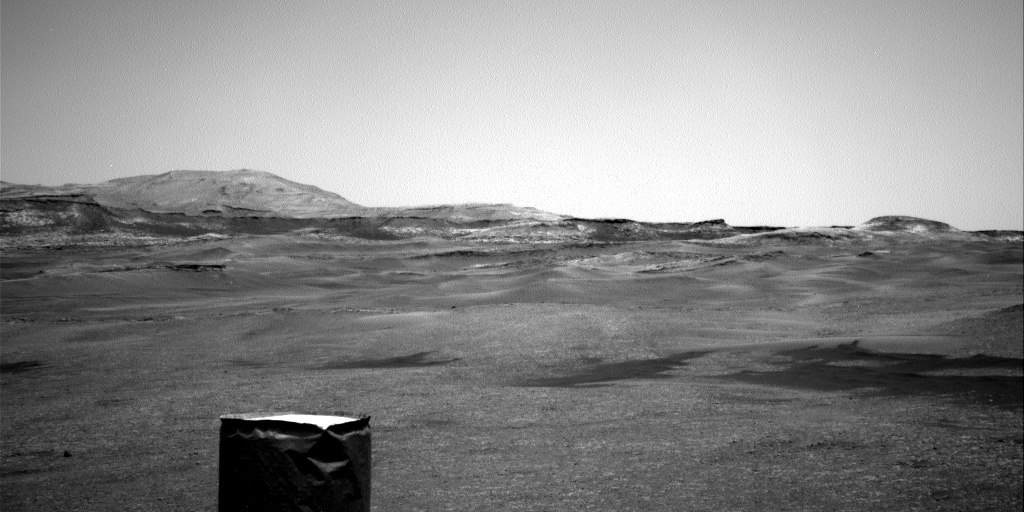
Navcam Right B image acquired on Sol 2376, April 13, 2019.
Credit: NASA/JPL-Caltech
Dust devil survey
Other observations in the weekend plan include a suite of atmospheric monitoring activities, Sun reports, including a Navcam dust devil survey.
Scientists are also taking advantage of Curiosity’s stationary location by continuing the change detection campaign with Mastcams of “Claymore” and Mars Descent Imager (MARDI) observations. Lastly, also planned is a Mastcam mosaic of the sulfate unit to aid in targeting a ChemCam long-distance Remote Micro-Imager (RMI) observation of the sulfate unit, Sun concludes.
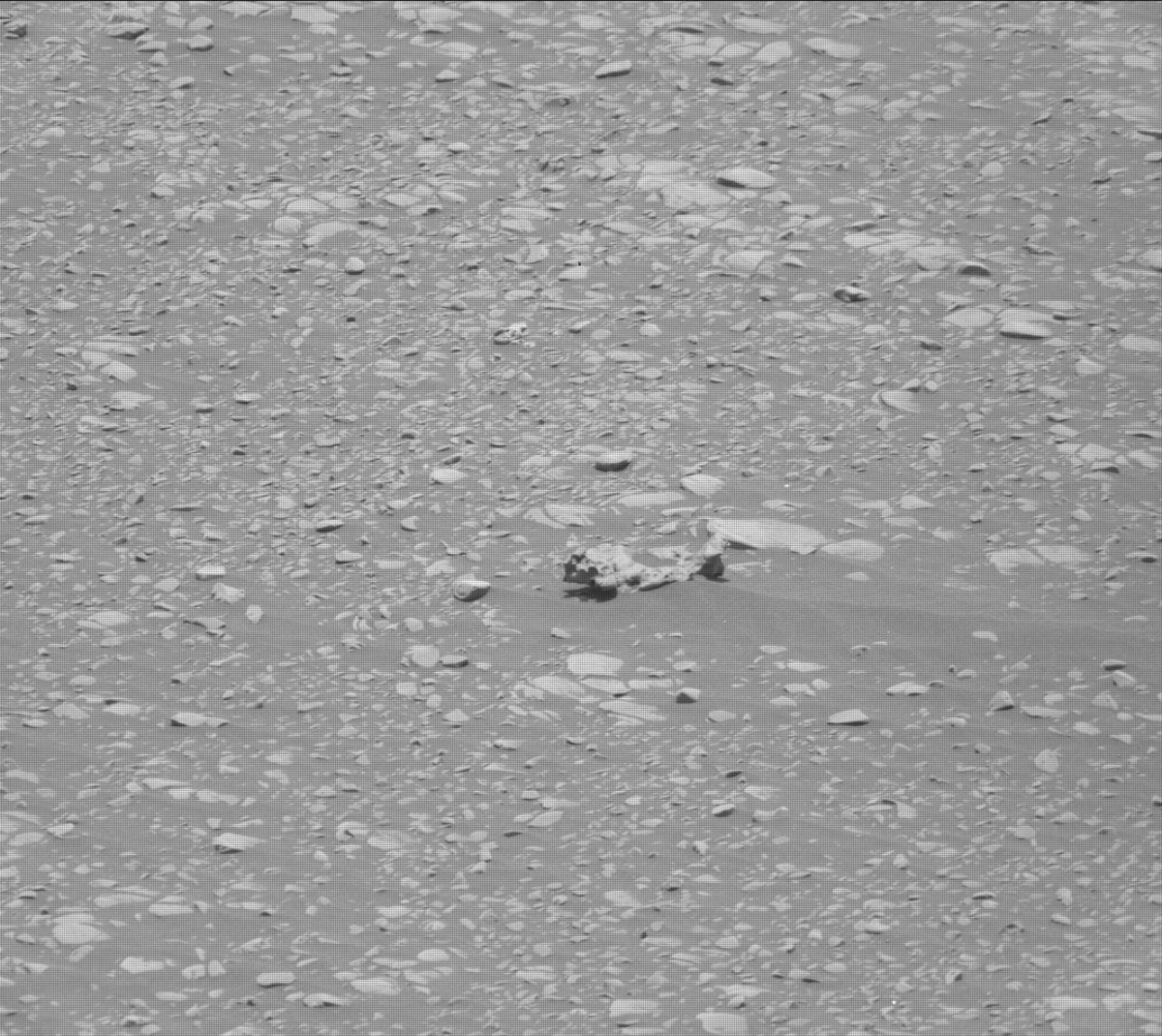
Possible meteorite fragment? Mastcam Right image taken on Sol 2365, April 2, 2019.
Credit: NASA/JPL-Caltech/MSSS

Meteorite? Photo taken by Curiosity ChemCam Remote Micro-Imager on Sol 2376, April 13, 2019.
Credit: NASA/JPL-Caltech/LANL

Credit: NASA/Apollo 11 photo
China’s stepping stone space agenda is likely to include a piloted Moon mission to be launched by the mid-2030s.
That finding is presented in a new report — China’s Pursuit of Space Power Status and Implications for the United States – has been issued by the U.S.-China Economic and Security Review Commission.
This paper is the product of professional research performed by staff of the Commission, and was prepared at the request of the Commission to support its deliberations.
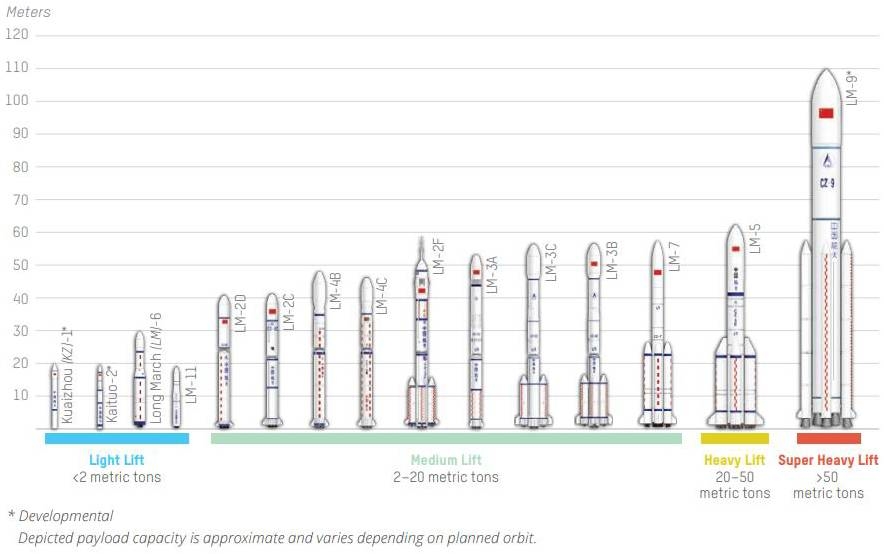
Source: Defense Intelligence Agency, Challenges to Security in Space, February 11, 2019
Legitimacy and international prestige
A set of executive summary findings:
- China seeks to become a peer in technology and status of the United States in space. Although China still lags behind the United States in some areas, given the fact that in at least one key area it is likely to accomplish in 20 years what took the United States 40 years to complete, it will likely achieve other important milestones more quickly than the United States did in the past.
- China’s successful deployment of a lander to the Moon’s farside, the first in history, clearly demonstrates Beijing’s ability and desire to achieve increasingly sophisticated milestones in space. It is likely a Chinese crewed lunar mission will launch by the mid-2030s.
- China’s deliberate and comprehensive approach to its space program, backed by high levels of funding and political support, has allowed it to attain domestic legitimacy and international prestige. China will probably launch, assemble, and operate a long-term space station before 2025 and has invited international partners to participate in its use.
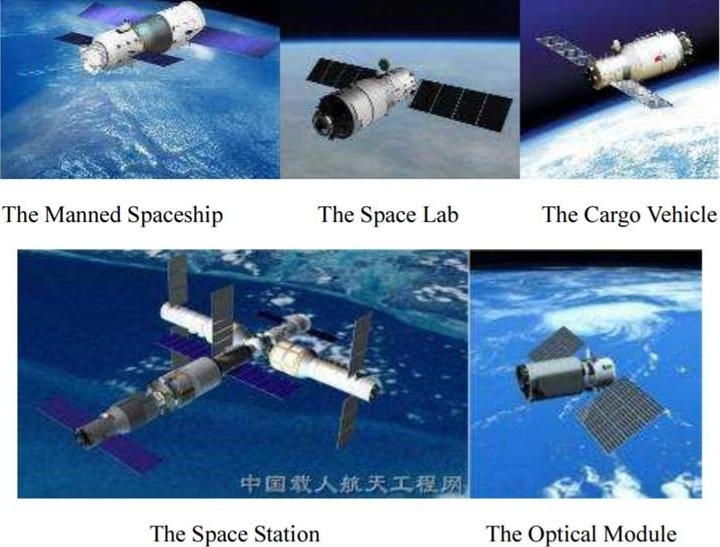
Credit: CMSA
To read the entire document, go to:
https://www.uscc.gov/sites/default/files/Research/USCC_China%27s%20Space%20Power%20Goals.pdf
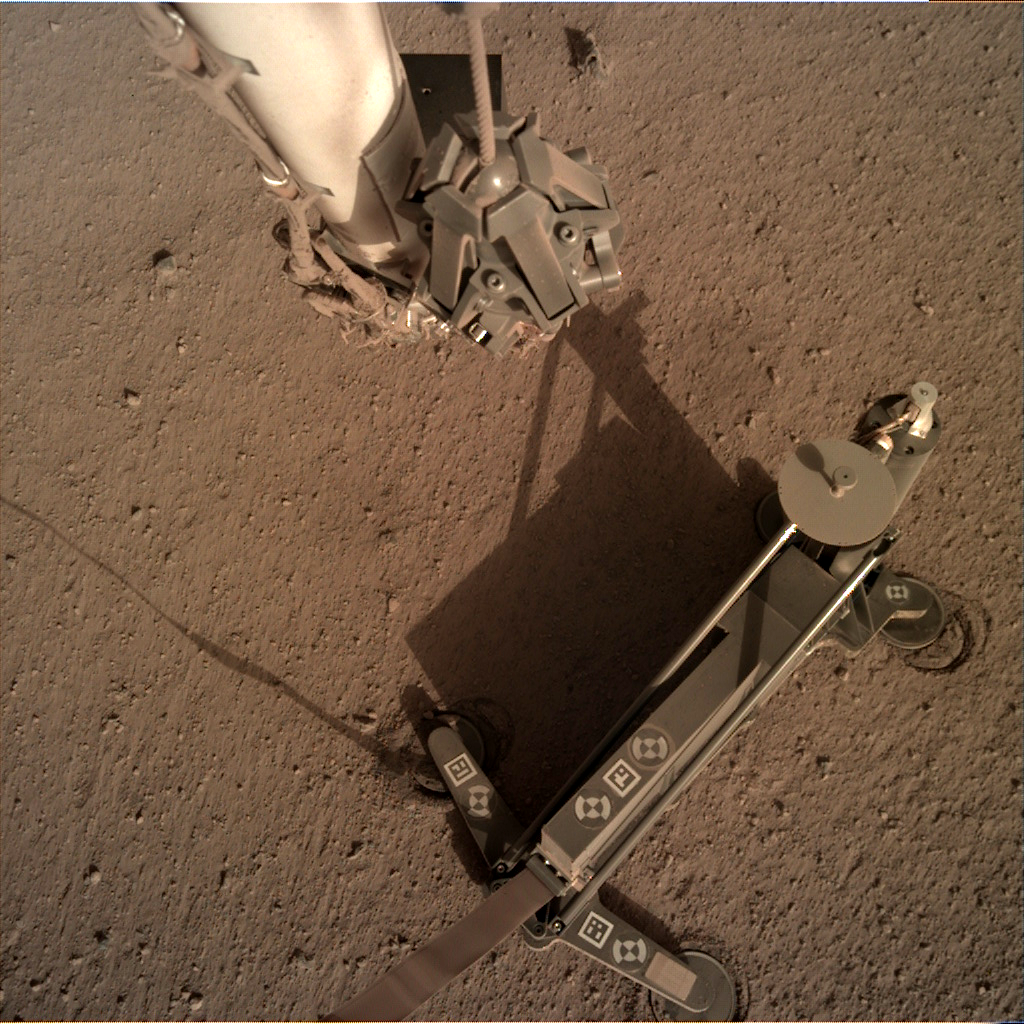
Sol 128 image taken April 7 by the Instrument Deployment Camera (IDC) shows the Heat and Physical Properties Package (HP3). There remains uncertainty as to why the “mole” — the nickname for the self-hammering spike that is part of HP3 — is not performing as expected.
Credit: NASA/JPL-Caltech
Engineers on the NASA InSight Mars lander mission are still trouble-shooting the Heat and Physical Properties Package (HP3). There remains uncertainty as to why the “mole” — the nickname for the self-hammering spike that is part of HP3 — is not performing as expected.
“The discussion about the reasons of the mole not penetrating further have settled to three hypotheses of similar credibility but differing likelihood of occurring,” reports Tilman Spohn of the German Aerospace Center’s (DLR) Institute of Planetary Research in Berlin.

Components of the HP3 heat flow probe. Top left: the radiometer (RAD), which is used to measure the radiation temperature (roughly equivalent to the ground temperature) of the surface. Right: the casing with the mole penetrometer, the temperature measuring cable (TEM-P) and the data cable (ET) connected to the lander. In addition, the casing contains an optical length meter for determining the length of the temperature measuring cable that has been pulled from the casing. The mole contains the TEM-A active thermal conductivity sensor and the STATIL tiltmeter. Bottom left: the electronic control unit, known as the back end electronics (BEE), which remains on the lander and is connected to the probe via the ET.
Credit: DLR
- The mole or the tether that it is trailing behind may be snagged in the Support Structure. While this hypothesis is credible it so far lacks a clear mechanism of how this may have happened. Tests at the DLR Institute of Space Systems have shown, that the tether may get snagged but only in very special circumstances.
- The mole may have encountered a sufficiently large rock or stone at 30cm depth. The size of the rock would have to be 10cm or larger for the mole not being likely to push it aside or to go around it. This explanation is so simple that everybody would be ready to believe it. But, the likelihood of such a stone blocking the moles’ way is only a few percent judging from the well-established (surface) rock-size-frequency distribution for the landing site.
- The mole may not have enough friction on the hull to balance the recoil. Geologists have seen that the topmost centimeters on Mars is formed by what is called a “duricrust”. Here, chemical reactions between grains of sand have made them stick together, providing cohesion in that layer. The duricrust is usually thin and not a problem. But at the InSight landing site, it seems to be 20 or so centimeters thick! If the mole is sitting in the duricrust, its hull may very well have lost friction and upon time, the mole may have widened the hole in the duricust as is suggested by the data from our accelerometer and by our thermal data.
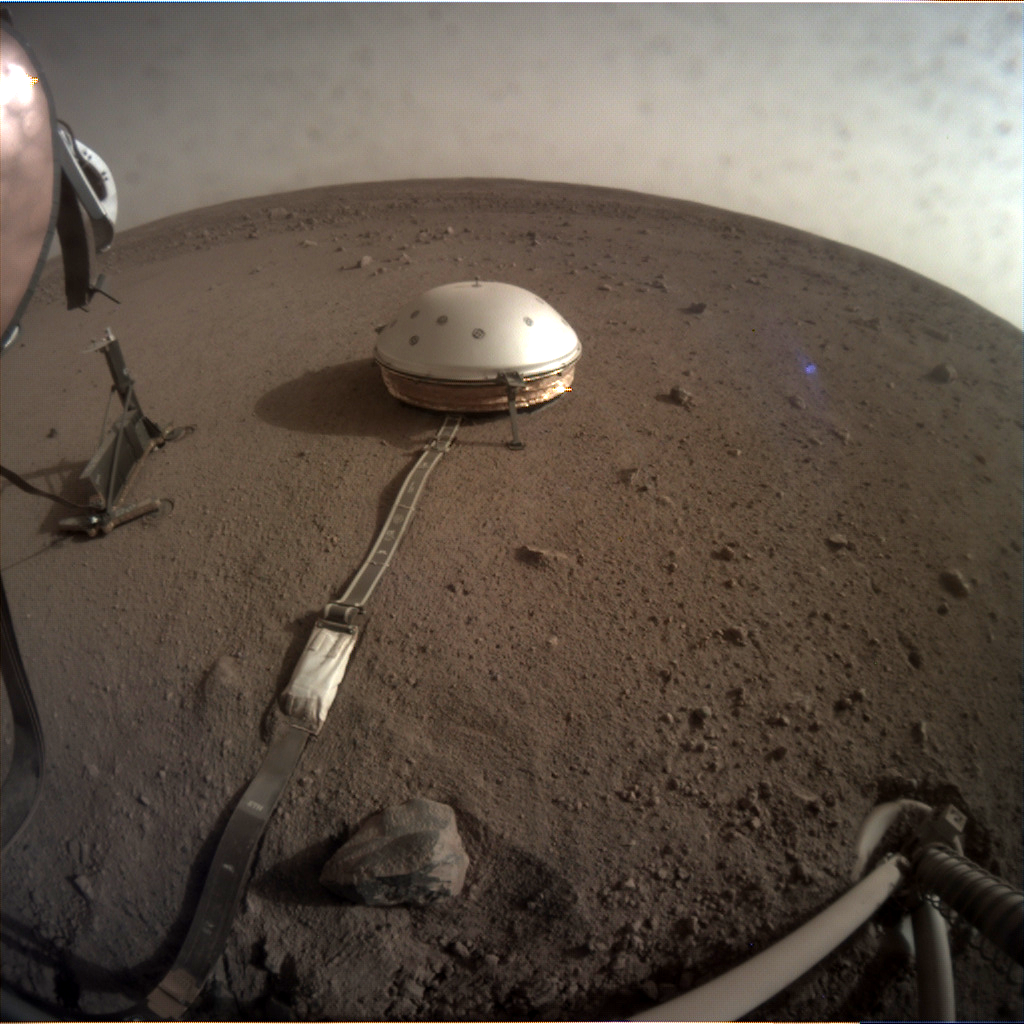
InSight’s Instrument Deployment Camera (IDC) acquired this image showing the HP3 experiment and SEIS seismometer (Seismic Experiment for Interior Structures) on Sol 99, March 8, 2019.
Credit: NASA/JPL-Caltech
“At the moment it seems that the discussion is leaning towards hypothesis #3, not the least as we have seen such a behavior in tests on Earth in cohesive sand and low atmosphere pressure,” Spohn says. “But we have not settled yet on this explanation.”
In any case, if hypothesis #3 were found to be the best explanation, Spohn adds, “it may also offer the simplest remedy. All we would need to do is help the mole to balance the recoil.”
InSight’s robotic arm may be of help here but that needs to be assessed further by engineers.
“Otherwise, the mole is entirely healthy,” Spohn concludes. “Stay tuned.”

Credit: NASA
Hack the Moon celebrates the engineers behind the Apollo program.
A digital trove of Apollo artifacts debuts on a special website established by the Charles Stark Draper Laboratory’s in Cambridge, Massachusetts.
There’s a treasure trove of newly released photos, videos and stories about the unsung heroes of Apollo.

Credit: Draper
Hack extras
Hack the Moon is free and open to the public. Visitors to the site will find more than 2,000 images, 200 pieces of original content and 150 videos that tell the story of the Apollo missions.
The site features a handy search engine, a mobile-friendly design and special sections on the people, the technology and the missions.
A section called “Hack Extras” takes visitors to podcasts, resources, upcoming events, trivia quizzes and more. “In Their Own Words” presents the personal stories of many of the engineers of Apollo as they encounter and overcome challenges and make some surprising discoveries.
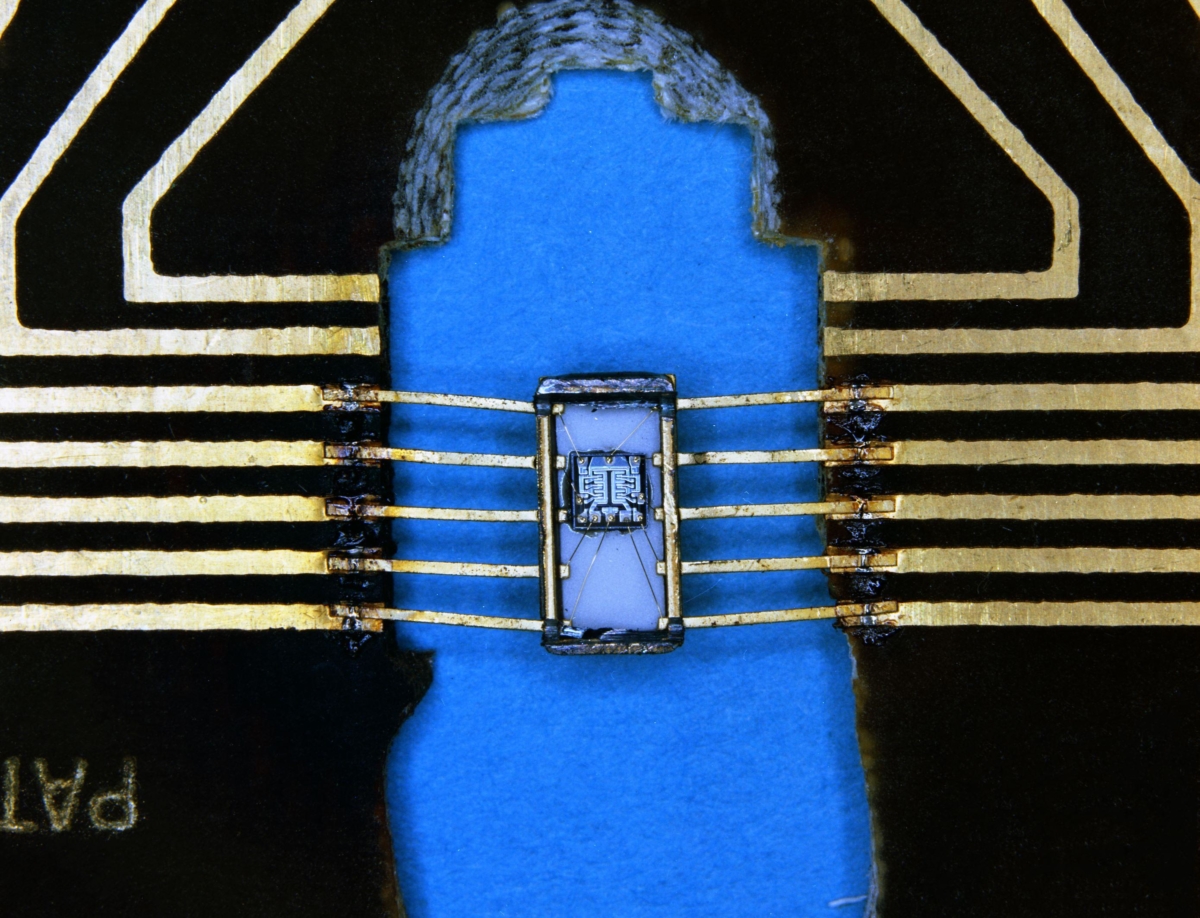
Credit: Draper
Personal accounts
Visitors can read personal accounts from Apollo astronauts such as Jim Lovell’s recollection of seeing the Moon for the first time, and Apollo 17’s Harrison Schmitt’s story about his scientific discovery on the Moon.
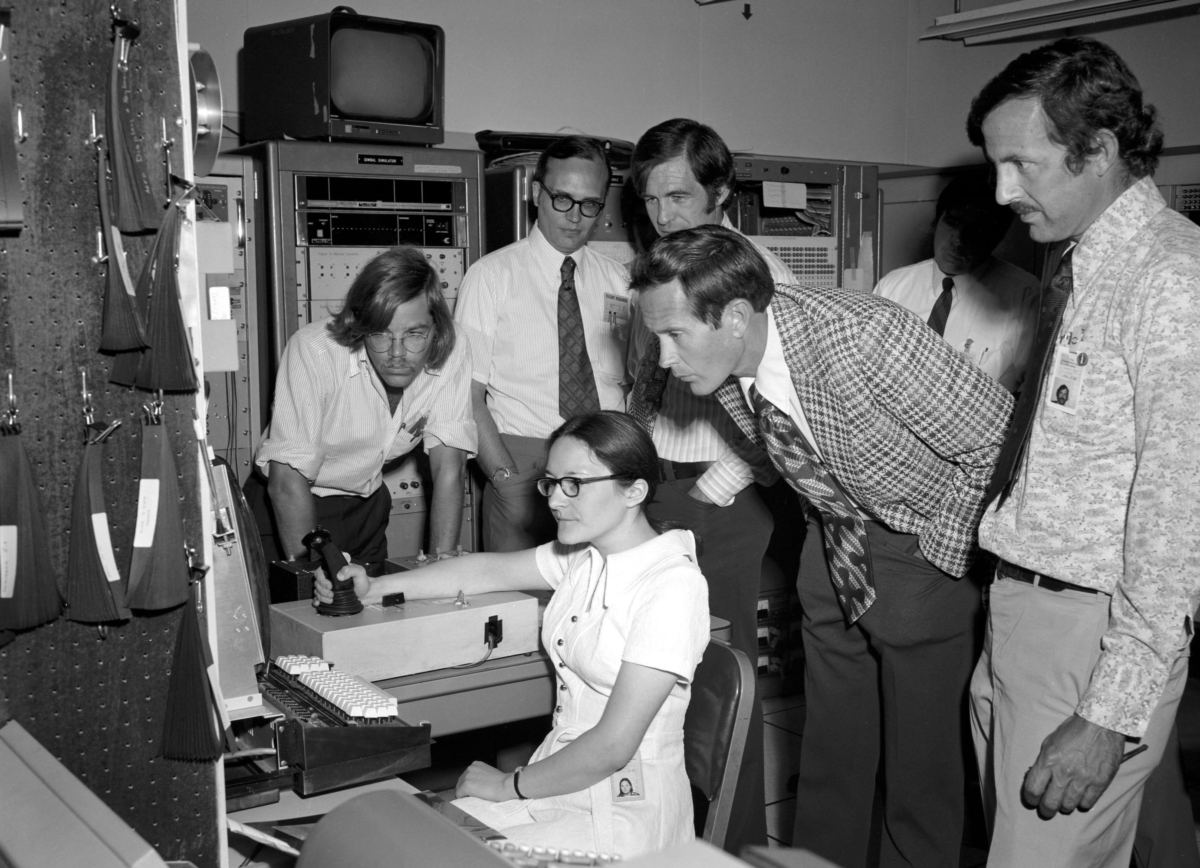
Credit: Draper
Among the many video stories, Draper engineer Don Eyles recounts his experience averting disaster during Apollo 14, and Margaret Hamilton remembers the happy accident in the lab that led her to develop Apollo’s error detection recovery code.
To access Draper’s new website — Hack the Moon – go to:

Credit: SpaceIL/IAI/Screengrab Inside Outer Space
Israel’s Beresheet Moon lander is nearing the moment of truth, projected to land on the Moon at about 11 p.m. Israel time on April 11.
That time may change due to final maneuvers, but in achieving a controlled landing on the Moon, Israel moves into the lunar elite column of capable countries that have plopped surviving hardware down on the Moon. Israel would follow the Soviet Union, the United States, and China.
The Moon lander is on an “excellent” track, according to controllers.
Now awaiting its fate, Beresheet is circling the Moon. SpaceIL and Israel Aerospace Industries (IAI) will conduct a series of intense spacecraft maneuvers in preparation for the landing.
Beresheet on Monday morning, April 8, performed a maneuver as it entered ever-tighter orbits around the Moon. Over the next three days, additional maneuvers will turn the spacecraft’s current elliptic orbit into a circular orbit 125 miles (200 kilometers) (125 miles) away from the lunar surface.

Projected landing area on Moon by Israel’s Beresheet spacecraft. Credit: Aharonson, et al.
Projected landing site
SpaceIL’s spacecraft will land on a site within Mare Serenitatis, on the northern hemisphere of the Moon. This site has magnetic anomalies to be explored by a magnetometer device taking measurements as part of the lander’s scientific experiments.
According to Oded Aharonson of the Weizmann Institute of Science, Rehovot, Israel, in addition to a suite of cameras, the mission has integrated a scientific payload consisting of a small Lunar Retroreflector Array (LRA) provided by NASA Goddard Space Flight Center. Also on Beresheet, a magnetometer provided by the University of California, Los Angeles.
Integrated on Israeli lunar lander, a NASA scientific payload consisting of a small Lunar Retroreflector Array (LRA).
Credit: NASA/Goddard Space Flight Center
Science mission
In a paper presented at the 50th Lunar and Planetary Science Conference (LPSC) last month – The Science Mission of the SpaceIL Lunar Lander – lead author, Aharonson spotlighted Beresheet’s science mission: detailed characterization of the landing site, measuring the crustal magnetic anomalies to constrain their possible origin and longevity of the lunar dynamo, and localization of the lander using ranging via the NASA-provided LRA.
Beresheet’s targeted landing site is located in the northeastern part of Mare Serenitatis and West of the main Posidonius crater – the area of the three optional landing sites, a primary site and two backups.

Credit: SpaceIL/Israel Aerospace Industries
“We plan to use these data to associate the anomalies with geologic features on the surface, and thus probe the genesis of the remnant magnetization,” the LPSC paper explains. “A relation between magnetization and local wrinkle ridges would be consistent with the hypothesis that the Serenitatis mare are uniformly magnetized with an intensity higher than typical Apollo mare basalts but only producing surface fields at physical breaks where the field lines can emerge due to edge effects.”
Also onboard the lunar lander is an experiment — smaller than a computer mouse — that could enable spot-on touch downs of future robotic and human-carrying landers, the Lunar Retroreflector Array (LRA).
For more information on the NASA LRA, visit my recent Space.com story at:
NASA’s Piggyback Experiment on Israeli Moon Lander Could Aid Future Lunar Touchdowns
https://www.space.com/israel-moon-lander-nasa-instrument.html

