 By
By  October 8th, 2020
Venus in ultraviolet taken by NASA’s Pioneer-Venus Orbiter in 1979 indicating that an unknown absorber is operating in the planet’s top cloud layer.
Credit: NASA
All that recent press about the history of Venus and it possibly being a life-supporting world has received additional attention. But this time, Earth’s Moon plays center stage.
Yale astronomers suggest that NASA Artemis lunar crews might collect billions of bits of Venus likely to have crashed on the Moon.
Venusian meteorites mixed in within the lunar terrain – how would they get there?
The researchers said asteroids and comets slamming into Venus may have dislodged as many as 10 billion rocks and sent them into an orbit that intersected with Earth and Earth’s Moon.

Don Mitchell, a retired researcher, matched his computer science skills with a passion for old spacecraft data to reveal never-before-seen details in the former Soviet Union’s Venera-13 lander images taken on the surface of cloud-veiled Venus.
Credit: Don Mitchell
A new study – “Lunar Exploration as a Probe of Ancient Venus” — details the theory, one that has been accepted by the Planetary Science Journal.
Detectable amounts
Yale astronomers Samuel Cabot and Gregory Laughlin write that if Venus’ atmosphere was at any point thin and similar to Earth’s, then asteroid impacts transferred potentially detectable amounts of Venusian surface material to the lunar regolith.
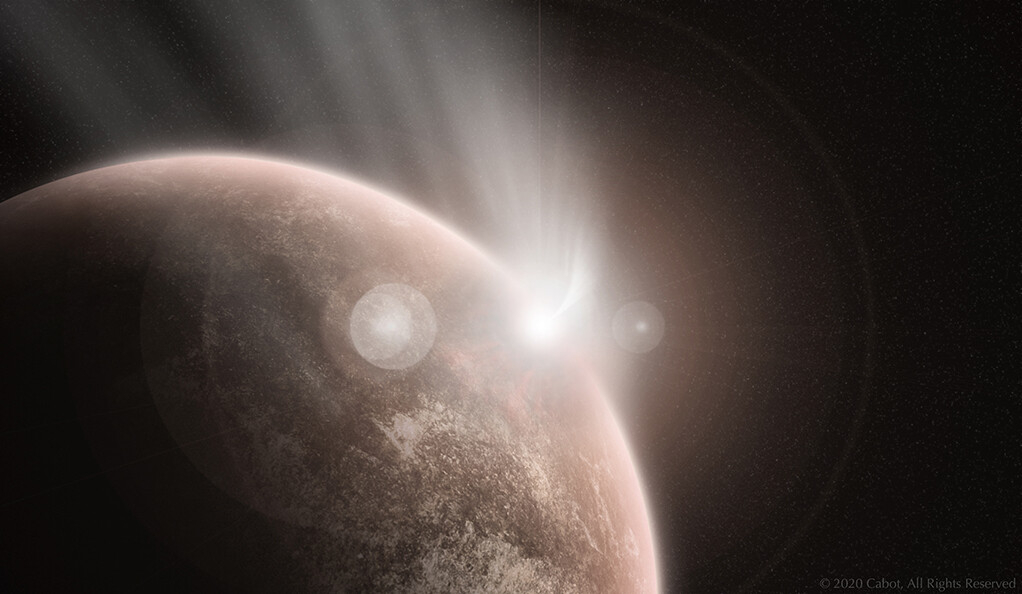
A comet strikes ancient Venus. Credit: Illustration by Sam Cabot
Laughlin and Cabot cited two factors supporting their theory, according to a Yale University press statement.
— Asteroids hitting Venus are usually going faster than those that hit Earth, launching even more material.
— A huge fraction of the ejected material from Venus would have come close to Earth and the Moon.
Important processes
Three important processes work in favor of recovering Venusian meteorites on the Moon, the Yale researchers state in their research paper.
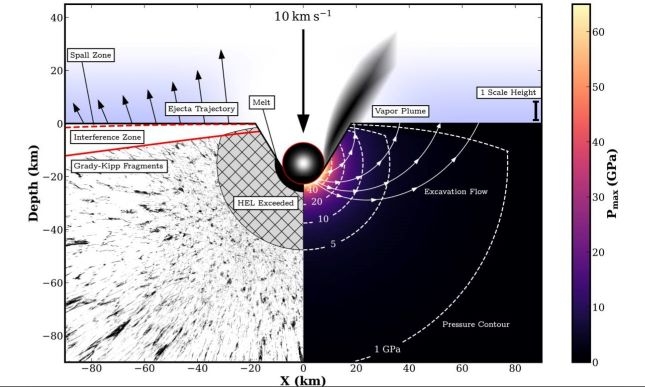
Credit: Cabot/Laughlin
“First, much of the ejected material is minimally shocked, due to shock-wave interference and spallation. Second, meteorite fragments are likely to survive their impact on the Moon, given their relatively low impact-velocities. They are even more likely to survive oblique impacts. Finally, the Moon’s regolith is relatively shallow. It is amenable to excavation, particularly in existing craters; although excavation of the deeper mega-regolith presents a more challenging scenario.”
Escape travel
Cabot told Inside Outer Space that Venus meteorites on the Moon would tell you more so about its past atmosphere and geology from billions of years ago, rather than what it is like today.
“These meteorites would have come from asteroid or comet impacts on Venus a long time ago, when the planet had a thin atmosphere like Earth’s,” Cabot said. “Today, Venus has a much thicker atmosphere, and if there was an impact then it would be much more difficult for rocks to escape and travel to the Moon.”

Credit: NASA
Near horizon
Given renewed lunar exploration on the near horizon, “we posit that meteorite acquisition and identification will answer an important outstanding question about the history of Venus,” Cabot and Laughlin explain in their paper.
“Our findings indicate that in situ analysis or sample return missions, with particular focus on zircon-grains and oxygen isotope fractionation, have a high potential of identifying ancient Venusian meteorites,” they conclude.
To access their paper, “Lunar Exploration as a Probe of Ancient Venus,” go to:
 Posted in Space News

