 By
By  April 1st, 2016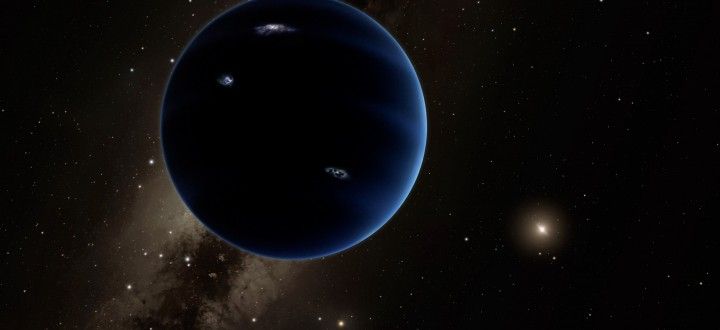
The prospect that a planet lurking in the “out there” may trigger comet showers roughly every 27 million years that then wipes out life on Earth is receiving increased attention.
Not long ago, Caltech researchers suggested that a still-to-be-found Planet X is about 10 times the mass of Earth and could currently be up to 1,000 times more distant from the Sun.
Adding more fuel to the apocalyptic prognosis is Daniel Whitmire, a retired professor of astrophysics at the University of Arkansas, now working in the university’s Department of Mathematical Sciences.
Whitmire recently published “Periodic mass extinctions and the Planet X model reconsidered” in the January issue of Monthly Notices of the Royal Astronomical Society.
Whitmire and his colleague, John Matese, first published research on the connection between Planet X and mass extinctions in the journal Nature in 1985 while working as astrophysicists at the University of Louisiana at Lafayette.
Dislodged comets
Whitmire and Matese’s theory is that as Planet X orbits the Sun, its tilted orbit slowly rotates and Planet X passes through the Kuiper belt of comets every 27 million years, knocking comets into the inner solar system.
The dislodged comets not only smash into the Earth, they also disintegrate in the inner solar system as they get nearer to the Sun, reducing the amount of sunlight that reaches the Earth.
Whitmire says what’s really exciting is the possibility that a distant planet may have had a significant influence on the evolution of life on Earth.
“I’ve been part of this story for 30 years,” Whitmire explains. “If there is ever a final answer I’d love to write a book about it,” he adds in a university press statement.
The paper, “Periodic mass extinctions and the Planet X model reconsidered” can be found at: http://mnrasl.oxfordjournals.org/content/455/1/L114.abstract?sid=afad37d0-2eba-4eea-ad57-29ba70b5476d

The outer solar system as we now recognise it. At the center of the map is the Sun, and close to it the tiny orbits of the terrestrial planets (Mercury, Venus, Earth and Mars). Moving outwards and shown in bright blue are the near-circular paths of the giant planets: Jupiter, Saturn, Uranus and Neptune. The orbit of Pluto is shown in white. Staying perpetually beyond Neptune are the trans-Neptunian objects (TNOs), in yellow: seventeen TNO orbits are shown here, with the total discovered population at present being over 1,500. Shown in red are the orbits of 22 Centaurs (out of about 400 known objects), and these are essentially giant comets (most are 50-100 kilometers in size, but some are several hundred kilometers in diameter). Because the Centaurs cross the paths of the major planets, their orbits are unstable: some will eventually be ejected from the solar system, but others will be thrown onto trajectories bringing them inwards, therefore posing a danger to civilisation and life on Earth.
Credit: Duncan Steel
For related stories on Inside Outer Space, go to:
Comet Threat Warning: Environmental Upheaval
https://www.leonarddavid.com/comet-threat-warning-environmental-upheaval/
Death Threat from Planet 9?
 Posted in Space News

