 By
By  June 9th, 2026
Image credit: SpaceX
A new study presents the atmospheric impacts of different aspects of spaceflight.
Focus of the research was to appraise the effects of chemical reactions in the rocket plume in setting up a global emission inventory, leading to emission indices that vary with altitude.
The study team was led by Yvar S. W. Vliex, an operations and environment specialist within the faculty of aerospace engineering at Delft University of Technology, Delft, The Netherlands.
Supercomputer-aided study
Researchers calculated emissions from186 rockets launched in 2022 — along with 472 objects equaling a combined total mass of nearly 5,000 tons — that reentered the atmosphere that year.
This research was carried out on the Dutch National Supercomputer Snellius – the largest system in the Netherlands in terms of high-performance computing.
“Although the current atmospheric impact of spaceflight is small, this is expected to change as the sector continues to grow,” Vliex and colleagues explain in the paper, published in the American Geophysical Union’s journal, Earth’s Future.
“As the space industry continues to grow, a better understanding of the effects of re-entry emissions, rocket plume chemistry and aerosols such as those from alumina is required, alongside in situ measurements of emissions from new rocket engines and propellant types,” the study team reports.
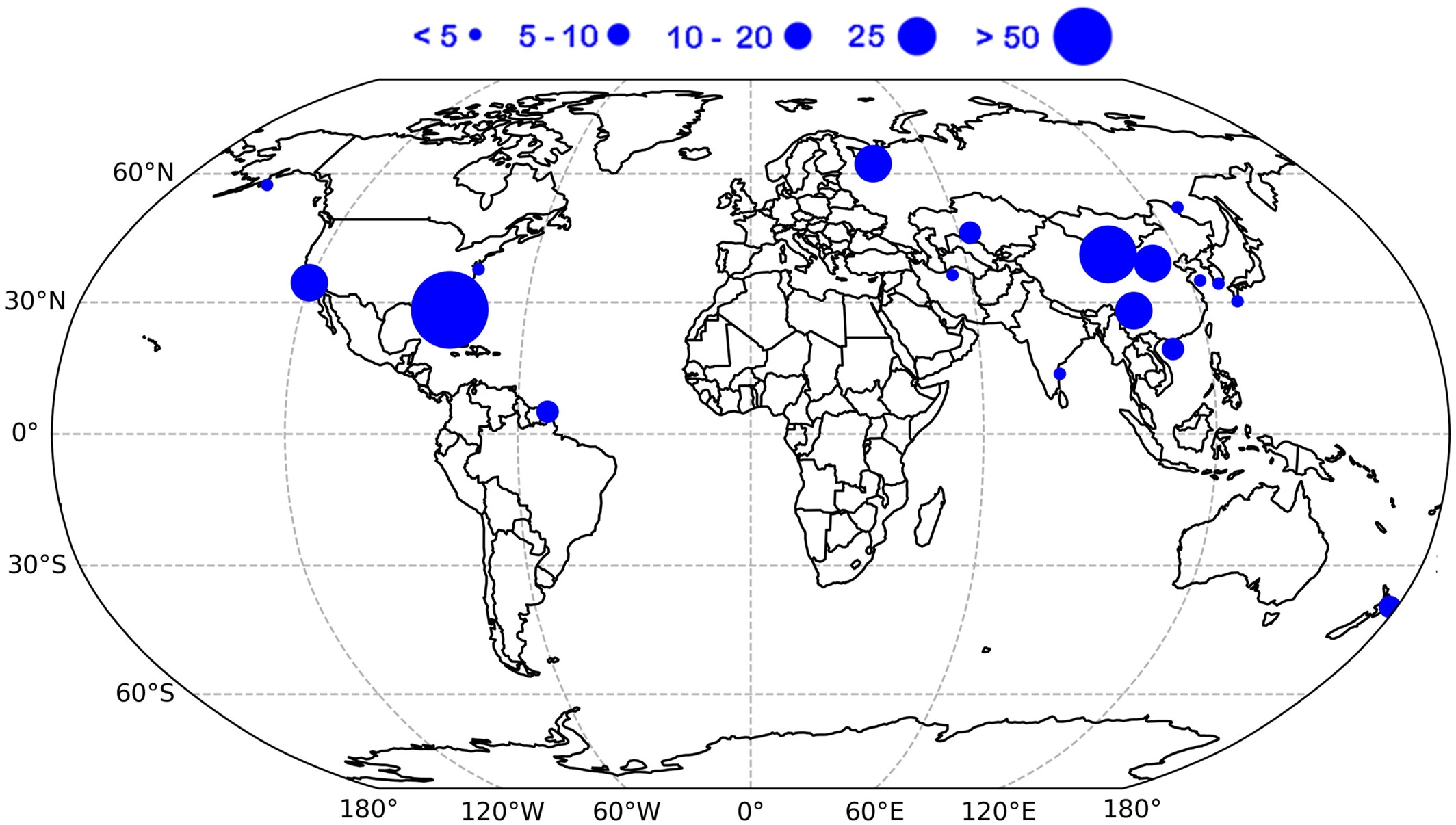
Locations and number of rocket launches in 2022, with marker size indicating launch frequency.
Image credit: Yvar S. W. Vliex, et al.
Launch rate on the rise
The space industry has grown rapidly in recent decades. The yearly launch rate has more than tripled since 2005. Also, the number of operational spacecraft has more than doubled to reach roughly 2,900 Earth orbiting satellites.
“Based on current trends such as the privatization of the space industry, the development of reusable boosters, and the plans for satellite mega-constellations and space tourism, the yearly launch and re-entry rates are expected to increase considerably, with almost 10,000 spacecraft being planned for low-Earth orbits in the upcoming years,” Vliex and colleagues observe.
Atmospheric pollutants
Rocket engines give off pollutants in all layers of the atmosphere, they report, “and the burn-up of satellites and discarded rocket bodies leads to emissions at high altitudes.”
Furthermore, as the space industry is expected to continue to grow rapidly, “a good understanding of its environmental effects is needed.”
The overall climate impact of spaceflight can likely be reduced by using more liquid hydrogen (LH2), a common rocket fuel due to its high efficiency, instead of the Rocket Propellant-1 (RP1) fueled rockets that now dominate the market.
However the low density and cryogenic storage requirements make LH2 less suitable for lower stages.
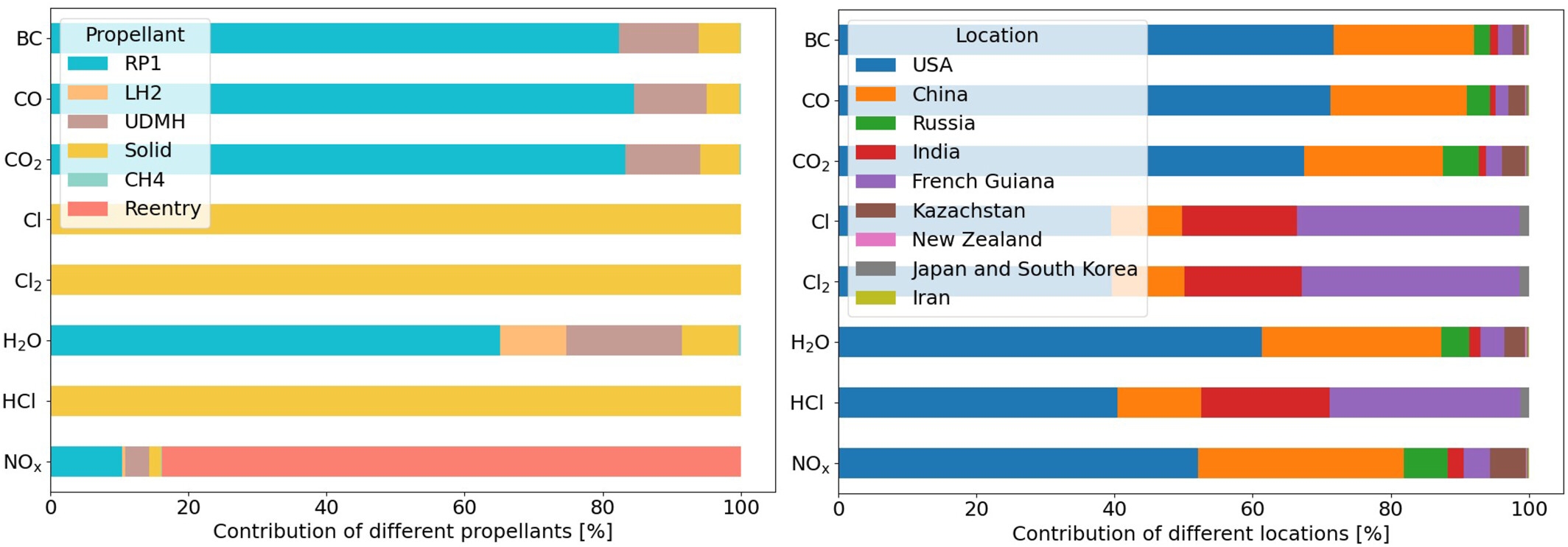
Spaceflight emissions mass contributions for 2022 per propellant type (left) and launch location (right).
Image credit: Yvar S. W. Vliex, et al.
Rocket fuel types
“The current development of liquid-methane rockets will likely reduce the climate impact of spaceflight, as methane is expected to produce less black carbon per unit mass than RP1, but further research is needed to determine how the effect of liquid-methane compares to current propellant types,” Vliex and colleagues add.
Comparing rocket fuel types, solid propellant has the largest impact on ozone depletion. Rocket-grade kerosene has the largest climate response relative to payload mass, they report.
“Our results highlight the need to consider and accurately model re-entry emissions, engine plume reactions and their interactions,” they conclude.
To access the report – “The Role of Propellant Type, Re‐Entry, and Plume Reactions in the Atmospheric Impacts of Spaceflight” – go to:
https://www.repository.cam.ac.uk/items/8d85ab81-c214-4837-a0c6-0feb14cbd382
 Posted in Space News


Burning hydrogen will put water at high altitudes. I assume they are talking “CO2 is pollution”.
Note this is a computer model.
Show me the OBSERVED effects.