 By
By  November 4th, 2023
Modeling by Cornell astronomers finds that telescopes could more easily detect an exoplanet with higher levels of atmospheric oxygen than modern Earth, as existed during the dinosaur age.
Image credit: Rebecca Payne/Carl Sagan Institute
“Dinosaurs Discovered on Exoplanet!”
Now that’s a headline, surely above the fold if you’re still reading newspapers.
Research by Cornell astronomers suggest that telescopes could more easily detect an exoplanet with higher levels of atmospheric oxygen than modern Earth, as existed during the dinosaur age.
According to the new work, their analysis of the most recent 540 million years of Earth’s evolution — known as the Phanerozoic Eon — finds it feasible that detection of potential chemical signatures of life in the atmosphere of an Earth-like exoplanet might more closely resemble the age of the dinosaurs here on Earth.
Heavy on the “light fingerprint”
A possible tyrannosaur tipoff involves two key biosignature pairs – oxygen and methane, and ozone and methane. They appeared stronger in models of Earth roughly 100 million to 300 million years ago, when oxygen levels were significantly higher.
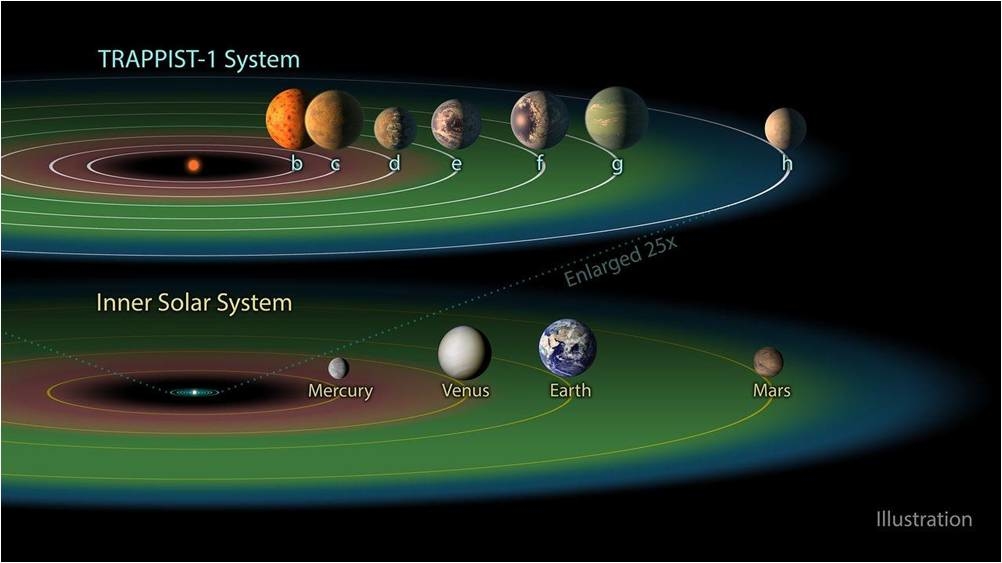
Illustration of the seven planets orbiting the TRAPPIST-1 ultra-cool low mass star. Planets e, f, and g orbit in the suspected habitable zone (green) based on the spectral type and
modeling of the system. Note: the size of the planets is greatly exaggerated compared to their orbital
radii and that the radial dimension of the TRAPPIST-1 system has been enlarged by a factor of 25. In
other words, the entire TRAPPIST-1 system would fit well inside the orbit of Mercury.
SOURCE: NASA/JPL-Caltech
Could the “light fingerprint” of these conditions suggest a weighty tyrannosaur traipsing across on Trappist-1e, perhaps a protoceratops on Proxima Centauri b, or a quetzalcoatlus on Kepler 1047c?
“Modern Earth’s light fingerprint has been our template for identifying potentially habitable planets, but there was a time when this fingerprint was even more pronounced – better at showing signs of life,” said Lisa Kaltenegger, director of the Carl Sagan Institute (CSI) and associate professor of astronomy in the College of Arts and Sciences.
“This gives us hope that it might be just a little bit easier to find signs of life – even large, complex life – elsewhere in the cosmos,” Kaltenegger stated in a university press statement.
More oxygen
One catch: while similar evolutionary processes leading to roaming dinosaurs may or may not unfold on exoplanets, the new modeling fills in the missing puzzle piece of what a Phanerozoic Earth would look like to a telescope. That modeling in hand is helping to create new templates for habitable planets with varying atmospheric oxygen levels.
The new research led by Rebecca Payne, a research associate exoplanet detective at CSI and in the Department of Astronomy and co-authored by Kaltenegger, appears in the Monthly Notices of the Royal Astronomical Society: Letters, Volume 527, Issue 1, January 2024.
Regardless of the prospect of exoplanets being a denizen of dinosaurs, the models confirm that from a great distance, such a planet’s light fingerprint would stand out more than a modern Earth’s.

Image credit: Universal Pictures
“Hopefully we’ll find some planets that happen to have more oxygen than Earth right now, because that will make the search for life just a little bit easier,” Kaltenegger said. “And who knows, maybe there are other dinosaurs waiting to be found.”
Jurassic Park – live-action remake?
To date, about 40 rocky exoplanets have been found in habitable zones where oceans could exist. Planets like Phanerozoic Earth are viewed as extremely promising targets for finding life in the cosmos.
While it may be too early to send moviemaker Steven Spielberg and crew for a Jurassic Park live-action remake, the research is seen as “a tool to plan and optimize our observation strategy, train retrieval methods, and interpret upcoming observations with ground- and space-based telescopes in order to identify life on Earth-like exoplanets.”
To access this intriguing new work, go to:
 Posted in Space News

