 By
By  June 20th, 2017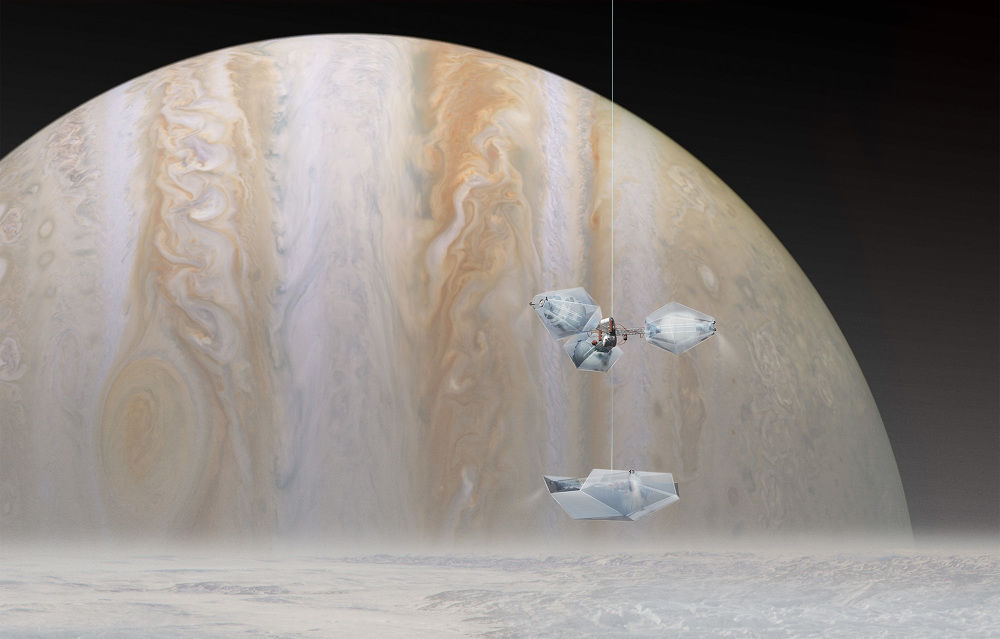
Credit: Clouds AO
Forget looking but don’t touch!
The concept is called HydroLander – an interplanetary long duration exploration vehicle focused on a human, on-the-spot search for life on the icy moons of Jupiter and Saturn.
According to the principal architects of the idea — Ostap Rudakevych and Masayuki Sono at the Clouds Architecture Office in New York – this explorer module is able to touch down on the surface of those icy worlds and take samples or harvest water ice.
Credit: Clouds AO
Crew of six
In an update on their research, they note:
“The icy moons of Saturn and Jupiter are believed to have oceans of liquid water and are thus prime candidates for extra-terrestrial life. This proposal is for an interplanetary vehicle to house a crew of six on a long duration exploration of icy moons in the Jovian and Saturnian systems.
Inflatable elements
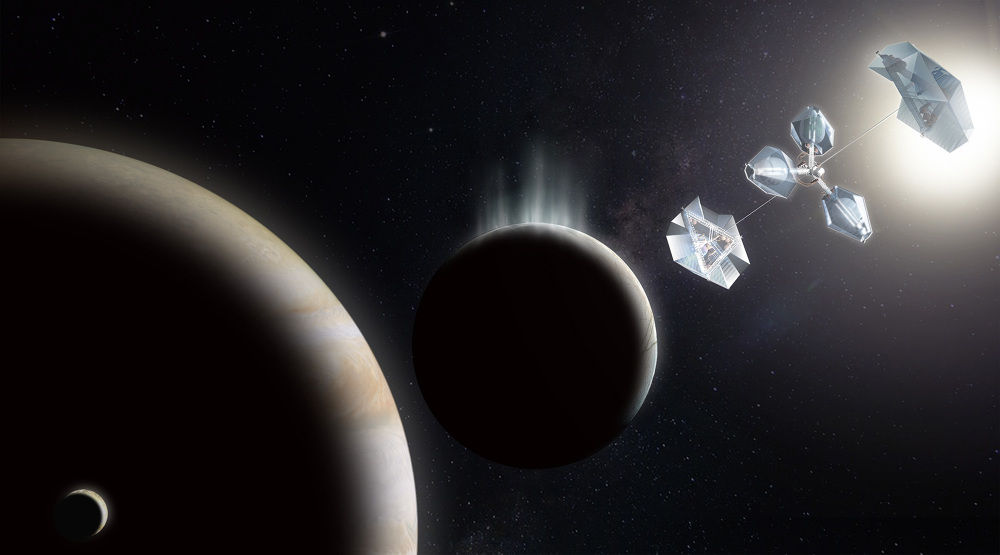
As detailed by Sono and Rudakevych, the vehicle is a low mass hybrid of rigid and inflatable structural elements. During interplanetary travel the vehicle is in a compact state allowing for induced gravity from rotation. Inhabited pods would spin about a central axis generating 1 G of centrifugal gravity.
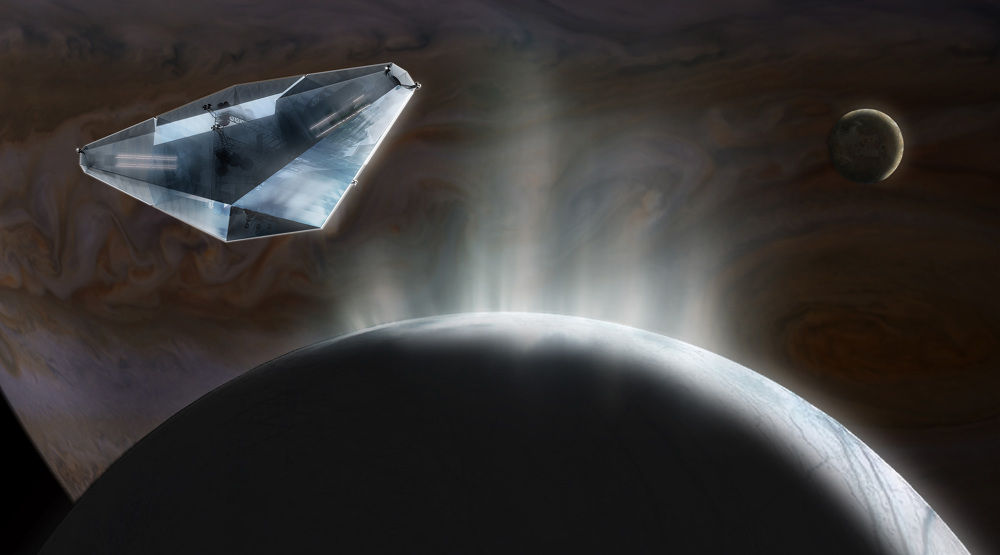
“The concept consists of three pressure vessels surrounded by transparent and translucent water ice for radiation shielding and views out. When the vehicle reaches a target moon it would stop spinning and park in an L1 spot (stable Lagrange Point),” the researchers note.
Credit: Clouds AO
Lowered via tether
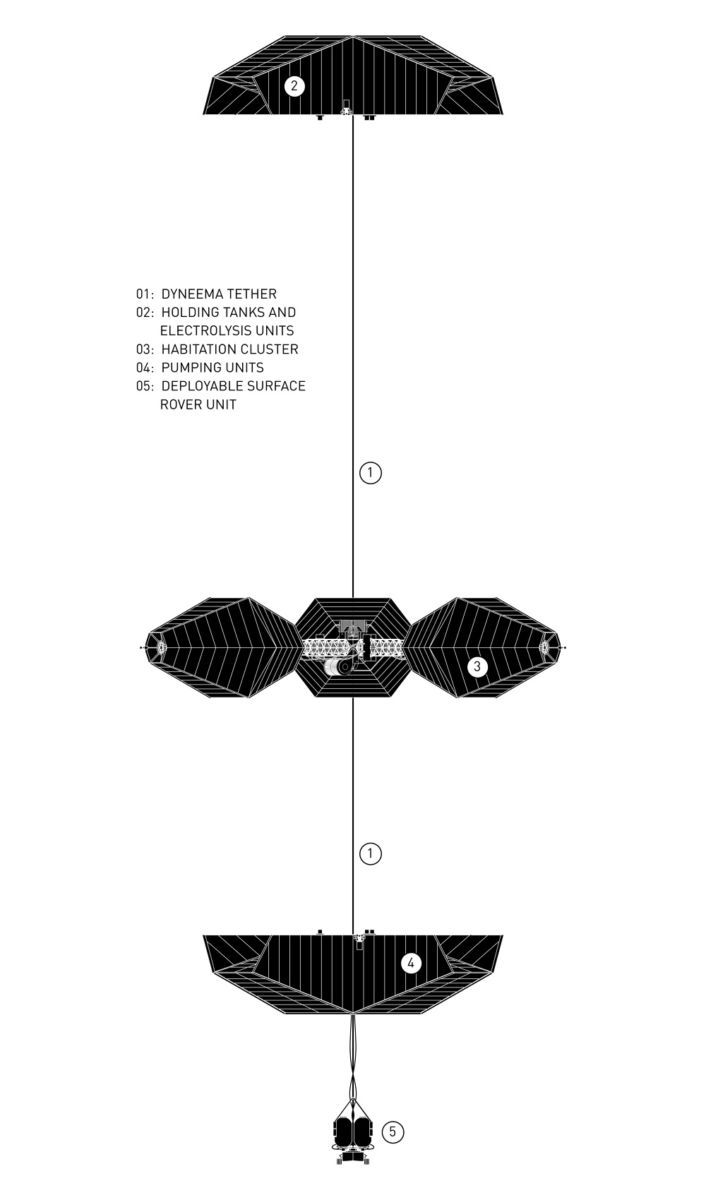
From there, the habitat and surface modules would be lowered on a tether from the supporting counterweight at L1.
“The tethered expansion of the units allows for slow and steady analysis of atmospheric conditions on the way down to the surface. At its extreme limit the explorer module is able to touch down on the surface and take samples or harvest water ice,” they explain.
Credit: Clouds AO
The system can run indefinitely since it can recharge its supply of propellant by electrolyzing water. The unlimited supply of fuel allows for more flexibility in mission planning and adjustments based on findings by the human crew.
Be advised that this idea is filed at Clouds Architecture Office as speculative, space, architecture.
Go to this video at:
 Posted in Space News


Have they done any calculations on where the Jupiter/Europa L1 point is? How stable it is? How long the cable would have to be, and how much would it have to weigh?
It’s an interesting concept, but without more details, hard to tell if it really closes.
~Jon