 By
By  April 8th, 2017
Credit: Center for Space Policy & Strategy
Satellites operate in a vacuum; policy makers do not.
The Aerospace Corp.’s Center for Space Policy & Strategy has initiating a White Paper series to address space policy, strategy, and technology topics.
These documents are designed to provide context and points of consideration for important space and technology topics. This library will be expanded and updated on a continuing basis.
A set of White Papers now includes:
1)
National Space Council: History and Potential
Since the dawn of the Space Age, most presidential administrations have had some form of space advisory group. A space council in the Executive Office of the President can be a boon if it works well—aligning policy and strategy across the civil, commercial, and defensive space sectors to serve national interests—or a wasteful exercise if it doesn’t.
http://www.aerospace.org/publications/white-papers/national-space-council-history-and-potential/
2)
Considerations for the Next National Space Policy
Over the past four decades, presidential directives on national space policy, with the intent of providing overarching guidance on civil, commercial, and national security space, have become standard. A new policy directive could simply reiterate many long-held positions—or set new directions and settle unanswered questions.

DSCOVR spacecraft view of the entire sunlit side of Earth from one million miles away, as seen on July 6, 2015.
Credit: NASA
3)
Updating National Policy on Commercial Remote Sensing
The current U.S. commercial remote sensing policy was not designed to accommodate the number, the increasing capabilities, the diverse applications, and the expanding array of global operators of modern remote sensing satellite systems. A revised presidential directive could provide needed guidance on the government’s treatment of satellite imagery and related hardware, software, and value-added services marketed to commercial and foreign entities.
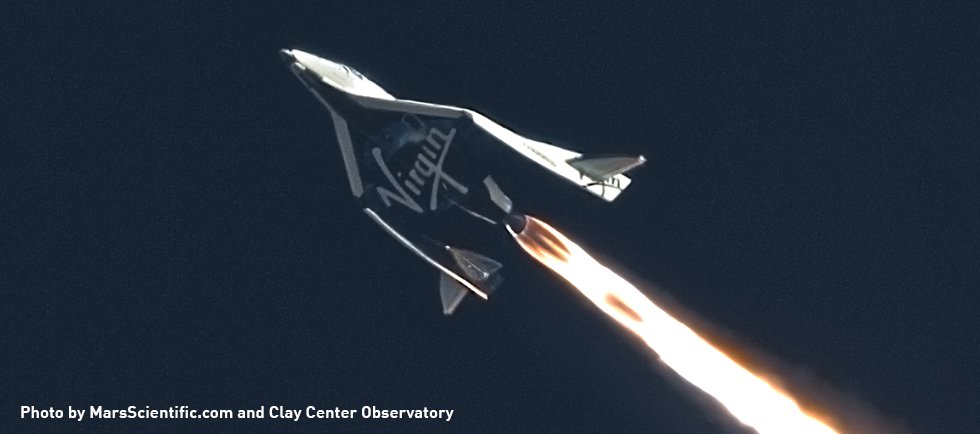
Virgin Galactic’s SpaceShipTwo is shown making a rocket-powered test flight on Jan. 10, 2014.
Credit: MarsScientific.com/Clay Center Observatory
4)
International Commercial Spaceflight Regulation: Assessing the Options
Analysts have begun to address commercial spaceflight regulation, asking questions such as: Does this emerging industry need something akin to the International Civil Aviation Organization? If so, how soon is it needed, what would it look like, and what should be within its jurisdiction?

The crowded space environment may look like this a decade from now, with proposed mega-constellations.
Credit: Center for Space Policy & Strategy
5)
Orbital Debris Remediation through International Engagement
Orbital debris constitutes a serious and growing threat to space operations. As technical barriers to on-orbit cleanup are overcome, political and legal barriers will loom larger. Nonetheless, it is possible to surmount these barriers within the current environment of international treaties and norms.
6)
Orbital Slots for Everyone?
Vast constellations of satellites bring greater risk for collisions and the creation of debris—and no organization is responsible for assessing how they may impact the broader space community. In a future world of mega-constellations, is the unregulated status quo for orbit selection a sustainable path?
http://www.aerospace.org/publications/white-papers/orbital-slots-for-everyone/
For more information on the Center, go to:
 Posted in Space News


Leonard – thanks for the mention of our reinvigorated Center. We look forward to publishing more papers on additional topics of interest, and to a sustained dialogue with the space policy community.