 By
By  January 1st, 2017

Features called recurring slope lineae (RSL) have been spotted on some Martian slopes in warmer months. Some scientists think RSL could be seasonal flows of salty water. Red arrows point out one 0.75-mile-long (2 kilometers) RSL in this image taken by NASA’s Mars Reconnaissance Orbiter.
Credit: NASA/JPL-Caltech/Univ. of Arizona
A major Mars finding in recent years has been discovery of recurring slope lineae in certain areas of the Red Planet. These dark fingers of mystery – RSL in Mars shorthand — emerge from steep, rocky exposures. They incrementally grow, fade, and reform on a seasonal basis.
What RSL truly represent is debatable, but some researchers say they are suggestive that liquid water occurs on or near the surface of Mars today.
Question: Do RSL make noise?
Listen up
NASA’s 2020 Mars rover is to carry special cameras and microphones to capture stunning views and sounds, and not just its barnstorming entry and descent toward the Red Planet.
If the robot achieves a safe touchdown, the rover’s onboard microphones could put an ear to Mars, adding to the ambience of exploration.
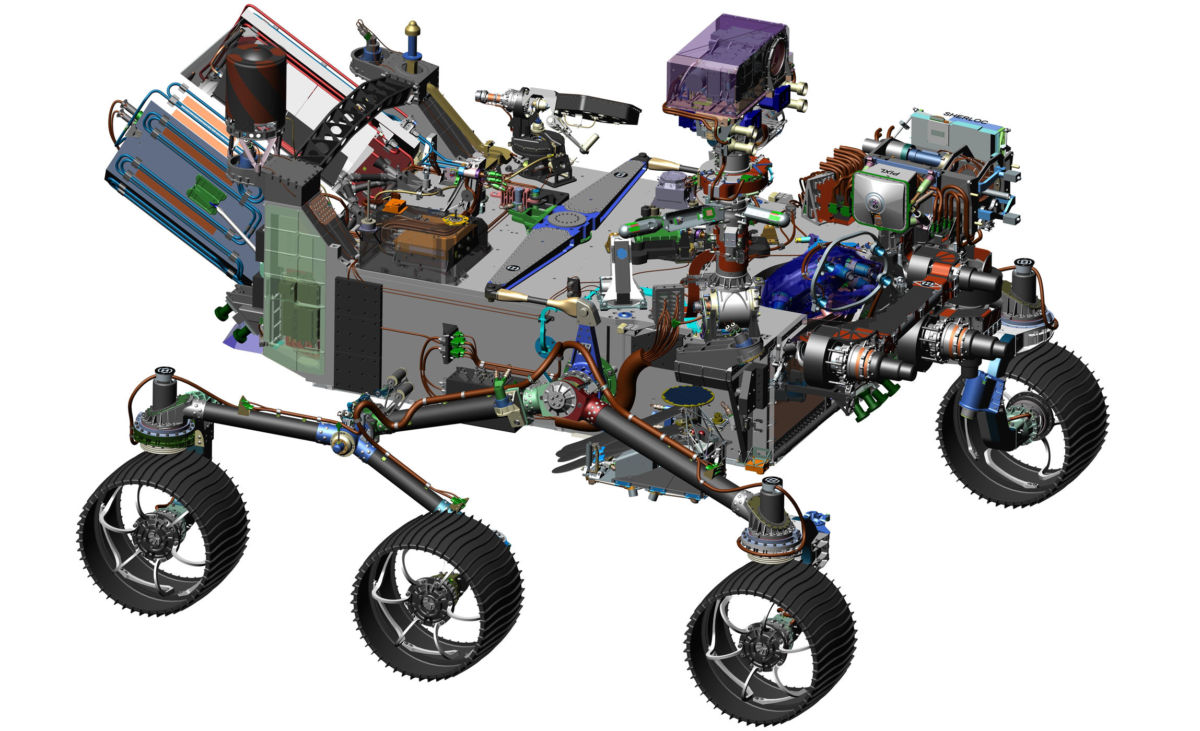
The listening robot. New computer generated image of Mars 2020 rover.
Credit: NASA/JPL/Caltech
The future rover’s landing site has yet to be chosen…and given the gift of hearing, just what could its microphones pick up?
In an interview I did last year with Matthew Wallace, Mars 2020 rover deputy project manager at NASA’s Jet Propulsion Laboratory in Pasadena, California, he said the sounds of rover wheels trekking across the planet, the drill drilling, and rover’s mast moving are likely to be heard. High-speed wind bursts too.
From a distance
Any hope of hearing RSL?
“Probably not much…like grain flows, maybe some faint hissing or popping sounds?”
That’s the response from Alfred McEwen, a planetary geologist and director of the Planetary Image Research Laboratory at the University of Arizona in Tucson. He is the principal investigator of the High Resolution Imaging Science Experiment (HiRISE) for NASA’s Mars Reconnaissance Orbiter.
HiRISE has been the major tool in stimulating an “outpouring” of interest in RSL.
While HiRISE observations of RSL have been interpreted as present-day, seasonally variable liquid water flows, Mars-orbiting spectroscopy of the features has not confirmed the presence of liquid water, only hydrated salts.
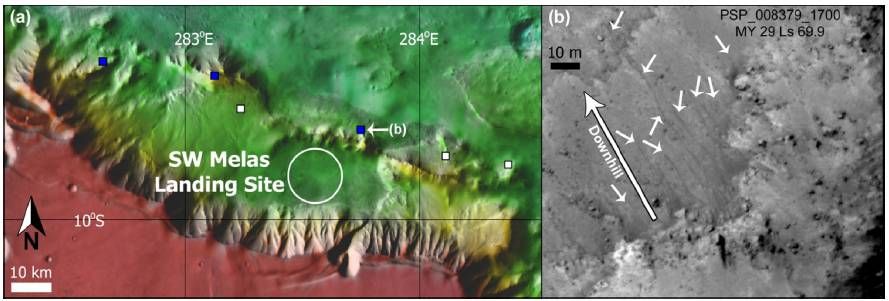
Candidate RSL near the potential SW Melas Mars 2020 rover landing site – one of eight now under review.
Credit: D.E. Stillman et al.
Planetary protection
Whatever they are, say a rover is safely positioned near RSL activity, what’s the chance of hearing and seeing RSL in action?
Such a circumstance is moot as a rover won’t go near any candidate RSL due to NASA planetary protection rules. Where there is water, so too there may be microbial life.
“They probably make a little bit of noise, but the Mars 2020 probably could not hear it as it would be too far away,” said David Stillman, senior research scientist at the Southwest Research Institute in Boulder, Colorado.
Atmospherics
Adds John Rummel, a senior scientist at the SETI Institute with a distinguished track record in astrobiology and planetary protection issues:
“My guess is that you could get noise produced by a group of RSL,” Rummel said, “much the way that you can hear water running under a group of aspen in a small copse in the mountains in spring, even though it is hard to identify exactly where the noise is coming from.”
A copse is a thicket of bushes or a small stand of trees.

NASA Mars Reconnaissance Orbiter’s HiRISE image of recurring slope lineae in Melas Chasma, Valles Marineris. Arrows point out tops and bottoms of a few lineae.
Credit: NASA/JPL-Caltech/University of Arizona
But how far that noise could be received with such a small amount of atmosphere on Mars, “remains to be heard,” Rummel told Inside Outer Space.
“I would guess that you wouldn’t hear anything much, even if the noise were being produced right next to you. There is just not enough atmosphere to carry the sound,” Rummel added. “Sales figures for picnic boom-boxes on Mars will be slow, at first!”
All ears, eyes
For more information on how the Mars robot will be “all ears and eyes,” go to my Space.com story:
Mic’d Up on Mars! 2020 Rover Will Capture Sounds of Red Planet
August 4, 2016 07:00am ET
http://www.space.com/33637-nasa-mars-2020-rover-microphone.html
 Posted in Space News

