 By
By  December 8th, 2016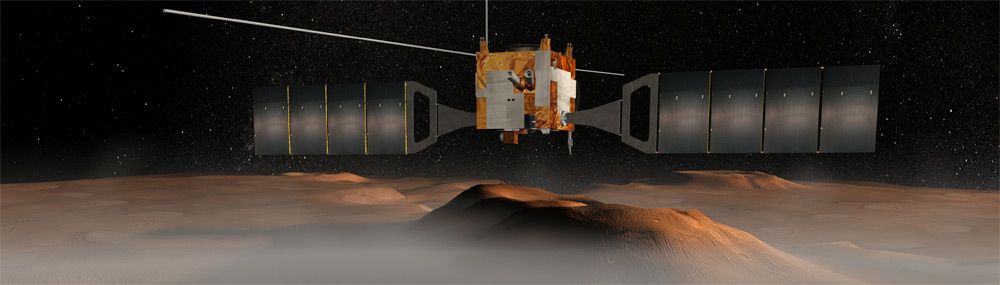
Credit: ESA/DLR
Take a trip down Mawrth Vallis – a dried-up outflow channel Mars.
This visual trek comes courtesy of the High Resolution Stereo Camera (HRSC) operated by the German Aerospace Center (Deutsches Zentrum für Luft- und Raumfahrt; DLR) on board the European Space Agency’s Mars Express spacecraft.

The first all-European mission to another planet – Mars Express – was launched on June 2, 2003. On board the spacecraft was the High Resolution Stereo Camera (HRSC), which was developed by the DLR Institute of Planetary Research. HRSC was the first camera system on a planetary mission to systematically acquire high-resolution, three-dimensional image data in color.
Credit: Deutsches Zentrum für Luft- und Raumfahrt e. V. German Aerospace Center (DLR)
Digging down
Mawrth Vallis is one of the potential targets for the second part of ESA’s ExoMars mission (2020), in which a rover will analyze rock samples down to a maximum depth of two meters.
The valley may have been capable of supporting life in the past. Some scientists even think it is possible that traces of life might still exist in the valley’s lower layers.

ExoMars 2020 rover.
Credit: ESA
Scientists from the Freie Universität Berlin have created a simulated overflight animation along the course of the valley from the digital terrain model calculated at the DLR Institute of Planetary Research.
Friendly to life?
Mawrth Vallis is thought to be an ideal locale for the search for life on Mars based on a couple of reasons:

Mawrth Vallis is one of four candidate landing sites under consideration for the ExoMars 2018 mission. It is one of the oldest outflow channels on Mars, at least 3.8 billion years old.
Credit: ESA/DLR/FU Berlin & NASA MGS MOLA Science Team
- Firstly from the volume of hydrated (water-retaining) minerals that can be identified using the cameras and spectrometer data from the various Mars spacecraft in orbit around the planet.
- Secondly, it is known from Earth that such clay minerals form in comparable – neither acidic nor alkaline – water. Such environmental conditions are also thought to be particularly friendly to life.
Visual field trip
Mawrth Vallis is roughly Approximately 373 miles (600 kilometers) long and up to 1.2 miles (two kilometers) deep.
Numerous impact craters and light and dark deposits can be seen. The light, layered sediments are among the largest deposits of sheet silicates on Mars. These clay minerals are found in numerous places and are an indication that liquid water existed in this region.
Mawrth Vallis is a potential ExoMars 2020 landing site target that is under consideration, as are Oxia Planum, Aram Dosum and Hypanis Vallis.
For your visual field trip, go to:
http://www.esa.int/spaceinvideos/Videos/2016/12/Fly_over_Mawrth_Vallis
 Posted in Space News

