 By
By  September 5th, 2016
ESA/Rosetta/MPS for OSIRIS Team MPS/UPD/LAM/IAA/SSO/INTA/UPM/DASP/IDA
The European Space Agency announced today that the Philae comet lander has been found!
Images taken by ESA’s Rosetta spotted the lander, wedged into a dark crack on Comet 67P/Churyumov–Gerasimenko.
Imagery clearly shows the main body of the lander, along with two of its three legs.

This series of 19 images, acquired by the Rosetta orbiter’s Optical, Spectroscopic, and Infrared Remote Imaging System (OSIRIS) on November 12, 2014, shows the Philae lander during its descent towards Comet 67P/Churyumov-Gerasimenko.
Credit: ESA/Rosetta/MPS for OSIRIS Team MPS/UPD/LAM/IAA/SSO/INTA/UPM/DASP/IDA
Ballistic bounces
Back in November 2014, Philae was last seen when it first touched down at Agilkia, bounced and then flew for another two hours before ending up at a location later named Abydos, on the comet’s smaller lobe.
After three days, Philae’s primary battery was exhausted and the lander went into hibernation, only to wake up again and communicate briefly with the Rosetta orbiter in June and July 2015 as the comet came closer to the Sun and more power was available.
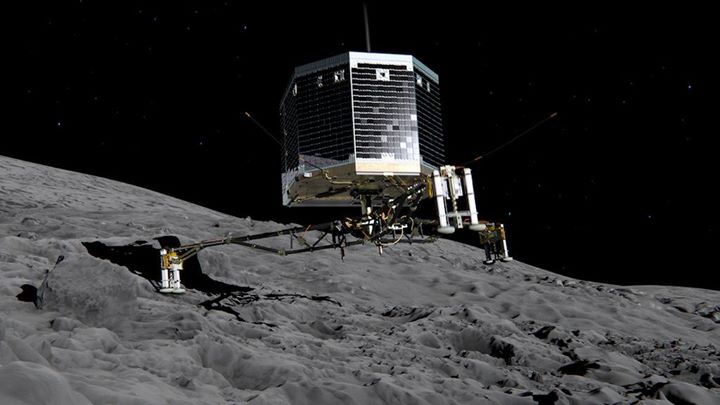
Artist view of the Philae lander that made historic landing.
Credit: ESA
Orbiter finale
The discovery comes less than a month before Rosetta descends to the comet’s surface. On September 30, the orbiter will be sent on a final one-way mission to investigate the comet from close up.
The images also provide proof of Philae’s orientation, making it clear why establishing communications was so difficult following its landing on November 12, 2014.
ESA scientists are keen on taking more images of the lost and now found Philae, with more details forthcoming about spotting the lander.
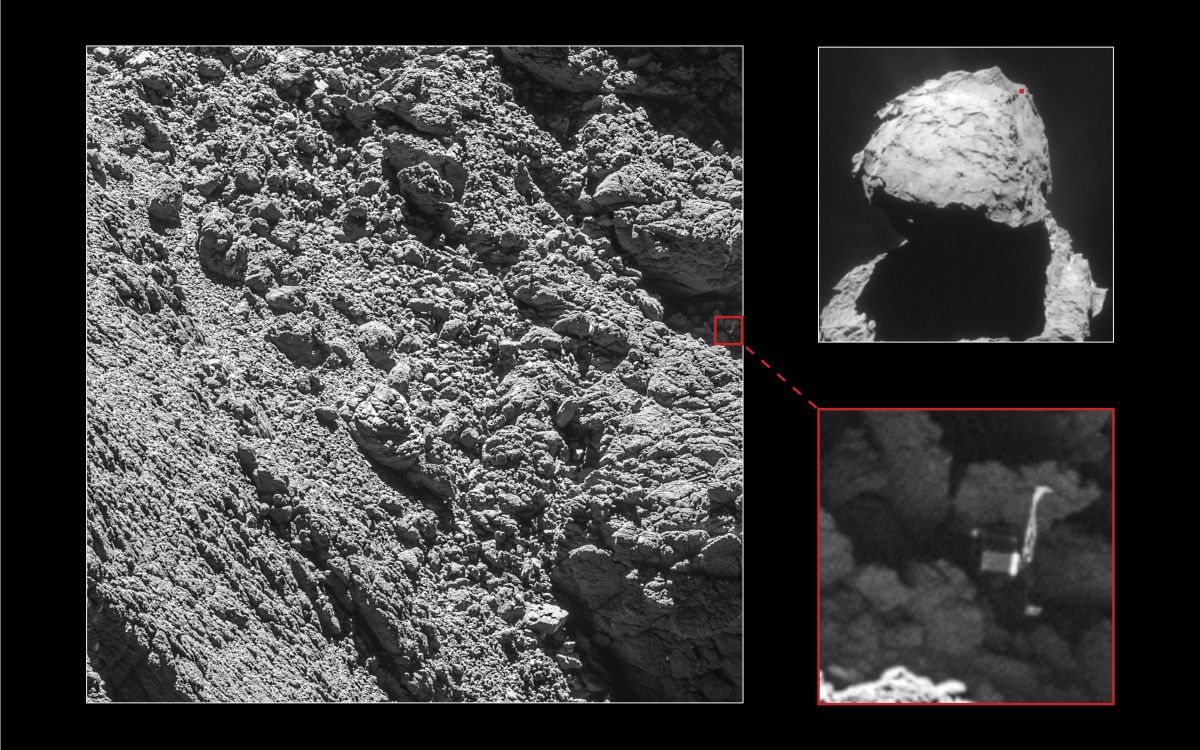
Main image and lander inset: ESA/Rosetta/MPS for OSIRIS Team MPS/UPD/LAM/IAA/SSO/INTA/UPM/DASP/IDA; context: ESA/Rosetta/NavCam – CC BY-SA IGO 3.0
 Posted in Space News

