 By
By  July 4th, 2016
Illustration of NASA’s Juno spacecraft firing its main engine to slow down and go into orbit around Jupiter.
Credit: Lockheed Martin
DENVER, Colorado – After 5 years of travel, NASA’s Juno spacecraft has gunned its way into orbit around giant Jupiter.
Launched on August 4, 2011 – the $1.13 billion Juno is the first solar-powered spacecraft designed to operate at Jupiter.

Size of Juno relative to a basketball court.
Credit: NASA/JPL-Caltech
The spacecraft fired its main engine for some 35 minutes to insert itself into orbit around the massive Jupiter.
Burn, baby, burn
Space engineers, scientists and general public well-wishers burst into applause here at Lockheed Martin Space Systems Company given the word that Juno attained an initial orbit.
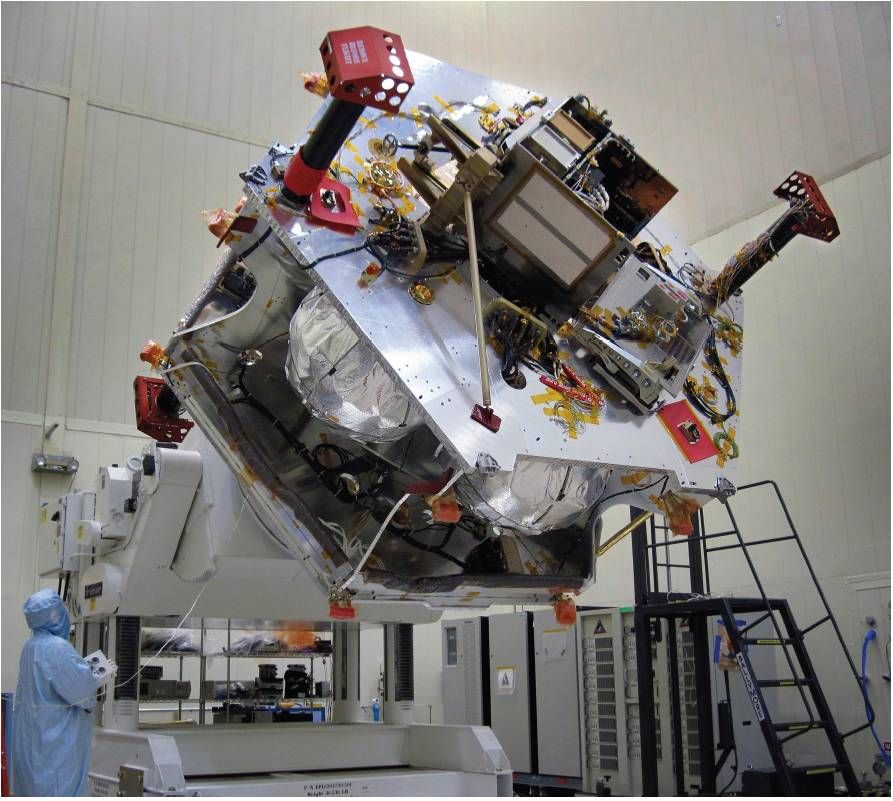
Juno’s specially designed radiation vault protects the spacecraft’s electronic brain and heart from Jupiter’s harsh radiation environment.
Credit: NASA/JPL-Caltech/LMSS
“The burn cut off within one second of what it was supposed to do,” reported Tim Gasparrini, Program Manager (Development) at Lockheed Martin.
It takes 48 minutes for transmission from Juno to get to Earth.
Lockheed Martin built the 4-ton Juno spacecraft and is on the flight operations team with the Jet Propulsion Laboratory (JPL) in Pasadena, California.
Sunblock
Juno’s primary goal is to improve our understanding of Jupiter’s formation and evolution.
Gasparrini detailed one of Juno’s engineering marvels – a large titanium vault. “It’s like sunblock,” he said.
To protect sensitive spacecraft electronics, the probe carries a radiation-shielded electronics vault, weighing about 400 pounds (200 kilograms).
This titanium box is about the size of a SUV trunk.

Kenneth Starnes, Lockheed Martin’s Juno program manager and leader of the Juno flight team.
Credit: Lockheed Martin
First big radiation dose
The mood of the team is one of elation, said Kenneth Starnes, Lockheed Martin’s Juno program manager and leads the Juno flight team. “We are in orbit,” he said.
Starnes told Inside Outer Space that the immediate task post-insertion was how well Juno’s solar panels are performing. “This was our first big radiation dose,” he said, with engineers also looking at the state of charge on the spacecraft’s batteries.
Providing Juno’s energy are 18,698 individual solar cells.
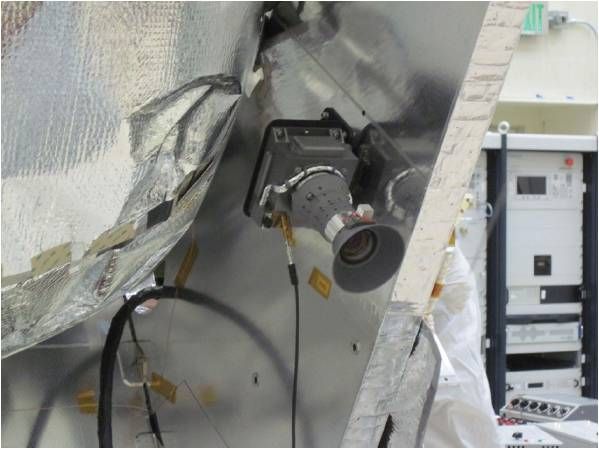
JunoCam is onboard the spacecraft, a visible-light camera that can provide the first pictures of Jupiter’s poles.
Credit: NASA/JPL-Caltech/LMSS
Ditching into Jupiter
Juno’s first two orbits are 53 day orbits, Gasparrini said, “time to understand how the spacecraft responded to Jupiter.”

Juno spacecraft being prepped for Jupiter at Lockheed Martin Space Systems. Bunny-suited Jack Farmerie, (left) Lockheed Martin’s lead spacecraft technician on the Juno project and SPACE.com reporter Leonard David (right).
Credit: Gary Napier
The spacecraft will orbit Jupiter 37 times.
Juno will nosedive into Jupiter at the end of its last orbit – closing off the almost one-and-a-half year science phase of the mission.
“NASA is extremely serious about protecting other worlds,” Gasparrini said. While a small probability, to assure the probe will not crash into any moon of Jupiter, the craft will be purposely ditched into Jupiter, he said.
For more information on the Juno mission, go to my 2011 story detailing its building and testing:
SPACE.com Gets an Inside Look at Jupiter-Bound Spacecraft
By Leonard David, Space.com’s Space Insider Columnist
February 23, 2011 07:09am ET
http://www.space.com/10889-jupiter-spacecraft-juno-person.html
 Posted in Space News


Hi Leonard. I knew you would be excited by this achievement..Wow ! think of the math involved with this undertaking. Had a nice visit with Felice & Ian Kay on Sunday.