 By
By  May 12th, 2016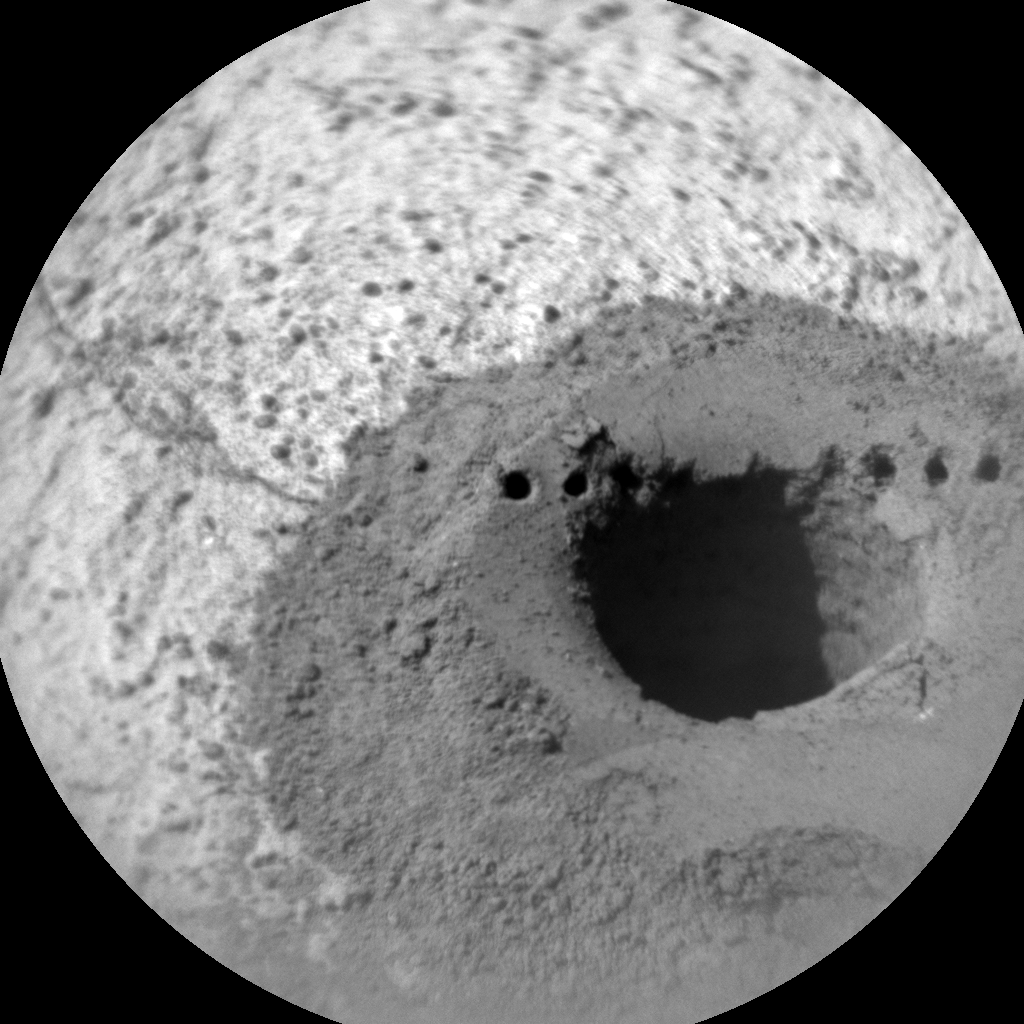
Curiosity’s ChemCam Remote Micro-Imager took this image on Sol 1338, May 11m 2016.
Credit: NASA/JPL-Caltech/LANL
Yesterday, on May 11, NASA’s Curiosity Mars rover has been on the surface of Mars for two Mars years – almost four Earth years.
During that time, the rover has made systematic measurements to compare how conditions change from year to year on the Red Planet.
Curiosity is now in Sol 1339, with the plan calling for the continuation of a drill campaign at the target “Okoruso,” reports Ryan Anderson, a planetary scientist at the USGS Astrogeology Science Center in Flagstaff, Arizona.
Also on tap for this Sol 1339, the rover’s Mars Hand Lens Imager (MAHLI) is to observe a pile of drill tailings that was dumped without being sieved.
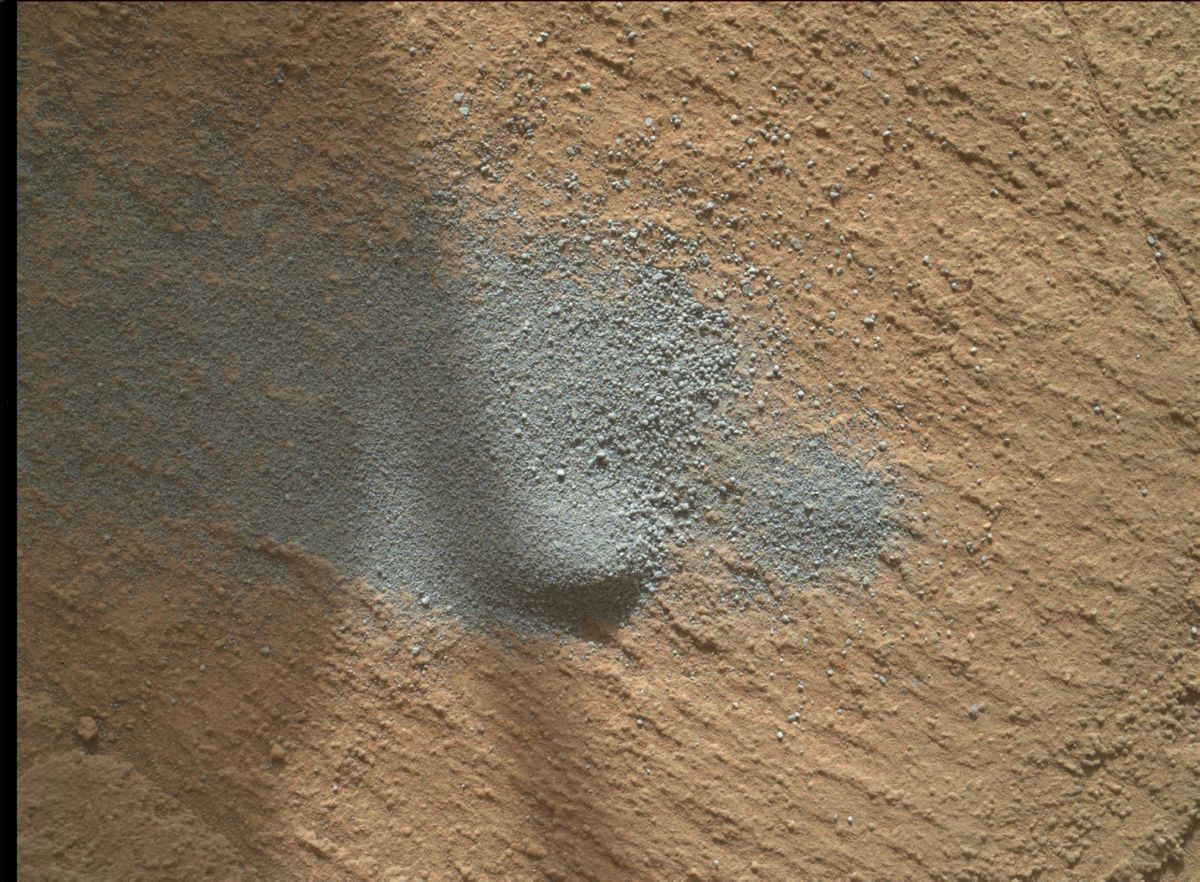
NASA’s Mars rover Curiosity acquired this image using its Mars Hand Lens Imager (MAHLI), located on the turret at the end of the rover’s robotic arm, on May 11, 2016, Sol 1337.
Credit: NASA/JPL-Caltech/MSSS
Science block
The robot’s Chemistry & Mineralogy X-Ray Diffraction/X-Ray Fluorescence Instrument (CheMin) is to complete the analysis from the Sol 1338 plan, and the Alpha Particle X-Ray Spectrometer (APXS) will make an overnight measurement of the dump pile.
Anderson notes that on Sol 1340, scientists have a targeted science block with the Chemistry & Camera (ChemCam) making passive and active observations of the dump pile, and active observations of the targets “Kobos 2”, “Stampriet”, and “Swartmodder.”
Curiosity’s Mastcam will then document those targets. Then Mastcam and Navcam will make some atmospheric dust observations.
Icing on the cake
On an eat your cake and have it all too, Anderson explains that French colleagues at CNES (Centre national d’études spatiales) made a Mars-themed cake to honor Curiosity’s two Mars years of exploration, “complete with a little rover exploring a delicious-looking cocoa-dusted martian surface!”
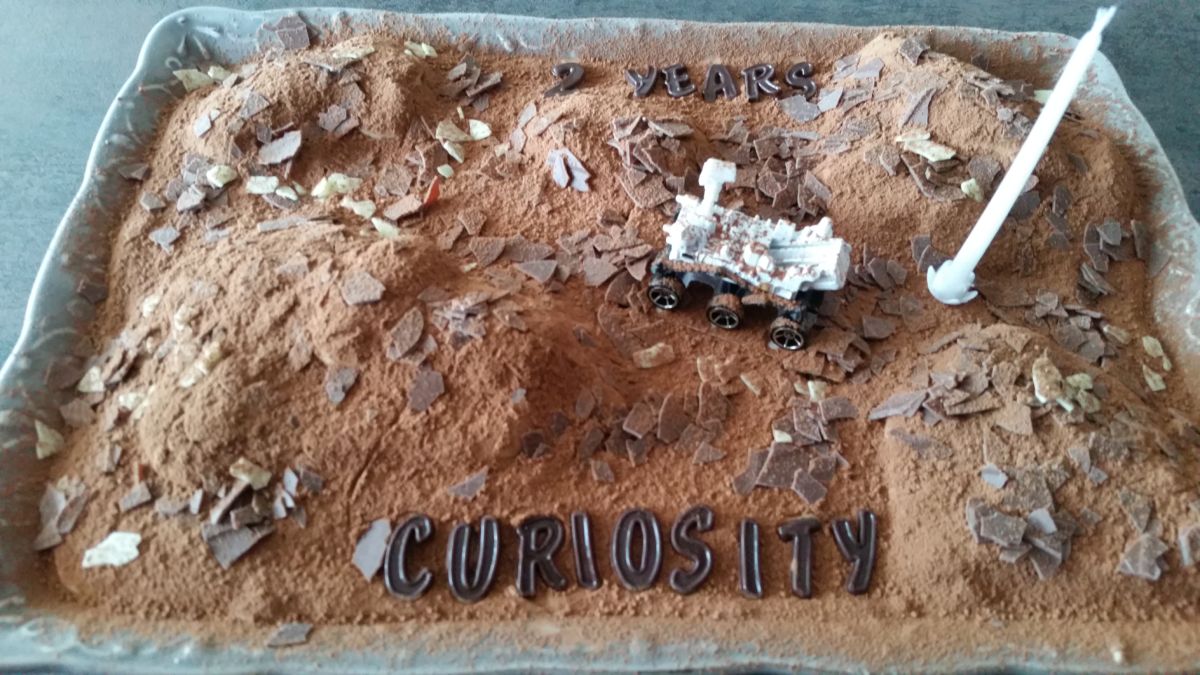
Tiramarsu cake made by French colleagues engaged in the Curiosity rover’s Mars exploration.
Credit: USGS
Meanwhile, the makings of a new Curiosity “selfie” appear to be now back here on Earth! Curiosity’s selfie requires 60 different images, and takes nearly an hour to acquire.

This picture is a thumbnail version of a larger image, a merged product from the Mars Hand Lens Imager (MAHLI) to create a rover selfie. MAHLI is located on the turret at the end of the rover’s robotic arm, taking this image on May 11, 2016, Sol 1338.
Credit: NASA/JPL-Caltech/MSSS
Dates of planned rover activities are subject to change due to a variety of factors related to the martian environment, communication relays and rover status.
 Posted in Space News

