 By
By  May 4th, 2016
SpaceX Dragon makes use of Supersonic Retro-Propulsion (SRP) to land on Mars.
Credit: SpaceX
One small tweet for humankind…a giant leap to Mars?
A lot of high fives have been flying since Elon Musk and his fellow Musketeers tweeted April 27: “Planning to send Dragon to Mars as soon as 2018. Red Dragons will inform overall Mars architecture, details to come.”
Details aside, at SpaceX they’ve never been secretive about future intentions, as noted on the company’s website.
“SpaceX designs, manufactures and launches advanced rockets and spacecraft. The company was founded in 2002 to revolutionize space technology, with the ultimate goal of enabling people to live on other planets.”
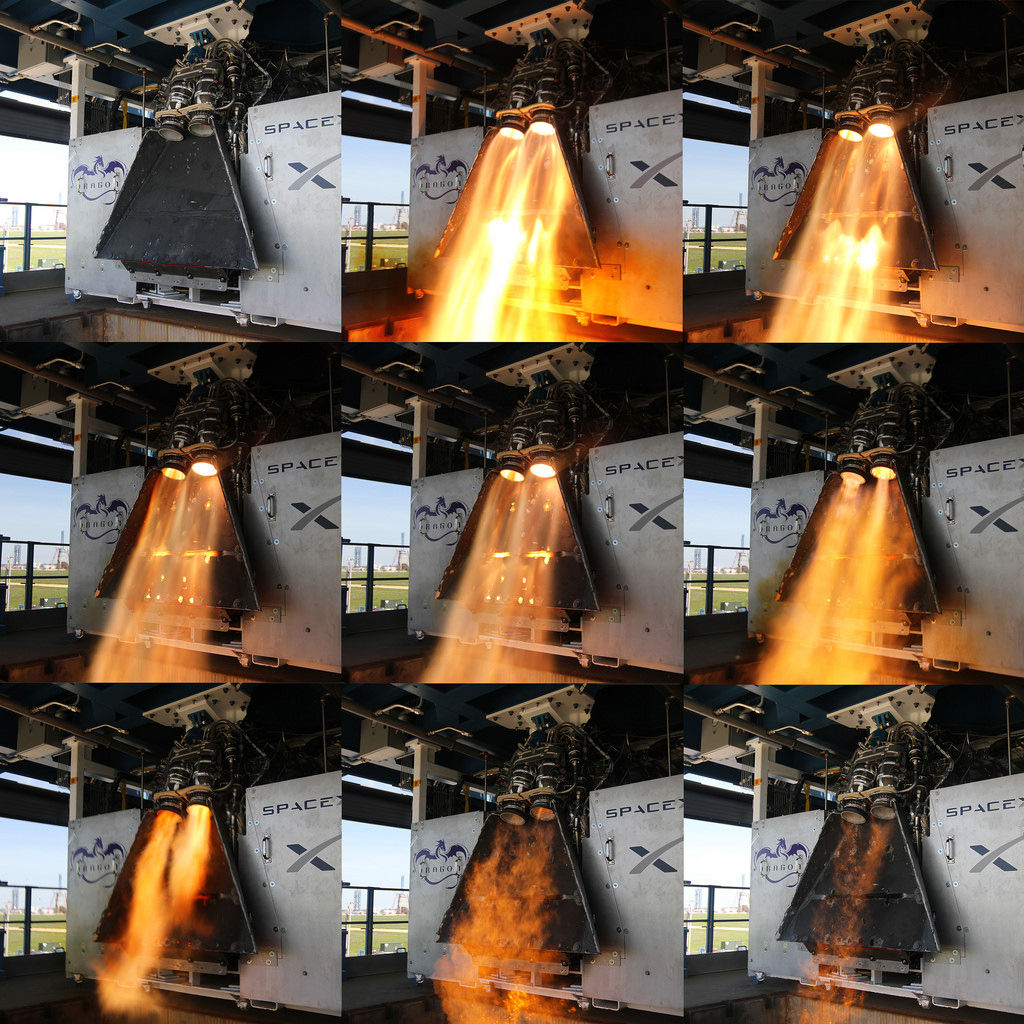
SpaceX testing of SuperDraco rocket engines is in full-blast mode.
Credit: SpaceX
To that end goal, enter the SpaceX SuperDraco – a hypergolic propellant liquid rocket engine. It is part of SpaceX’s Draco family of rocket engines. A redundant array of eight SuperDraco engines provides fault-tolerant propulsion for use as a launch escape system and propulsive-landing thrust for the Dragon V2 passenger-carrying space capsule.
Dealing with Deceleration
The other key to the kingdom of Mars is Supersonic Retro-Propulsion (SRP).
Human-scale Mars landers require the delivery of much heavier payloads to the surface of Mars than previously attempted. Most current concepts for large Mars landers are not able to passively achieve subsonic velocities and must use SRP to perform the final deceleration and a soft landing on the Martian surface.
“We have been studying SRP-based entry, descent and landing systems for both human and robotic scale for a few of years now. I am hopeful,” explains Rob Manning, chief engineer and a Mars authority at the Jet Propulsion Laboratory on getting big payloads down safe and sound on the Red Planet.
Parachutes are still in the future for Mars Science Laboratory/Curiosity rover-scale missions and smaller, Manning told Inside Outer Space. “SRP has a big overhead in cost and mass that the big launch vehicles can help overcome,” he adds.
Building blocks
Bullish on Elon Musk’s march to Mars is Robert Braun of the Georgia Institute of Technology’s Daniel Guggenheim School of Aerospace Engineering.

Supersonic Retropropulsion profile.
Credit: Humphrey Price, Robert Manning, Evgeniy Sklyanskiy, Robert Braun
“SpaceX’s plan to land a robotic mission on Mars is inspiring, ground-breaking, and a testament to the innovative culture that is alive and well in the U.S. space industry,” Braun tells Inside Outer Space.
“Once Falcon Heavy and Dragon 2 are flying on Earth, SpaceX will have the building blocks needed to land on Mars,” Braun adds.

First stage landing taken by remote camera photo from “Of Course I Still Love You” droneship on April 8, 2016.
Credit: SpaceX
Mars-relevant
Braun points out that SpaceX utilizes supersonic retropropulsion technology in Mars-relevant conditions each time they return their first-stage booster to Earth.
“Having reviewed this data, I don’t believe there are any SRP showstoppers on the path to the Mars surface,” Braun says. Because this entry, descent and landing approach — blunt-body entry followed by SRP to the surface — is scalable to larger payloads “this EDL architecture has promise for one day landing humans on Mars,” he advises.
“Don’t get me wrong, any landing on Mars, particularly a new architecture, is a risky proposition,” Braun points out. “But, you’ve got to give them credit. Their plan relies extensively on systems they will be flying on Earth over the next few years. That certainly improves their chances of success at Mars,” he concludes.
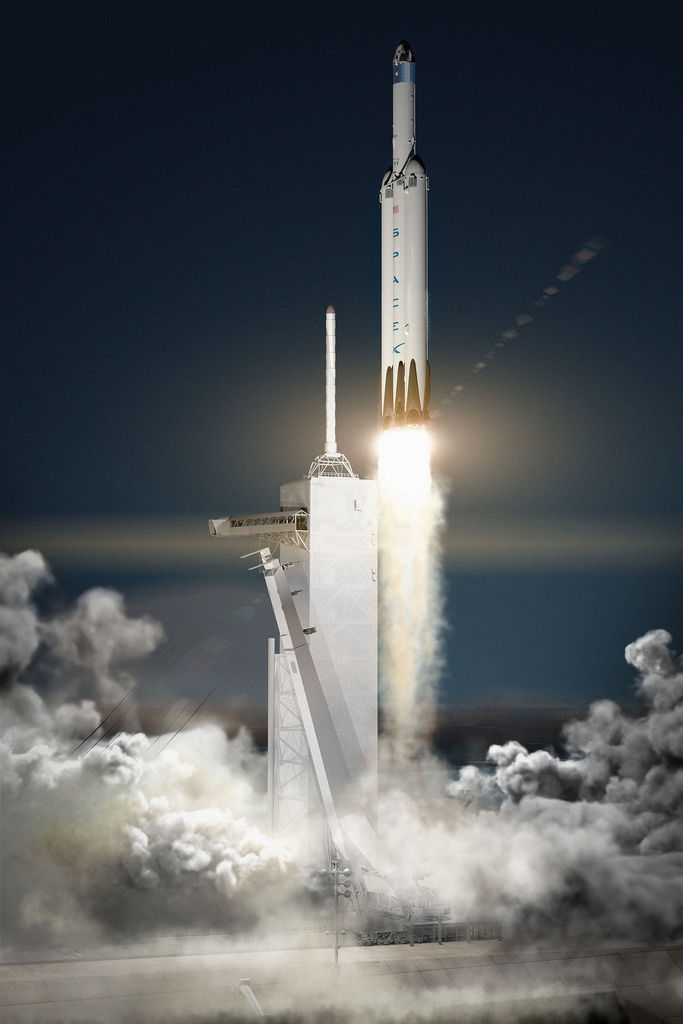
Artist’s view of still to fly SpaceX Falcon Heavy.
Credit: SpaceX
Details to follow
One of those details yet to follow is what possible payloads could Dragon ships plop down on Mars? Options include deployable science gear to look for life, trial-run oxygen and propellant production gear using local resources on Mars – perhaps even shoot back to Earth samples of the Red Planet.
For sure, NASA engineers are keen on instrumenting up the tail pipe any Mars-bound Dragon to gain more SRP data.
Musk has advised that he’ll roll out details on the SpaceX Mars plan during the International Astronautical Congress to be held September 26-30 this year in Guadalajara, Mexico.
 Posted in Space News

