 By
By  April 2nd, 2016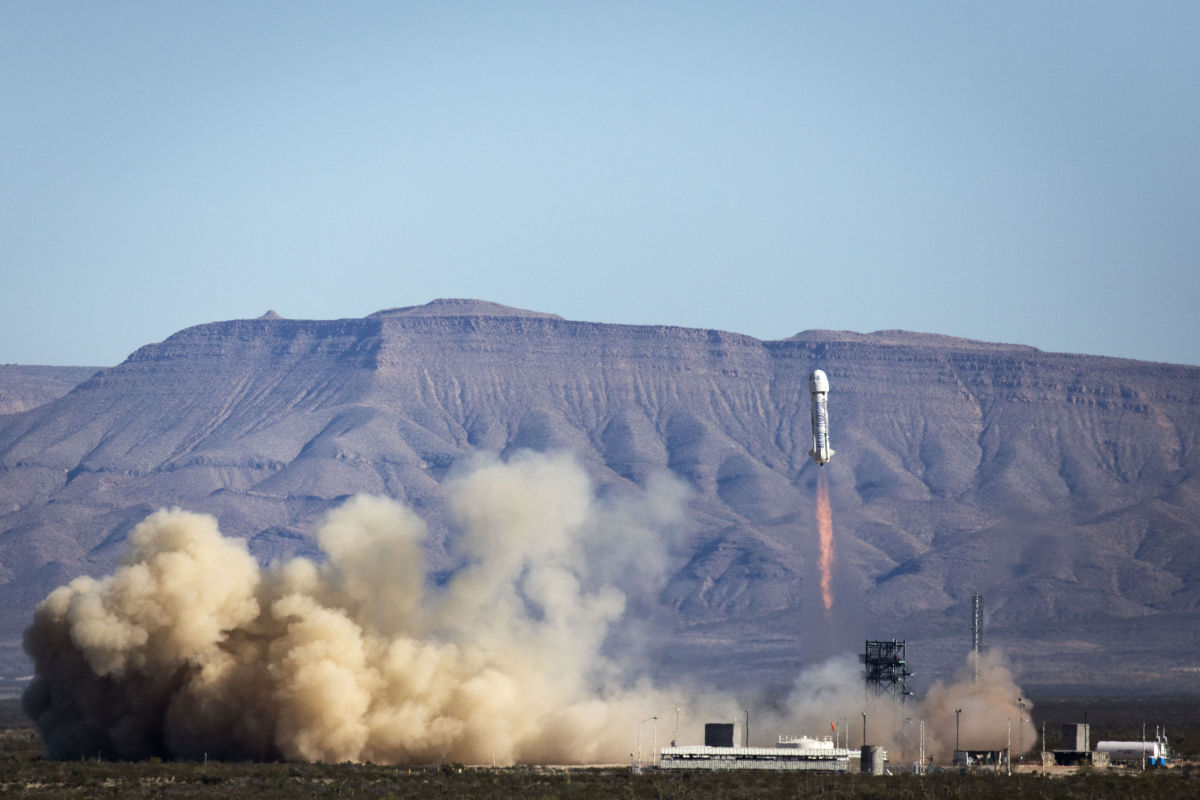
The reusable New Shepard space vehicle ascends through clear skies to an apogee of 339,138 feet.
Credit: Blue Origin
Jeff Bezos, the rocketeer and Amazon.com billionaire, reports today that his Blue Origin team has aced yet another flight of their New Shepard suborbital vehicle.
“We’ll share mission video including aerial as soon as we’re able to get it processed,” Bezos posted on Twitter. The rocket flight was done from the Blue Origin spaceport in West Texas.

BE-3 engine restarted at 3,635 feet above ground level and ramped fast for a successful landing.
Credit: Blue Origin
Bezos noted that the team pushed the envelope on their vehicle, restarting the rocket’s BE-3 high thrust engine just 3,600 ft from ground. The vehicle would impact in 6 seconds if that engine didn’t restart and ramp up fast, he tweeted.
“Flawless BE-3 restart and perfect booster landing,” Bezos added.
Onboard experiments
Two university microgravity experiments were onboard the vehicle. One investigation came from the Southwest Research Institute, a box of rocks experiment that offered insight into rocks on the surface of an asteroid; the other came from the University of Central Florida that delves into impacts between objects in microgravity.
The Southwest Research Institute experiment designed to better understand the rocky soil on small, near-Earth asteroids flew aboard Blue Origin’s reusable New Shepard space vehicle. Principal Investigator: Dr. Dan Durda.
Go to video:
A University of Central Florida experiment designed to mimic impacts between objects in microgravity also flew on Blue Origin’s reusable New Shepard space vehicle. Principal Investigator: Dr. Joshua Colwell.
Go to video:
https://www.youtube.com/watch?v=dVKBj4LmOm4
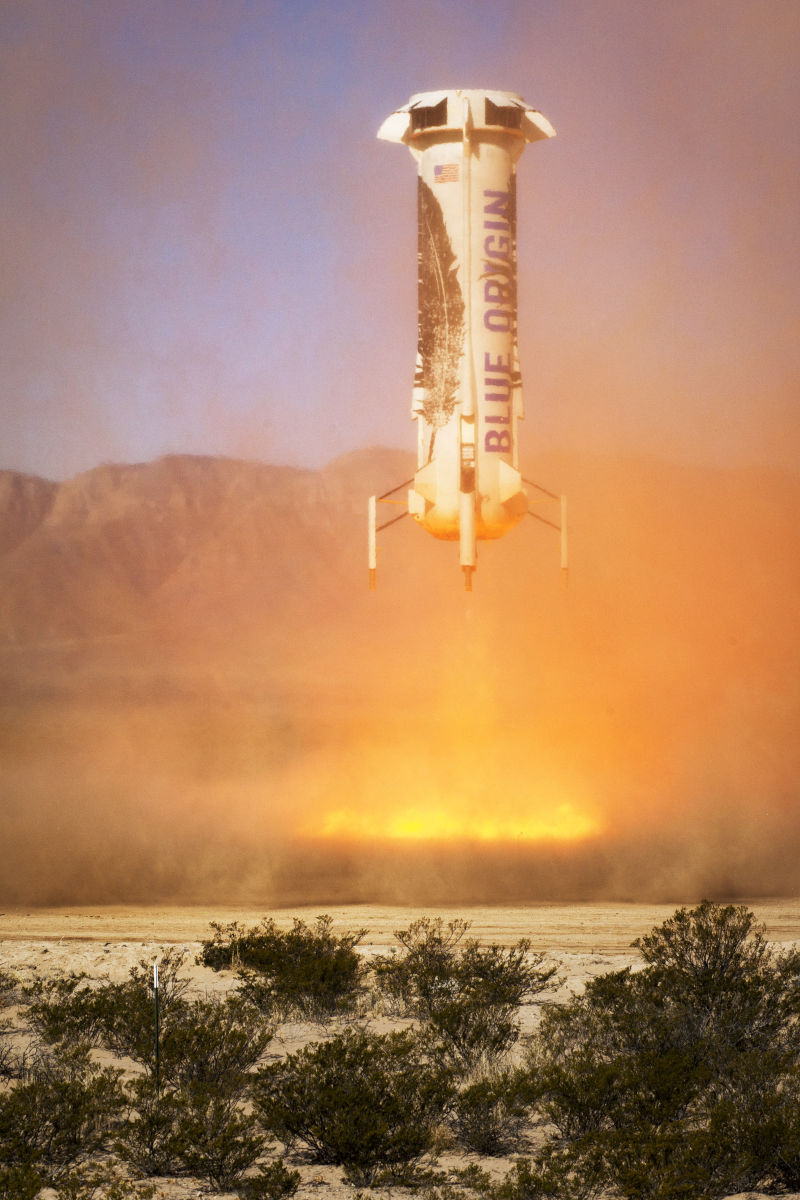
Precise thrust vector control and deep throttling enable pinpoint booster landing.
Credit: Blue Origin
Today’s flight was a repeat performance of the New Shepard design. It has rocketed to the edge of space on two earlier occasions in November 2015 and January 2016.
Step by step
The New Shepard system is a fully reusable vertical takeoff, vertical landing (VTVL) space vehicle. Built to carry “pay per view” passengers, after launch the vehicle soars to over 100 km above Earth—beyond the internationally recognized edge of space. “You’ll help extend the legacy of space explorers who have come before you, while pioneering access to the space frontier for all,” the Blue Origin website notes.

New Shepard flight profile.
Credit: Blue Origin
The system consists of a pressurized capsule atop a booster. The combined vehicles launch vertically, accelerating for approximately two and a half minutes, before the engine cuts off.
The capsule then separates from the booster to coast quietly into space. After a few minutes of free fall, the booster performs an autonomously controlled rocket-powered vertical landing, while the capsule lands softly under parachutes, both ready to be used again.
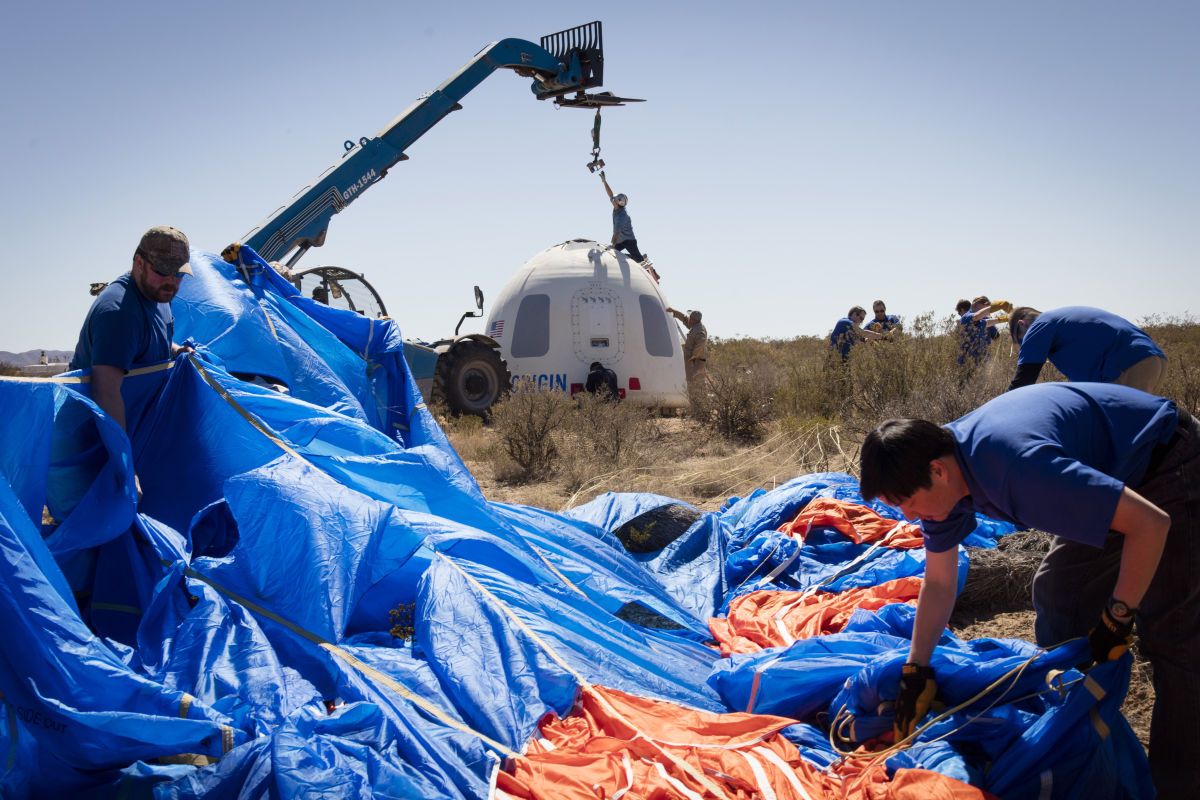
Members of the Blue Origin team recover the Crew Capsule after its fifth successful flight and soft landing.
Credit: Blue Origin
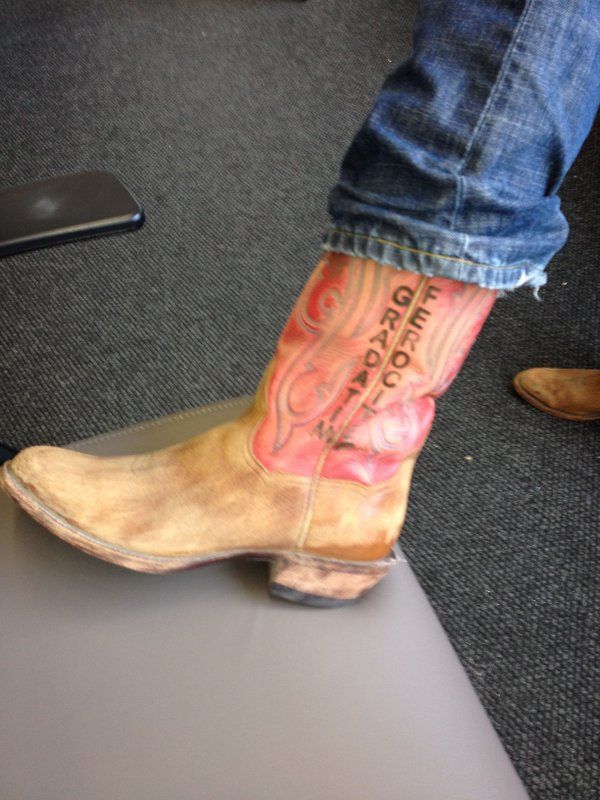
Boots of space businessman, Jeff Bezos.
Credit: Jeff Bezos/Twitter
Overall, the New Shepard program is one that Bezos boasts is a mix of “Launch…Land… Repeat” and also intellectually fueled by a touch of Latin: Gradatim Ferociter! – or “step by step, ferociously.”
New Shepard flew on April 2, 2016 reaching an apogee of 339,178 feet or 103 kilometers. It was the third flight with the same hardware. “We pushed the envelope on this flight, restarting the engine for the propulsive landing only 3,600 feet above the ground, requiring the BE-3 engine to start fast and ramp to high thrust fast,” explains the Blue Origin team.
For the video, go to:
https://www.blueorigin.com/news/news/pushing-the-envelope#youtubeYU3J-jKb75g
 Posted in Space News

