 By
By  February 4th, 2016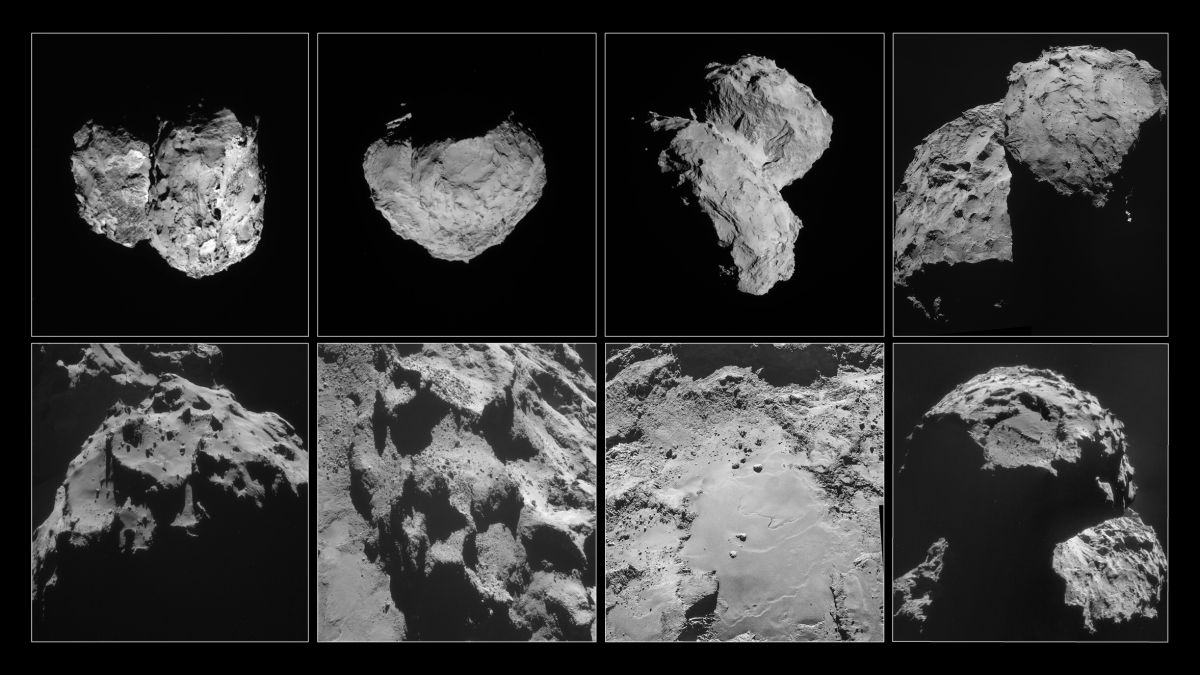
These images of comet 67P/Churyumov-Gerasimenko were taken by Rosetta’s navigation camera between August and November 2014.
Top row, left to right: Comet pictured on August 6, 2014, at a distance of 96 km; August 14, at a distance of 100 km; August 22, at a distance of 64 km; September 14, at a distance of 30 km.
Bottom row, left to right: Comet pictured on September 24, at a distance of 28 km; October 24, at a distance of 10 km; October 26, at a distance of 8 km; November 6, at a distance of 30 km.
Credit: ESA/Rosetta/NavCam – CC BY-SA IGO 3.0
Word from the European Space Agency (ESA) – there are no vast caverns inside Comet 67P/Churyumov-Gerasimenko.
A comet’s low density implies that these objects must be highly porous.
The view has been espoused that due to this porosity, huge empty caves may exist in the comet’s interior.
New study results have been published in the scientific journal, Nature. The research was led by Martin Pätzold, from Rheinische Institut für Umweltforschung an der Universität zu Köln, Germany. The team’s study has shown that Comet 67P/Churyumov-Gerasimenko is a low-density object…but they have also been able to rule out a cavernous interior.
The work is based on ESA’s Rosetta mission to Comet 67P/Churyumov-Gerasimenko.
Radio science
According to a ESA press statement, Pätzold’s team made their discovery by using radio science data to study the way the Rosetta orbiter is pulled by the gravity of the comet, which is generated by its mass.
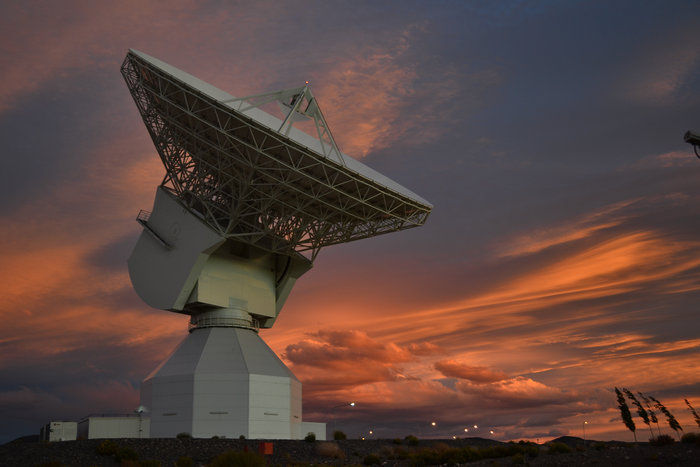
The frequency of the radio link to Earth from Rosetta to ESA’s 35-meter antenna at the New Norcia ground station in Australia is studied to spot caves on Comet 67P/Churyumov-Gerasimenko. The variations in the signals it received were analysed to give a picture of the gravity field across the comet.
Credit: ESA
The variations in the signals received were analyzed to give a picture of the gravity field across the comet. Large internal caverns would have been noticeable by a tell-tale drop in acceleration.
This finding is consistent with earlier results from Rosetta’s CONSERT radar experiment showing that the double-lobed comet’s “head” is fairly homogenous on spatial scales of a few tens of meters.
Controlled impact
This September, ESA’s Rosetta spacecraft will be guided to a “controlled impact” on the surface of the comet.
As Rosetta moves closer and closer to the complex gravity field of the comet, navigating the probe will become harder and harder.
The frequency of the radio link to Earth will be closely monitored – making use once again of ESA’s 35-meter antenna at the New Norcia ground station in Australia. The variations in the signals it receives will be scrutinized to give a picture of the gravity field across the comet – and a last ditch search for any large caverns in the comet.
The new research in Nature – “A homogeneous nucleus for comet 67P/Churyumov–Gerasimenko from its gravity field” — can be found at:
http://www.nature.com/nature/journal/v530/n7588/full/nature16535.html
 Posted in Space News

