 By
By  January 15th, 2016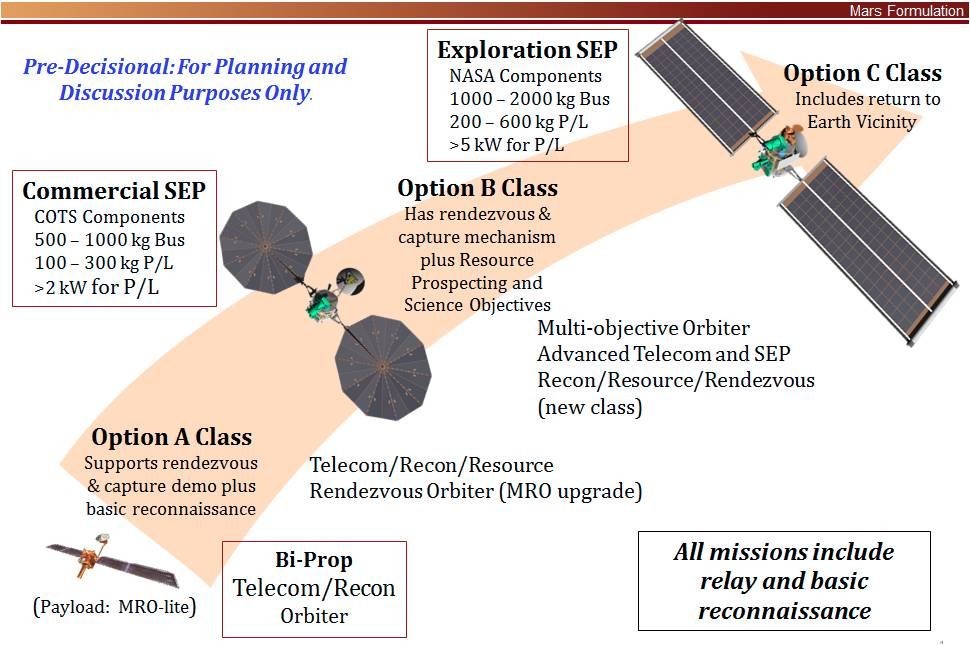
Credit: NEX-SAG
NASA is reviewing the idea of a multi-function next-generation Mars Orbiter.
If approved, this orbiter could be launched as early as 2022. One of the orbiter’s functions could be focused on the preparation for exploration by humans at Mars.
A Science Analysis Group (SAG) of the Mars Exploration Program Analysis Group dubbed NEX-SAG reports that a Mars Orbiter — utilizing Solar Electric Propulsion — and toting advanced telecommunications gear, could perform a 5-year mission in low Mars orbit.
New science
NEX-SAG suggests that the advanced Mars orbiter “could provide exciting new science and resource identification in addition to other programmatic functions,” such as:
- Replenish and advance the telecommunications and reconnaissance capability. Launched in 2022, this orbiter could back-up aging relay capabilities for a 2020 Mars rover in extended mission and for future spacecraft missions, whether for Mars sample return or in preparation for exploration by humans at Mars.
- Demonstrate progress in Mars orbit towards potential sample return, via release, rendezvous, and capture of a simulated orbiting container, or — if possible — the actual return of an orbiting sample cache from the surface of Mars to Earth vicinity.
- Conduct new science investigations motivated by discoveries about Mars over the last several years.
- Find resources on Mars for future missions, especially in support of human surface exploration, and address Strategic Knowledge Gaps (SKGs).
Scouting for martian resources
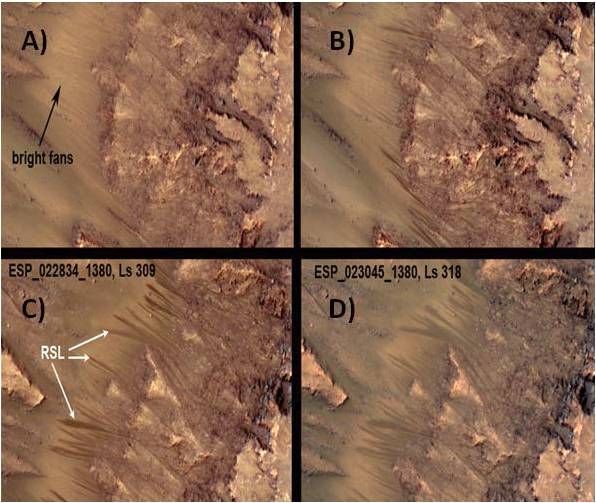
Recurring slope lineae (RSL) move down Martian slopes suggestive that water is flowing on Mars today. Images of RSL in Palikir Crater in Newton Basin showing: (A) faded RSL on bright fans from the previous Mars year and a hint of new RSL in bedrock regions; (B) new RSL appear; (C) the RSL lengthen downslope in early southern summer; and (D) the RSL are fading by mid-summer.
The ability of radar to probe below the surface could be key to tracing the source of subsurface water flow related to these features.
Credit: MRO HiRISE /U. Arizona/JPL/NASA
NEX-SAG participants point to the advanced Mars orbiter locating such resources as finding and quantifying the extent of shallow ground ice within a few meters of the surface and characterize its ice-free overburden; identify deposits with hydrated minerals as a water resource, and potential contaminants within these deposits; and spot site-specific mineral resources and geotechnical properties.
Furthermore, the next-generation Mars orbiter would extend the atmospheric climatology data base about the Red Planet with diurnal coverage and wind measurements.
Lastly, given Solar Electric Propulsion, the orbiter could address gravity and surface characteristics of the Martian moons – Phobos and Deimos.
 Posted in Space News

