 By
By  December 14th, 2015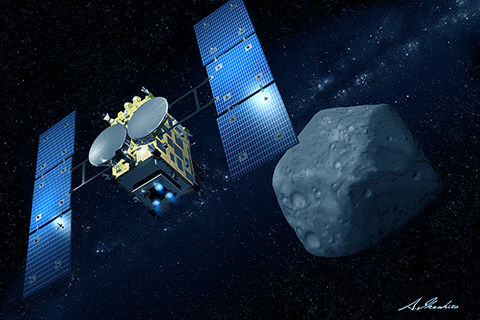
Japan’s Hayabusa2 en route to asteroid Ryugu.
Credit: JAXA/Courtesy of Akihiro Ikeshita
Following its Earth swing-by, a spacecraft is now on trajectory and headed for asteroid “Ryugu.”
Japan’s Hayabusa2 is en route to its target, a C-type asteroid to study the origin and evolution of the solar system as well as materials for life.
The Japan Aerospace Exploration Agency (JAXA) announced today that the swing-by of Earth on December 3, the explorer’s orbit turned by about 80 degrees and the probe’s speed was increased.
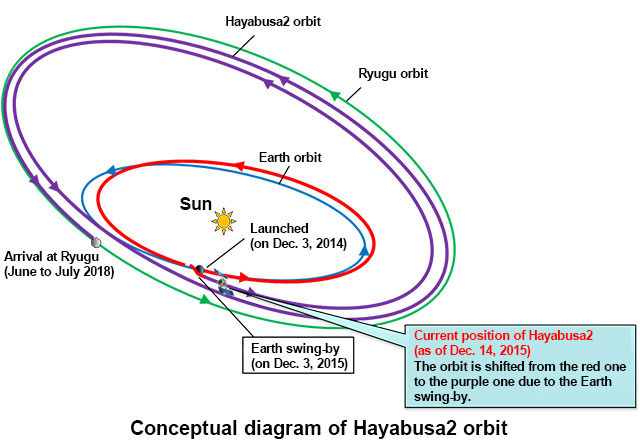
Credit: JAXA
In good health
According to the operation supported by the NASA Deep Space Network stations and European Space Agency deep space ground station, “the Hayabusa2 is in good health,” JAXA reports.
JAXA adds that as of 0:00 a.m. on Dec. 14, 2015, the Hayabusa2 is flying at about 4.15 million kilometers from the Earth, and about 144.85 million kilometers from the Sun. Its cruising speed is 32.31 km per second (against the Sun). The Hayabusa2 is increasing its speed under the influence of the Sun’s gravity after the swing-by.

Australian continent and Antarctica captured by Hayabusa2 camera.
Credit: JAXA
Precious picture
Post swing-by, the Hayabusa2 took images of the Earth using its onboard Optical Navigation Camera — Telescopic (ONC-T).
One image released shows the Australian continent and Antarctica. The South Pole is not lit by the Sun during the summer, and meteorological satellites also do not cover the Antarctic area to take its images, “hence the shot this time is precious,” JAXA points out.
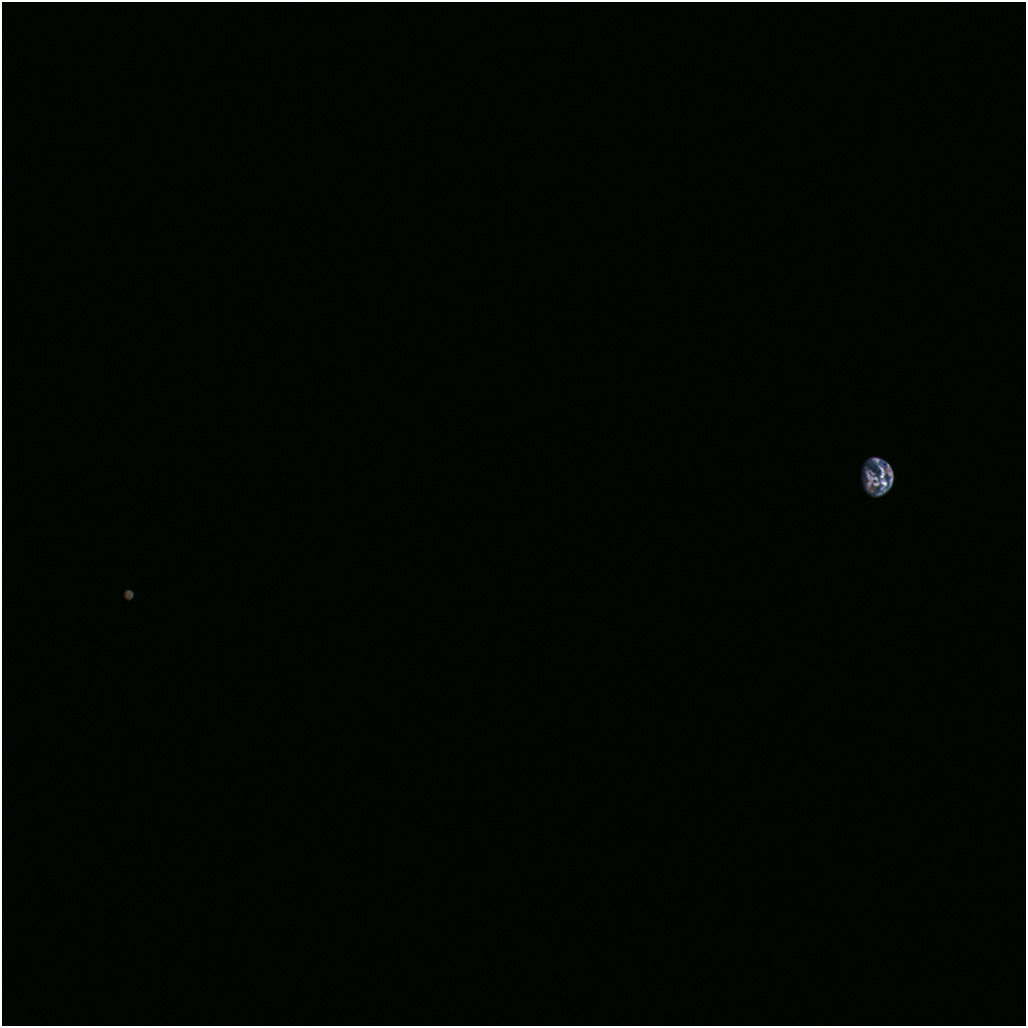
Celestial twosome: Moon and Earth taken by Hayabusa2.
Credit: JAXA
2020 return to Earth
Prior to the Earth swing-by, Hayabusa2’s ONC-T imaged the Earth and the Moon on November 26, 2015.
Hayabusa2 was launched on December 3, 2014. It should arrive at the C-type asteroid in mid 2018, carrying out an aggressive set of science and technology tasks for one and a half years, such as creating a crater on the object and sampling the space rock.
The craft will then depart the asteroid at the end of 2019 and return its sampling to Earth around the end of 2020.
 Posted in Space News

