 By
 November 16th, 2026
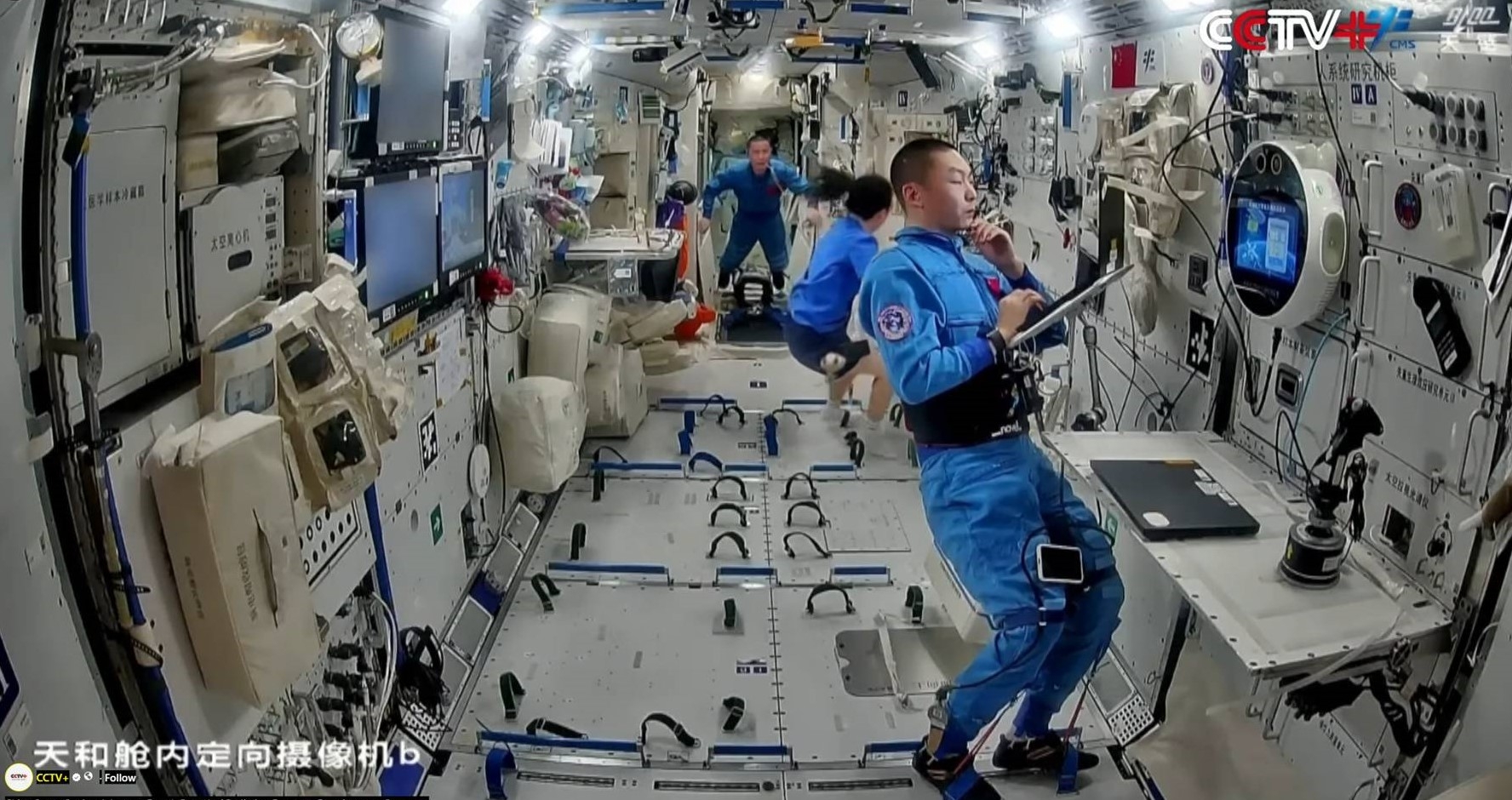
Shenzhou-23 crew performs wraps up experiments.
Image credit: CCTV/Inside Outer Space screengrab
China’s Tiangong space station has entered an era of long-term human habitation.
The Shenzhou-23 spacecraft was launched on May 24, carrying three astronauts, Zhu Yangzhu, Zhang Zhiyuan and Li Jiaying.
Two of the crew will near the end of their sixth month in orbit, while the third individual is scheduled to remain in space for a full year, reports China Central Television (CCTV).
Meanwhile, the Shenzhou-24 mission is expected to be underway after launch in late November, slated to be a six-month spaceflight mission.
According to CCTV:
The Shenzhou-24 crew will maintain a continuous human presence on the Chinese space station known as the Tiangong, taking over from the Shenzhou 23 crew.
A Pakistani astronaut will join the Shenzhou-24 crewed flight mission as a payload specialist, the China Manned Space Agency (CMSA) said on Saturday.
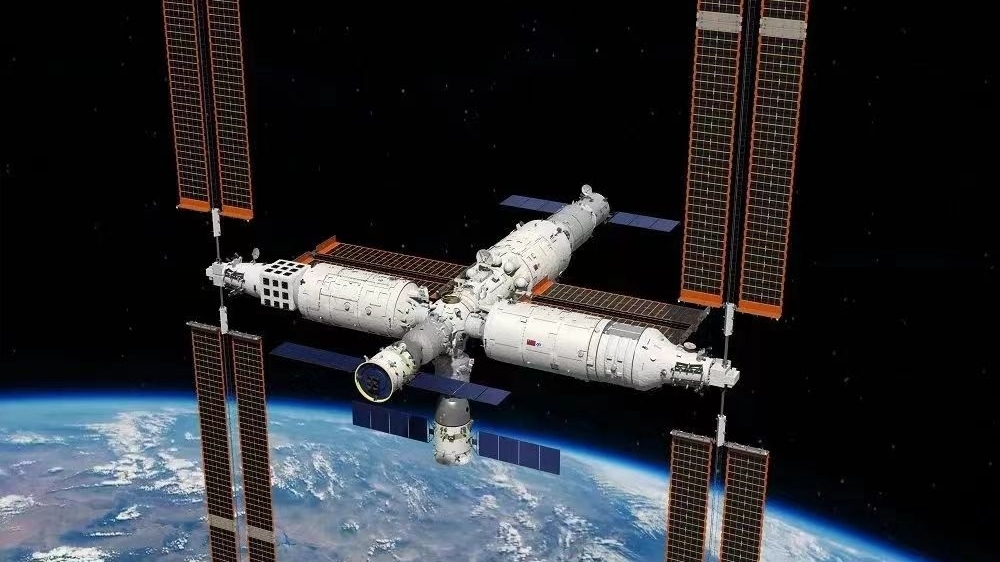
Artwork depicts China’s Tiangong space station.
Image credit: China Manned Space Agency
After completing a short on-orbit flight, the Pakistani astronaut will return to Earth aboard the Shenzhou-23 spacecraft.
The mission will mark the first joint flight involving Chinese and foreign astronauts in the history of China’s manned space program.
Cooperation agreement
In February 2025, China and Pakistan signed a cooperation agreement in Islamabad on the selection and training of Pakistani astronauts for flight missions aboard China’s space station, officially launching the selection process.
Following a rigorous three-stage screening and evaluation process, two Pakistani candidates were chosen as reserve astronauts.
After completing training in China and passing all assessments, one of the two will be assigned to the crewed flight mission, while the other will serve as the backup astronaut.

Image credit: CCTV/Inside Outer Space screengrab
CCTV also reports that China’s space station has made steady progress in its fourth round of space radiation exposure experiments over the past week, with samples including nanozymes, actinomycetes and plant seeds brought back after completing a five-month exposure outside the space station.
The Chinese space station’s external exposure platform is mounted outside the orbital outpost’s Mengtian lab module. It has two fold-out, wing-like platforms, one facing space and the other Earth, as well as a fixed platform on the module’s exterior, providing 37 dedicated sample positions.
For a CCTV video on the space radiation exposure activity, go to:
 Posted in Space News

